
10th Indian Delegation to Dubai, Gitex & Expand North Star – World’s Largest Startup Investor Connect
Travel

Vedantu’s FY24 Loss Falls 58% To INR 158 Cr


SUMMARY

Vedantu’s net loss declined 58% to INR 157.52 Cr in FY24 from INR 372.64 Cr in the previous fiscal year on the back of growth in its top line and improvement in margins

The startup’s revenue from operations increased 21% to INR 184.50 Cr from INR 152.59 Cr in FY23

The edtech startup managed to reduce its expenses by 34% to INR 367.79 Cr from INR 553.09 Cr in FY23

Edtech unicorn Vedantu’s net loss declined 58% to INR 157.52 Cr in the financial year 2023-24 (FY24) from INR 372.64 Cr in the previous fiscal year on the back of growth in its top line and improvement in margins.

The startup’s revenue from operations increased 21% to INR 184.50 Cr from INR 152.59 Cr in FY23. Including an other income of INR 14.73 Cr, total revenue for the fiscal stood at INR 199.23 Cr.

Founded in 2014 by Vamsi Krishna, Anand Prakash, and Pulkit Jain, Vedantu is an edtech startup which offers online and offline courses for students in 4th class to 12th class. It also provides coaching for NEET and JEE entrance exams. Recently, it started offering curated courses for kids of 4 to 12 years of age. 

The startup entered the unicorn club after it raised $100 Mn in its Series E funding round led by ABC World Asia. In September 2024, the startup bagged $2.4 Mn in a mix of debt and equity financing from Stride Ventures Debt Fund II.

Where Did Vedantu Spend In FY24?

The startup managed to reduce its expenses by 34% to INR 367.79 Cr from INR 553.09 Cr in FY23. 
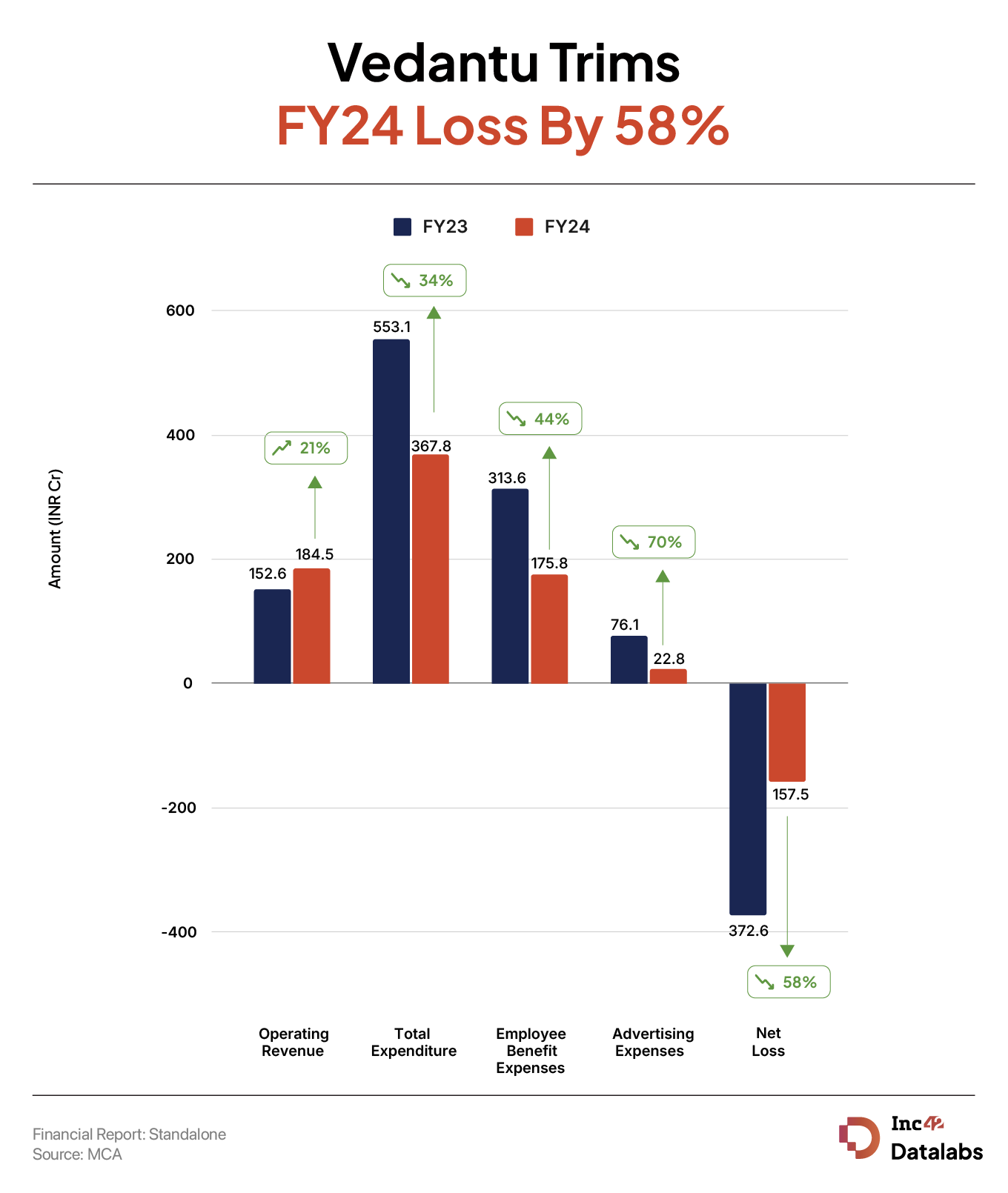
Employee Expenses: The major decline in Vedantu’s expenses came due to a sharp fall in its employee costs due to the layoffs it undertook in FY23. In 2022, the startup fired about 1,100  employees in total. As a result, its employee benefit expenses slumped 44% to INR 175.76 Cr in FY24 from INR 313.58 Cr in the previous fiscal year. 

Advertisement & Promotional Expenses: In a bid to cut down its losses, Rapido trimmed its promotional expenses by 70% to INR 22.84 Cr in FY24 from INR 76.06 Cr in the previous fiscal year.

Miscellaneous Expenses: The spending under the head, which included outsourcing teachers cost, courseware expenses, student welfare expenses, among others, also saw a decline. Vedantu spent INR 81.78 Cr on miscellaneous expenses, down 20% from INR 102.73 Cr it spent in FY23.

Vedantu competes with the likes of Unacademy, Allen Career Institute, among others. The country’s edtech sector has been under stress for over the last two years. BYJU’S, once the poster boy of the Indian edtech space, is currently undergoing insolvency proceedings.

Amid these, reports said that Unacademy was in talks with Allen for an acquisition. However, Unacademy CEO and cofounder Gaurav Munjal refuted this. The edtech startup reduced its net loss by 82.09% to INR 285 Cr in FY24 from INR 1,592 Cr in the previous fiscal. Meanwhile, its operating revenue also dipped 2.31% to INR 716 Cr in FY24 from INR 733 Cr FY23.






Source link

by Honey

Jetstar’s Big Move: Avalon Takes Off Internationally In a major win for Victorian travelers, Jetstar Airways has unveiled an ambitious expansion plan at Avalon Airport, set to reshape regional aviation from 2026 onward. The low-cost carrier announced it will launch its first-ever international flights from Avalon, connecting the airport directly to Bali (Denpasar) — one of Australia’s most popular leisure destinations. Alongside this exciting addition, Jetstar will also reinstate its Avalon–Adelaide route, which was suspended during the COVID-19 pandemic, and increase the frequency of Avalon–Brisbane services to meet surging passenger demand. The announcement represents a pivotal milestone for both Jetstar and Avalon Airport, which has long sought to expand its global footprint. The introduction of international routes marks the next phase of Avalon’s growth strategy — positioning it as a strong secondary airport option to Melbourne’s Tullamarine. Avalon Airport: From Domestic Hub to International Gateway Avalon Airport’s journey toward becoming an international gateway has been a long time coming. The introduction of Jetstar’s Bali flights cements its status as a crucial player in regional connectivity and tourism development. For Geelong and western Melbourne residents, the new service provides convenient and affordable access to one of Asia’s most beloved holiday destinations. According to Avalon Airport management, the Avalon–Bali route will not only attract thousands of leisure travelers but also strengthen tourism and economic ties between Victoria and Indonesia. Local businesses, particularly in the hospitality and tourism sectors, are expected to benefit from increased visitor flow. “The demand for outbound leisure travel remains exceptionally strong, and Bali continues to be a top destination for Australians,” said a Jetstar spokesperson. “Avalon is ideally located to serve both regional Victoria and Melbourne’s west, and these new services will make international travel more accessible and affordable for everyone.” Reconnecting Australia: Adelaide and Brisbane Routes Boost Domestic Travel Beyond international expansion, Jetstar’s decision to restart the Avalon–Adelaide route has been welcomed by frequent flyers and regional businesses alike. The route, which ceased operations during the pandemic, had long been a staple connection between Victoria and South Australia. Its return highlights Jetstar’s commitment to rebuilding domestic travel networks that were disrupted by COVID-19. Additionally, the airline plans to add more Avalon–Brisbane flights, responding to a sharp rise in domestic travel demand. This move will enhance connectivity between key eastern cities, providing travelers with more flexible and cost-effective options. Analysts believe Jetstar’s growing presence at Avalon could lead to more destinations being added in the coming years, transforming the airport into a vital hub for both domestic and short-haul international routes. Infrastructure Upgrades: Avalon Gets a Public Transport Link To complement Jetstar’s expansion, Avalon Airport is also set to receive a long-awaited public transport connection, improving accessibility for passengers traveling from Geelong and Melbourne. The new bus service will make it easier for travelers to reach the airport, which has previously faced criticism for limited transport options. The introduction of this link is seen as a crucial step toward making Avalon more competitive with larger airports. “Connectivity has …

by Honey

Jetstar’s Big Move: Avalon Takes Off Internationally In a major win for Victorian travelers, Jetstar Airways has unveiled an ambitious expansion plan at Avalon Airport, set to reshape regional aviation from 2026 onward. The low-cost carrier announced it will launch its first-ever international flights from Avalon, connecting the airport directly to Bali (Denpasar) — one of Australia’s most popular leisure destinations. Alongside this exciting addition, Jetstar will also reinstate its Avalon–Adelaide route, which was suspended during the COVID-19 pandemic, and increase the frequency of Avalon–Brisbane services to meet surging passenger demand. The announcement represents a pivotal milestone for both Jetstar and Avalon Airport, which has long sought to expand its global footprint. The introduction of international routes marks the next phase of Avalon’s growth strategy — positioning it as a strong secondary airport option to Melbourne’s Tullamarine. Avalon Airport: From Domestic Hub to International Gateway Avalon Airport’s journey toward becoming an international gateway has been a long time coming. The introduction of Jetstar’s Bali flights cements its status as a crucial player in regional connectivity and tourism development. For Geelong and western Melbourne residents, the new service provides convenient and affordable access to one of Asia’s most beloved holiday destinations. According to Avalon Airport management, the Avalon–Bali route will not only attract thousands of leisure travelers but also strengthen tourism and economic ties between Victoria and Indonesia. Local businesses, particularly in the hospitality and tourism sectors, are expected to benefit from increased visitor flow. “The demand for outbound leisure travel remains exceptionally strong, and Bali continues to be a top destination for Australians,” said a Jetstar spokesperson. “Avalon is ideally located to serve both regional Victoria and Melbourne’s west, and these new services will make international travel more accessible and affordable for everyone.” Reconnecting Australia: Adelaide and Brisbane Routes Boost Domestic Travel Beyond international expansion, Jetstar’s decision to restart the Avalon–Adelaide route has been welcomed by frequent flyers and regional businesses alike. The route, which ceased operations during the pandemic, had long been a staple connection between Victoria and South Australia. Its return highlights Jetstar’s commitment to rebuilding domestic travel networks that were disrupted by COVID-19. Additionally, the airline plans to add more Avalon–Brisbane flights, responding to a sharp rise in domestic travel demand. This move will enhance connectivity between key eastern cities, providing travelers with more flexible and cost-effective options. Analysts believe Jetstar’s growing presence at Avalon could lead to more destinations being added in the coming years, transforming the airport into a vital hub for both domestic and short-haul international routes. Infrastructure Upgrades: Avalon Gets a Public Transport Link To complement Jetstar’s expansion, Avalon Airport is also set to receive a long-awaited public transport connection, improving accessibility for passengers traveling from Geelong and Melbourne. The new bus service will make it easier for travelers to reach the airport, which has previously faced criticism for limited transport options. The introduction of this link is seen as a crucial step toward making Avalon more competitive with larger airports. “Connectivity has …

by INC42

When Thirukkurungudi Vengaram Sundram Iyengar, the Indian industrialist who founded the TVS Group, introduced intercity passenger bus service in Tamil Nadu in 1912, India barely had any organised bus services. At the time, most people relied on trains for long-distance travel and bullock carts for shorter routes, while motor cars were accessible only to a wealthy few. Today, 40% of India’s road-based travel demand comprises buses. While a large part of this percentage consists of unorganised, local players, tech-driven companies are… Source link

