
10th Indian Delegation to Dubai, Gitex & Expand North Star – World’s Largest Startup Investor Connect
EV

Two-Wheeler EV Sales Slowdown In Sept; Ola Electric’s Market Share Drops, Bajaj Overtakes TVS


SUMMARY

Bajaj Auto overtook TVS Motor with 18,933 two-wheeler EV registrations last month. Its market share also increased to a little over 21% last month from 19% in August

Ola Electric’s escooter registrations slipped 11% MoM to 23,965 units in September, while its market share fell to 27%

TVS Motor saw a 2% MoM increase in escooter registrations to 17,865 units, while IPO-bound Ather Energy’s registrations jumped over 15% to 12,579 units

Electric two-wheeler registrations in India seem to be witnessing another trend shift as the escooter sales of Bajaj Auto touched an all-time high in September, surpassing TVS Motor and inching closer towards Ola Electric’s registrations.

Bajaj Auto recorded 18,933 EV registrations last month, growing from 16,650 units in August this year, as per Vahan data as of October 1. On a year-on-year (YoY) basis, the legacy automotive player witnessed a 166% jump in its Bajaj Chetak sales.

Its market share also increased to a little over 21% last month from 19% in August.

Overall, electric two-wheeler registrations grew marginally by 1% to 88,156 units in September from 87,257 units in August. On a YoY basis, registrations rose over 37% last month.
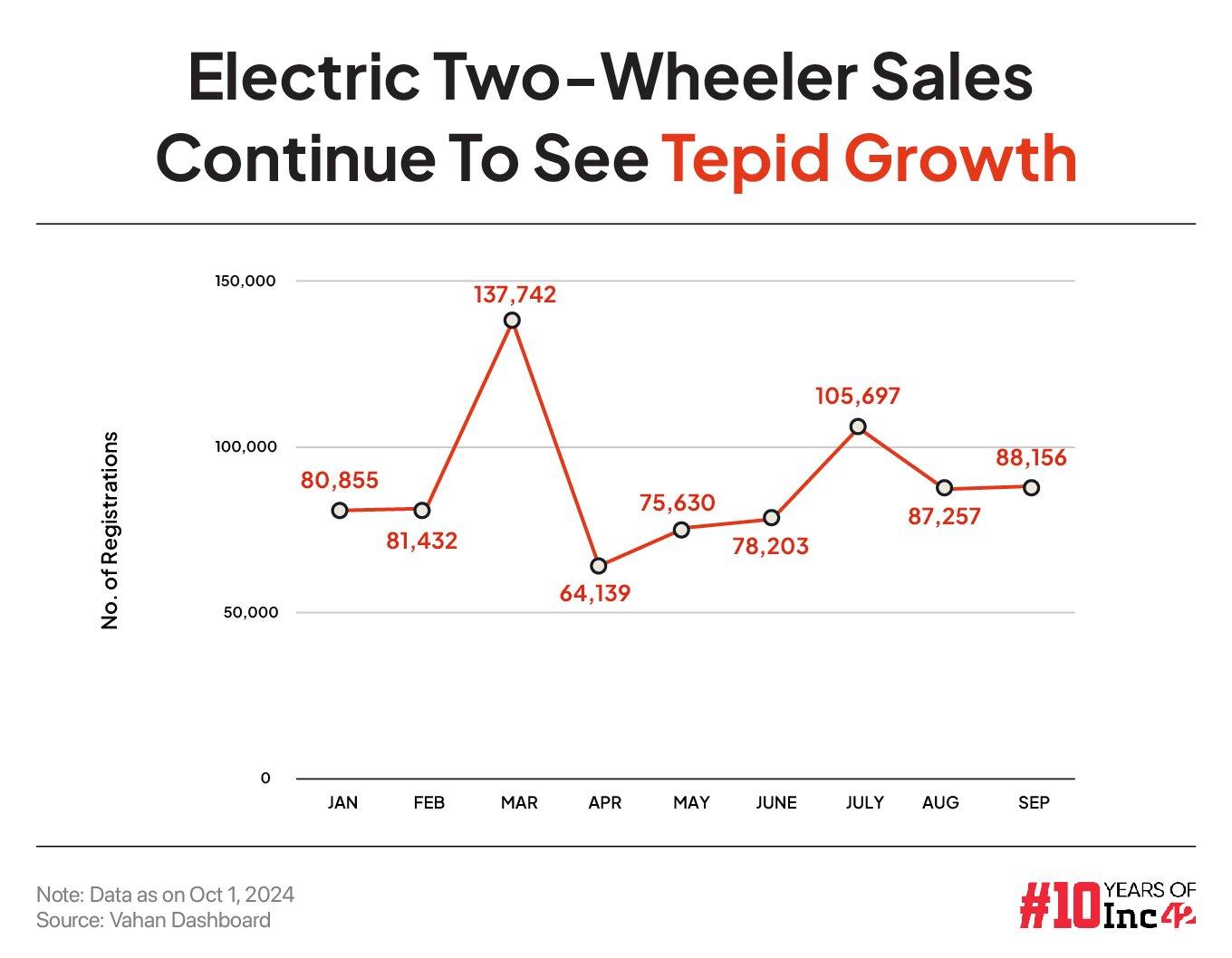
Electric Two-Wheeler Sales Continue To See Tepid GrowthElectric Two-Wheeler Sales Continue To See Tepid Growth

Recently listed electric mobility startup Ola Electric continued to maintain its top position last month, but its escooter registrations slipped 11% month-on-month (MoM) to 23,965 units. This was also the company’s lowest monthly vehicle sales since October last year, when registrations stood at 23,594 units.

Meanwhile, the Bhavish Aggarwal-led startup also continued to see decline in its market share in the electric two-wheeler market. From a little over 30% market share in August, the EV startup’s share fell to 27% in September.

To address this, Ola Electric recently launched “HyperService” to offer “one-day resolution” of service-related issues. It is pertinent to note that the company has been facing numerous complaints from customers about after-sales service on social media platforms.

Despite this, brokerage Bernstein believes that Ola Electric is on track to achieve EBITDA profitability. It also said recently that Ola Electric has the highest gross margin among its peers. 

Though TVS Motor fell behind Bajaj, its escooter registrations rose 2% MoM to 17,865 units in September. The legacy motorcycle maker’s share in the electric two-wheeler market also increased marginally to a little over 20%.

On the other hand, ahead of its public market debut, Ather Energy is also seeing a rise in its EV sales and market shares. Despite an overall slowdown in escooter sales, Ather’s vehicle registrations jumped over 15% to 12,579 units in September from 10,919 units in the previous month.

Ather also saw an over 75% rise in its vehicle sales on a YoY basis, while its market share increased to over 14% in September as against 12% in August.

However, legacy automotive player Hero MotoCorp, which is also a major shareholder in Ather, continues to face pressure in the electric two-wheeler market. Though its EV sales have grown sharply compared to the beginning of the year, Hero MotoCorp’s electric two-wheeler registrations fell over 9% MoM to 4,174 units last month.
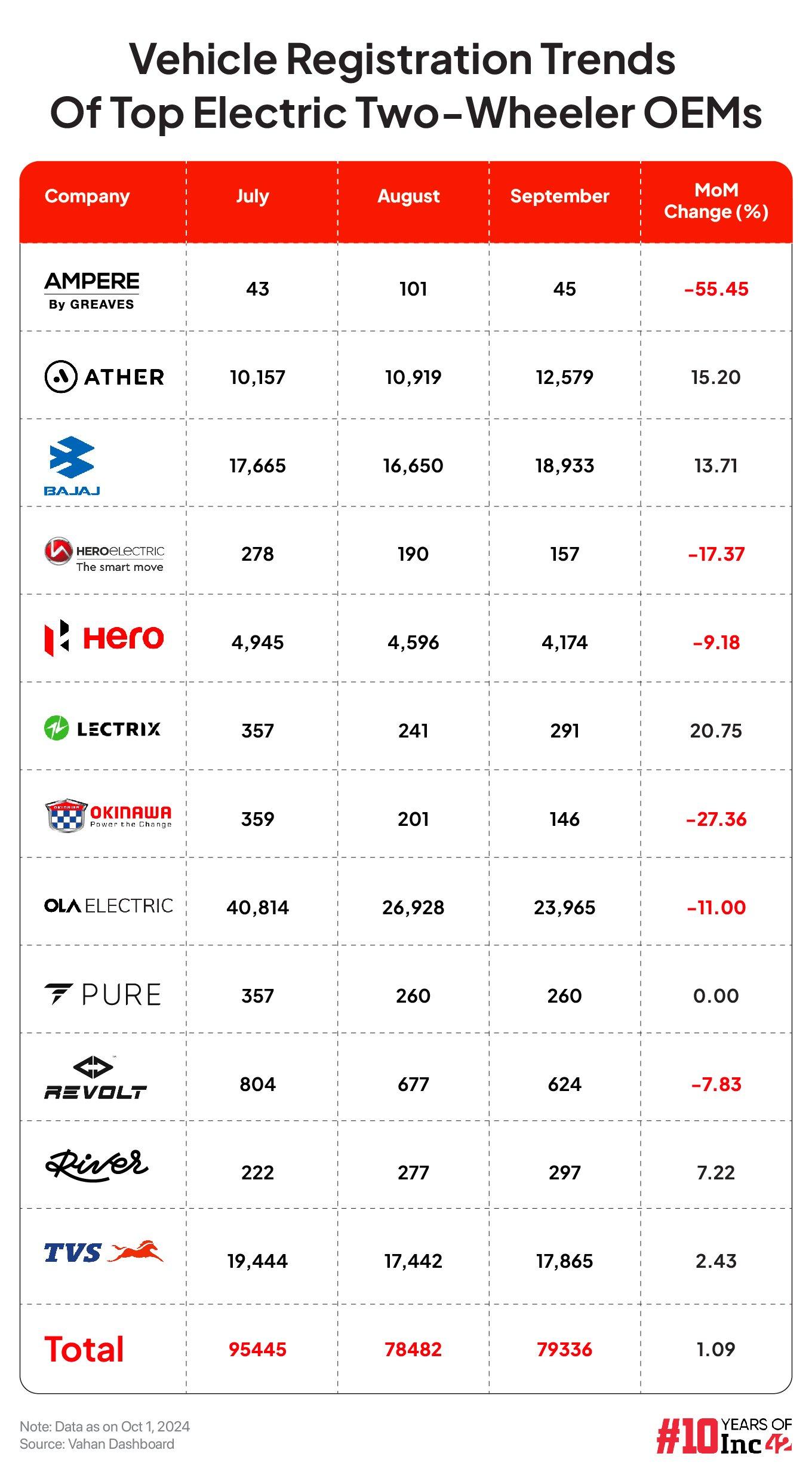
Vehicle Registration Trends Of Top Electric Two-Wheeler OEMs Vehicle Registration Trends Of Top Electric Two-Wheeler OEMs

Its EV registrations stood at 4,596 units in August as against 4,945 units in July.

On the other hand, some of the newest electric two-wheeler startups, including River and Ultraviolette, are witnessing slow but steady growth. River’s EV registrations increased 7% MoM to 297 units in September, while Ultraviolette’s electric motorcycle registrations grew to 51 units during the month from 47 units in August.

It is pertinent to note that the sales of two-wheeler EVs underwent significant volatility this year amid the government lowering the demand subsidy under the FAME scheme. While the industry was waiting for the third iteration of the Centre’s FAME scheme, the cabinet approved a new scheme in September—the ‘PM Electric Drive Revolution in Innovative Vehicle Enhancement (PM E-DRIVE) Scheme’.

The new scheme has an initial outlay of INR 10,900 Cr for a period of two years to support EV adoption. The scheme aims to support 24.79 Lakh electric two-wheelers (E2Ws), along with other vehicle categories. The Centre’s previous subsidy scheme FAME-II aimed to support 10 Lakh two-wheeler EVs.

Overall, total EV registrations in the country, across vehicle categories, stood at 1.66 Lakh units last month, growing from 1.65 Lakh units in August. With the festive season ahead, EV manufacturers will be hoping for a rise in sales in the coming months.






Source link

EV
by Team SNFYI

Are you considering investing in an electric vehicle? If so, you have made the right decision. Electric cars are gaining popularity due to their numerous benefits. However, before you buy an electric car, you must consider the factors discussed in the following sections. They will help you make an informed decision. 6 Points You Must Consider While Buying Electric Cars  Let’s take a look at the important points you must consider before buying electric cars in India:  Ideally, an electric car has a driving range of over 100 km, which is sufficient for daily driving. However, high-end electric vehicles offer a driving range of over 400 km.   Considering the maximum distance the vehicle can travel on a single charge will help you determine whether the car meets your requirements. To make your purchase stress-free, research the prices of the cars and know your budget. Consider applying for an electric vehicle loan to help you fulfil your dream of owning a car without denting your savings. Use a car loan EMI calculator to calculate your monthly instalment and formulate a financial plan, considering other liabilities.  The formula for calculating electric car loan EMI is as follows: EMI = [P x R x (1+R)^N]/[(1+R)^N-1] Here,  P = Principal sum of the car loan  R = Rate of interest charged by the lender  N = Tenure of the loan in months  As you can see, the calculation procedure is time-consuming and prone to errors. So, you can use an online car loan EMI calculator to get accurate results quickly.  The battery is the most important component of an electric car, and it’s quite expensive. Therefore, it is essential to check the battery life before purchasing an electric vehicle. Find out details about the battery range and other specifications.  Moreover, check how long the battery can last and how much it will take to replace it.  Remember that you won’t find an electric vehicle charging station as easily as you find a fuel station. This is because the electric vehicle charging infrastructure has yet to establish a strong footing in India. Fast chargers are quite expensive to install in the car, and your city might have very few charging stations for them. On the other hand, standard and slow-charging systems are more reasonably priced. So, before buying an electric car, check which charging system suits your vehicle and meets your budget. Electric vehicles are equipped with software, which must be updated regularly. While some manufacturers provide the software for free, others may charge a fee for it. Moreover, remember to ensure that your electric vehicle has the latest software upgrades/updates.  You must maintain your electric vehicle regularly, just as you would a conventional car. Otherwise, its performance will be affected. Electric cars have few moving parts, requiring less maintenance effort. Also, buying spare parts for an electric car will be more expensive than for conventional cars. So, consider the maintenance costs of an electric vehicle before investing in one.  Additional Important Things to Keep …

by Team SNFYI

Bharatsure, one of India’s leading Insurtech companies offering Infrastructure as a Service (IaaS) solutions has raised INR 6 Crores from Inflection Point Ventures (IPV) and other investors including Capital A and Atrium Angels. Bharatsure is pioneering transformation in India’s insurtech landscape, unlocking vast market potential while advancing health security and insurance penetration. As an Infra-as-a-Service (IaaS) Insurtech, Bharatsure empowers ecosystem partners with seamless group and embedded insurance distribution solutions. Bharatsure has doubled its revenues in FY25 breaking even at CM3 and is gradually progressing toward EBITDA profitability by the end of this year. With a clear growth trajectory, Bharatsure has set ambitious revenue milestones, targeting INR 100 Cr by FY28 and INR 1000 Cr by FY34, reflecting its bold vision and long-term scalability in the market. Anuj Parekh and Sanil Basutkar are the co-founders of Bharatsure. Anuj, a CA and IIM-Bangalore alumnus, brings deep expertise in finance and scaling ventures, while Sanil, a CA and an ISB alumnus, employs his fintech background to drive product innovation and distribution. Coinciding with the fundraise, Bharatsure announced a new partnership with Battery Smart, India’s largest battery-swapping network for electric two- and three-wheelers, to launch natural calamity insurance exclusively for its station partners. The initiative offers protection against events such as fires, floods, earthquakes, and storms alongside personal accident coverages to safeguard individual livelihoods.  Mitesh Shah, Co-founder, IPV says, “As India moves towards a greener and sustainable future with the widespread adoption of EVs, and the infrastructure that supports it, it is time that we adapt our insurance frameworks to suit the changing needs. Bharatsure’s futuristic mindset and farsight offers financial protection and peace of mind in the face of unexpected events. In a world that doesn’t always go according to plan, insurance doesn’t just offer protection, it also carries the burden of social responsibility.” Anuj Parekh, Co-Founder & CEO of Bharatsure, added: “These station partners play a frontline role in advancing sustainable mobility, and we’re proud to design coverage that genuinely addresses their needs. The funding allows us to further develop our infrastructure too ”  With over 1,500 stations and 70,000+ drivers across 50+ cities, Battery Smart’s station partners form the backbone of India’s growing EV infrastructure. This insurance plan ensures partners are equipped with financial protection to overcome unforeseen disruptions while continuing to power the country’s EV transition.  “Our station partners are at the heart of our operations,” said Ms. Sumi Jain, AVP – Network Strategy and Operations, Battery Smart. “This insurance partnership is not just about protecting assets, it’s about empowering the individuals who are driving India’s EV revolution. Together with Bharatsure, we are fortifying the backbone of our network.”  As EV adoption picks up pace in India particularly across two- and three-wheelers, battery swapping stations are emerging as a critical part of the ecosystem. To strengthen safety for its partners, this insurance initiative complements Battery Smart’s existing safety framework, which includes a 24×7 support helpline, in-app issue reporting, mandatory onboarding training and ongoing awareness campaigns.   About Battery Smart:  Battery Smart …

EV
by Team SNFYI

Shanghai, June 2025 – In a move set to shake up the electric vehicle (EV) landscape, Tesla has officially introduced a 6-seater version of its popular Model Y SUV for the Chinese market. This marks the first time the automaker has offered this specific seating configuration in China, indicating a strong focus on capturing the growing demand for more family-friendly electric vehicles in the world’s largest EV market. The new Tesla Model Y 6 seater is expected to launch in Q3 2025 and will be manufactured at Tesla’s Gigafactory in Shanghai, which already produces Model 3 and Model Y units for the Asia-Pacific region. Family-Focused Configuration The Tesla Model Y 6 seater introduces a more versatile interior layout, offering two captain’s chairs in the second row instead of the traditional bench seat. This setup not only enhances passenger comfort but also provides easier access to the third row, making it ideal for families with children or those who frequently transport multiple passengers. Tesla’s design update is in line with customer feedback from China, where extended family travel is common, and functionality often outweighs minimalism in vehicle interiors. According to local sources, the 6-seater Model Y will also include upgraded air filtration systems and enhanced rear climate controls, catering to the preferences of premium Chinese buyers. Market Strategy in China China represents Tesla’s second-largest market after the United States, and this launch signals the company’s strategic intent to remain competitive against domestic giants like BYD and Li Auto, both of which offer flexible seating layouts in their best-selling SUVs. The addition of the Tesla Model Y 6 seater is expected to boost the brand’s presence among middle- to upper-income families who previously might have considered more spacious alternatives. Tesla is also planning a strong marketing push around the family-first messaging, emphasizing safety, comfort, and advanced self-driving features. Competitive Pricing and Delivery Timeline While official pricing has not been confirmed, early reports suggest the 6-seater Tesla Model Y will be priced slightly above the Long Range variant but remain competitive in its segment. Industry analysts expect the starting price to be around ¥350,000 (approx. $48,000), positioning it below traditional luxury competitors like Mercedes-Benz EQB or NIO ES6. Pre-orders for the Tesla Model Y 6 seater are expected to begin by late July, with deliveries starting as early as September 2025. What’s Under the Hood? Mechanically, the 6-seater Model Y will remain consistent with current dual-motor AWD versions. It is expected to feature a similar battery configuration with a range of up to 530 km (approx. 330 miles) per charge under CLTC testing standards. Tesla’s infotainment and software upgrades will also be included, featuring the latest Full Self-Driving (FSD) beta, real-time traffic visualization, and a theater mode for rear passengers—a feature well-suited to longer family drives. Final Thoughts With this latest addition, Tesla is not just responding to consumer demand—it’s setting the tone for how EVs can adapt to regional market needs. The Tesla Model Y 6 seater represents a smart blend of …

