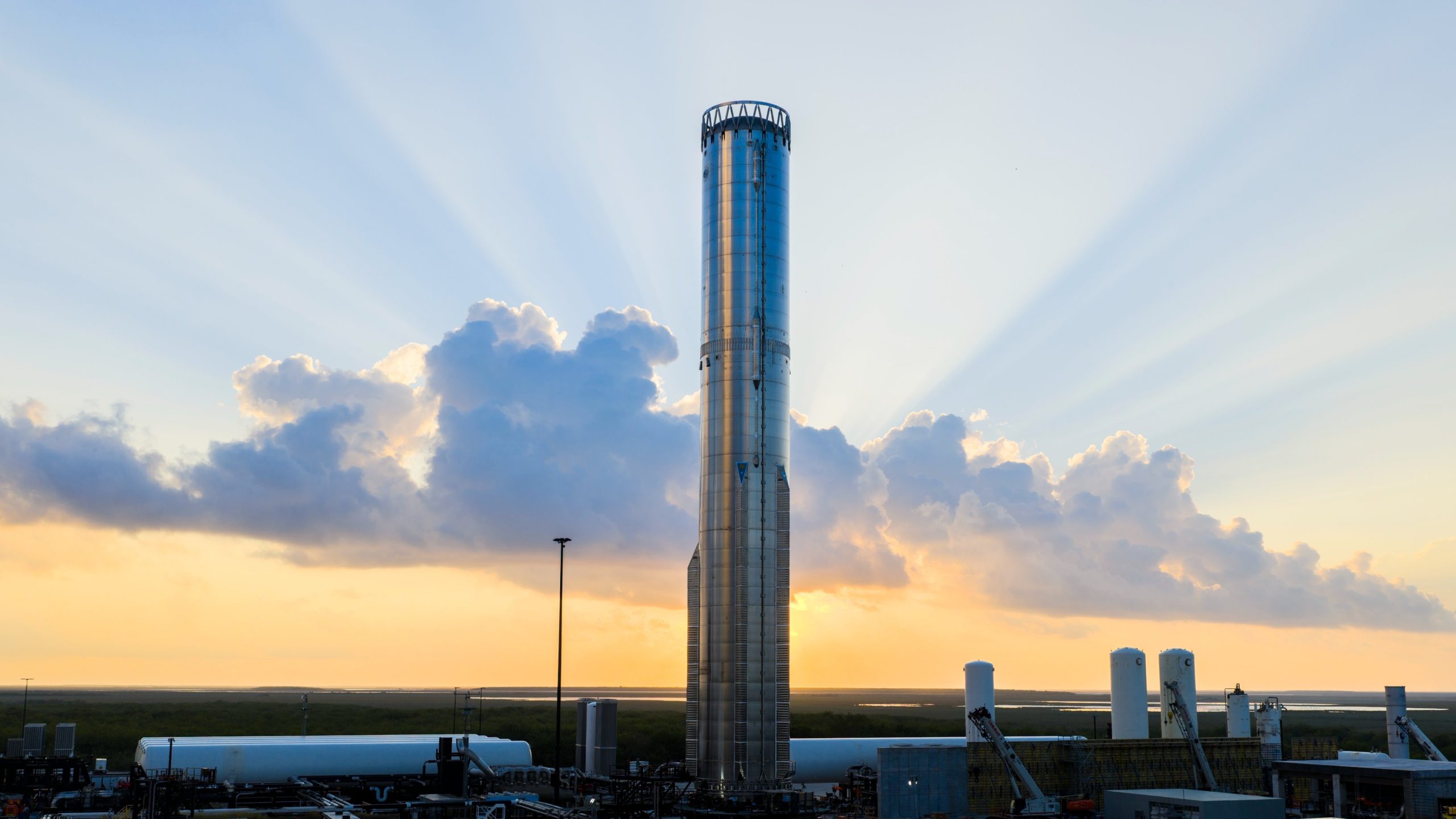
SpaceX has released an official statement following an incident involving its Starship Booster 18, part of the company’s new Version 3 design series. The booster suffered major structural damage during early testing at Starbase, Texas, marking an unexpected setback in SpaceX’s push toward rapid Starship development and reusability.
Booster 18 Crumples During Pressure Test
The SpaceX Starship Booster 18 experienced a serious malfunction during a cryogenic pressure test early Friday morning at the company’s Massey Test Site. According to footage shared by LabPadre Space, the lower portion of the massive first-stage booster crumpled near the liquid oxygen tank section around 4 a.m. Central Time. Images shared by space enthusiasts on social media showed significant deformation across the lower structure, indicating that the booster is likely a total loss.
This booster had just rolled out from the Starbase factory a day prior, signaling how rapidly SpaceX is moving through its test and build cycles. While no injuries were reported, the failure highlights the risks of pushing cutting-edge aerospace engineering at such a high pace.
SpaceX Confirms the Incident and Promises Rapid Investigation
In a brief statement posted on X, SpaceX confirmed that Starship Booster 18 encountered an anomaly during pressurization testing. The company emphasized that it would review the data to determine the root cause and apply lessons learned to upcoming prototypes.
The company’s history suggests that it will move quickly to analyze and address the issue. SpaceX is known for embracing an iterative testing approach, where hardware failures are treated as learning opportunities to refine design and performance. Despite this loss, engineers are expected to continue with Version 3 booster development without significant delay.
Why Booster 18 Was Important
Booster 18 is part of SpaceX’s Starship V3 program, which features structural upgrades, tank design modifications, and reliability enhancements over previous versions. It was expected to play a critical role in validating these new improvements before the system’s next round of flight tests.
The timing of the incident is especially significant given SpaceX’s ambitious schedule. The company aims to demonstrate tower-catching landings, full system reuse, and orbital refueling capabilities within the next two years. These milestones are key for NASA’s Artemis program, which relies on Starship’s development for its planned lunar landing mission in 2028.
What This Means for Starship’s Future
While the setback may seem severe, industry observers point out that failures like this are common in experimental rocket testing. SpaceX has a long track record of quickly diagnosing issues and returning to testing, often improving its designs dramatically after such events.
Losing Booster 18 will likely delay some test milestones, but SpaceX has multiple boosters and upper stages in various stages of production at Starbase. Given the company’s rapid prototyping system, a successor could be rolled out in a matter of weeks.
Moreover, the Version 3 improvements are essential for SpaceX’s long-term vision of turning Starship into a fully reusable, high-cadence launch vehicle capable of carrying humans and cargo to the Moon and Mars. Even with this setback, the company remains far ahead of most competitors in developing large-scale reusable spacecraft.
A Test-Heavy Road to Reusability
Each iteration of Starship and its booster contributes valuable data that brings SpaceX closer to achieving reliable, repeatable flight operations. The SpaceX Starship Booster test campaign represents one of the most ambitious engineering efforts in aerospace history, involving thousands of tons of thrust, complex fuel systems, and advanced materials that must withstand enormous forces.
SpaceX’s engineers are expected to recover and examine the damaged booster to understand exactly how the lower section collapsed. Lessons from the incident will likely feed into the next booster build, which could debut stronger welds or adjusted pressure tolerances in the cryogenic tanks.
Elon Musk’s Vision Remains Unchanged
Elon Musk has not yet commented publicly on the incident, but his philosophy around engineering failure is well known. In past statements, Musk has described early-stage hardware losses as an essential part of innovation. His focus remains on achieving rapid iteration to make Starship not just flyable, but economically sustainable for frequent launches.
With its Starship Booster program, SpaceX continues to push the limits of rocket technology faster than any other organization in the world. Each setback paves the way for stronger designs, bringing the company one step closer to its goal of interplanetary travel.Stay tuned to StartupNews.FYI for the latest updates on SpaceX, Starship development, and aerospace innovation worldwide.