A Growing Concern Beneath the Surface
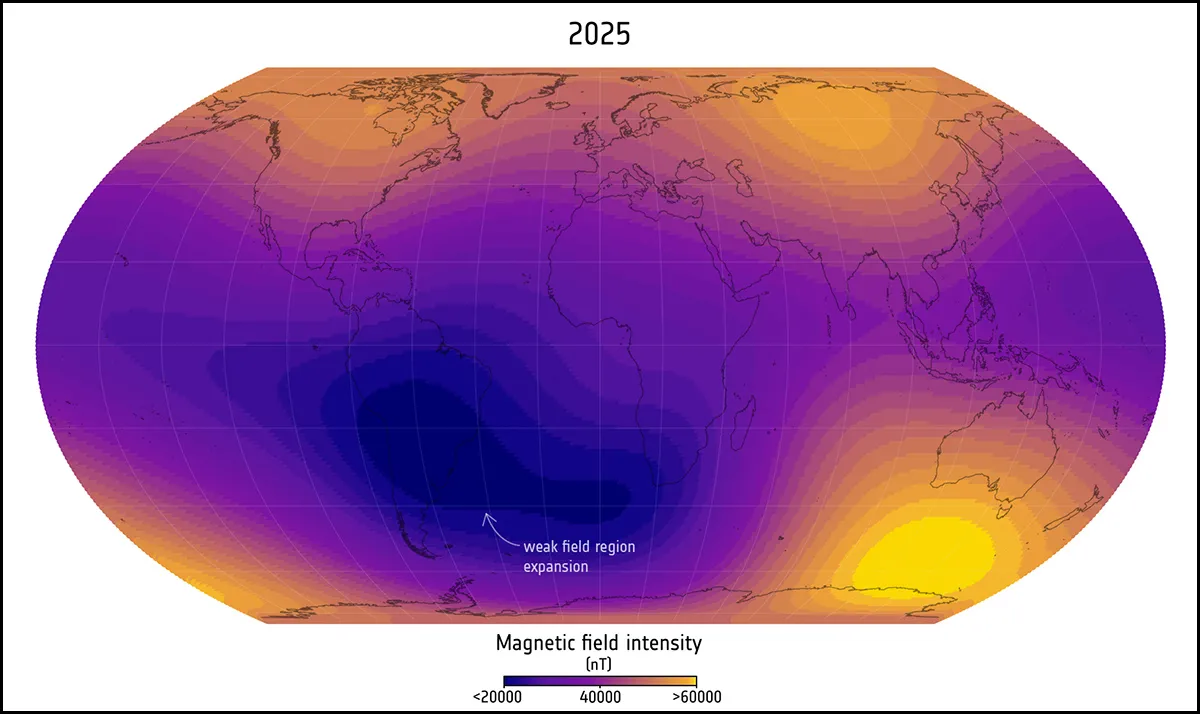
Scientists are closely monitoring the South Atlantic Anomaly (SAA) — a vast region where Earth’s magnetic field is significantly weaker than normal. This anomaly, which stretches over the South Atlantic Ocean and parts of South America, has been expanding and shifting eastward for over a decade. Recent data from the European Space Agency (ESA) reveal that the anomaly is not only growing but also developing a secondary weak zone toward southern Africa, raising new concerns about its impact on satellites, spacecraft, and the stability of Earth’s magnetic shield.
The South Atlantic Anomaly has become one of the most studied magnetic irregularities in recent years, as scientists uncover how deep-Earth processes influence what happens in space above us.
What Is the South Atlantic Anomaly?
The Earth’s magnetic field acts as a protective barrier, shielding the planet from solar radiation and charged particles emitted by the sun. However, in the SAA region, this protective “magnetic bubble” is unusually thin, allowing higher levels of radiation to reach satellites and other space equipment orbiting at low altitudes.
This thinning effect can cause:
- Temporary satellite malfunctions or blackouts
- Damage to onboard electronics and sensors
- Data corruption in orbital missions
According to ESA’s Swarm satellite constellation, which has been mapping Earth’s magnetic field since 2013, the South Atlantic Anomaly has continued to widen and weaken since 2014 — now covering an area nearly half the size of Europe.
Shifting and Splitting Toward Africa
Researchers have identified a significant structural change in the anomaly’s formation. It is no longer a single zone but now exhibits two lobes — one centered near South America and a newer, faster-growing weak region moving toward southern Africa.
“This isn’t just a static feature,” explains Chris Finlay, a geophysicist at the Technical University of Denmark. “The anomaly is evolving differently toward Africa than it is near South America.”
This uneven weakening suggests that local factors beneath Earth’s surface — possibly turbulent movements in the molten outer core — are influencing the pattern and direction of magnetic decay.
The Science Behind the Weakening Field
At the heart of the South Atlantic Anomaly lie regions of “reverse flux,” where magnetic field lines behave abnormally, turning back toward the core instead of extending outward. These zones occur deep below Earth’s surface where the outer core meets the mantle — a region responsible for generating the planet’s magnetic field.
Scientists believe that changes in the molten iron flow at these depths are disturbing the field’s stability, creating irregularities that manifest as weak spots on the surface.
Meanwhile, in the northern hemisphere, the magnetic field shows contrasting trends — weakening over Canada while intensifying over Siberia. These differences are linked to the gradual migration of the magnetic north pole, which continues to drift toward Siberia.
Implications for Satellites and Space Missions
Although the South Atlantic Anomaly does not directly endanger people on the ground, its effects on space-based operations are increasingly evident. Spacecraft passing through the region — including the International Space Station (ISS) — face heightened exposure to radiation. This can lead to:
- Sensor disruptions
- Shortened mission lifespans
- Temporary system failures in satellites
As the anomaly grows, mission planners are adapting by designing radiation-hardened electronics and updating orbit trajectories to minimize exposure.
Ongoing Research and Monitoring
ESA’s Swarm mission continues to play a vital role in tracking the South Atlantic Anomaly, offering high-resolution magnetic field data crucial for understanding Earth’s core dynamics. The mission is expected to continue operations through 2030, providing scientists with a long-term perspective on how the planet’s magnetic shield evolves.
According to Anja Strømme, ESA’s Swarm mission manager, continuous monitoring allows researchers to capture the “big picture” of how Earth’s interior processes shape the magnetic field — and how these shifts might influence space activity in the decades ahead.
The Bigger Picture
The South Atlantic Anomaly is a reminder that Earth’s magnetic field is not static. It fluctuates, shifts, and transforms due to complex forces deep below the surface. While these changes may appear gradual, they carry profound implications for the satellites, navigation systems, and communications networks we depend on daily.
Staying informed about these developments is crucial for industries, researchers, and defense agencies worldwide as we continue to expand human presence in orbit.
Stay informed on space, science, and innovation updates — visit StartupNews.fyi for the latest tech and research coverage.