
10th Indian Delegation to Dubai, Gitex & Expand North Star – World’s Largest Startup Investor Connect
Artificial Intelligence

Signal’s Meredith Whittaker scorns anti-encryption efforts as ‘parochial, magical thinking’


AI is “not open in any sense,” the battle over encryption is far from won, and Signal’s principled (and uncompromising) approach may complicate interoperability efforts, warned the company’s president, Meredith Whittaker. But it’s not all bad news.

(Actually, it is all bad news, because I wrote up the good news separately.)

Speaking onstage with me at StrictlyVC LA, Whittaker called out a resurgence of legislative attacks on encryption as “magical thinking.”

“We’re seeing a number of, I would say, parochial and very politically motivated pieces of legislation often indexed on the idea of protecting children. And these have been used to push for something that’s actually a very old wish of security services, governments autocrats, which is to systematically backdoor strong encryption,” said Whittaker. “Often, I believe, pushed by well-meaning people who just don’t have the knowledge or education to understand the implications of what they’re doing, that could, you know, fundamentally eliminate the ability to communicate privately digitally.”

Ironically, or perhaps cynically, one of the animating factors has been a decade of calls for tech companies to take more responsibility.

“The overall theme I’m seeing is a deep desire for accountability in tech, which we saw sort of animated mid-2010s. That, then, has been weaponized, and I think we’re seeing surveillance wine in accountability bottles,” she said.

“‘Accountability’ looks like more monitors, more oversights, more back doors, more elimination of places where people can express or communicate freely, instead of actually checking on the business models that have created, you know, massive platforms whose surveillance advertising modalities can be easily weaponized for information ops, or doxing, or whatever it is, right? There’s an unwillingness to hit at the root of the problem. And instead, what we see is effectively proposals to extend surveillance into government and NGO sectors in the name of accountability.”

One such proposal comes via the Investigatory Powers Act in the United Kingdom, under which the government there threatens to prevent any app updates — globally — that it deems a threat to its national security.

“[The IPA] is effectively claiming for the U.K. the ability to demand that any tech company, across all jurisdictions, check in with the U.K. government before you ship a security patch, because they may be exploiting that patch somewhere for some business they want to keep doing. It’s a form of, again, parochial, magical thinking here,” said Whittaker.

“It’s very dangerous because we are being threatened to a return before the liberalization of encryption in 1999, kind of an early ’90s paradigm where the government has a monopoly on encryption and the right to digital privacy. And where the ability to deploy encryption or privacy updates or anything that would secure and harden your service becomes something you have to get permission from the government to do.”

“And honestly,” she added, “I think we need the VC community, and the larger tech companies more involved in naming what a threat this is to the industry, and pushing back.”
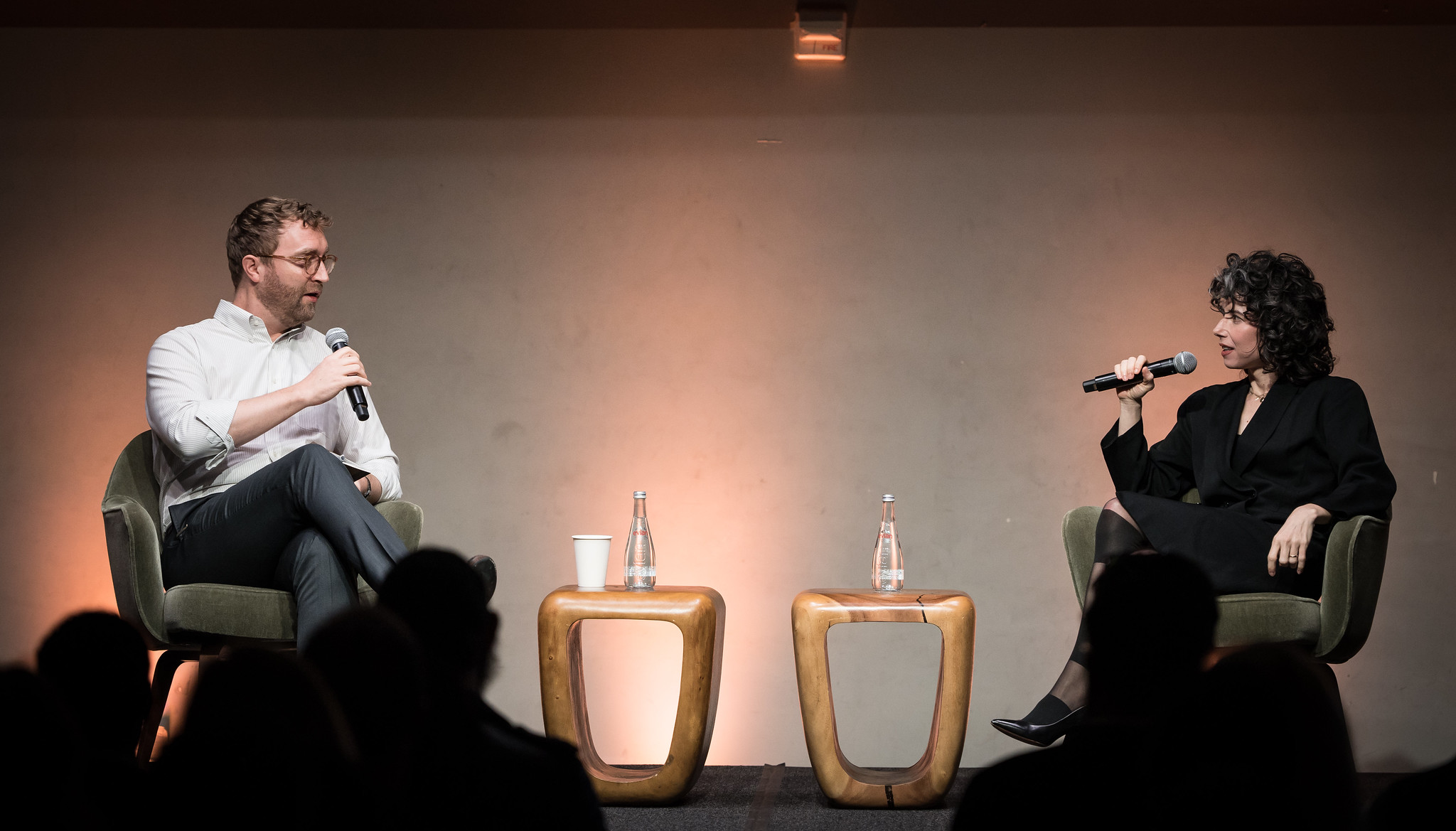
Signal president Meredith Whittaker and Devin Coldewey at StrictlyVC LA. Image Credits: TechCrunch

One bit of regulation that might seem to make sense is the messaging interoperability mandate being pursued in the EU via the Digital Markets Act. But this, too, has hidden perils.

“I think the spirit makes a lot of sense. But of course Signal can’t interoperate with another messaging platform, without them raising their privacy bar significantly,” even ones like WhatsApp that support end-to-end encryption and already partly utilize the protocol. “Because we don’t just encrypt the contents of messages using the Signal protocol. We encrypt metadata, we encrypt your profile name, your profile photo, who’s in your contact list, who you talk to, when you talk to them. That would need to be the level of privacy and security agreed across the board with anyone we interoperated with before we could consent to interoperate.”

There’s a risk, she explained, that the opposite would happen, watering down security and privacy in the name of convenience. “It could actually drop the standard of privacy, creating kind of an interoperating monolith that further relegates those who are demanding a standard of privacy with a lot of integrity to a more marginal position.” (Incidentally, she ridiculed the idea of Apple getting a pass and leaving any such regime hopelessly fragmented.)

In the private sector, Whittaker was quick to call the ascendant Nvidia a monopolist.

“It’s the chip monopoly — and the CUDA monopoly,” she said, referring to the proprietary computational architecture at the heart of much high-performance computing today.

I asked if she thinks the company has become dangerous in its accumulation of power.

“I mean, we have a lot of Spider-Men pointing at each other, right? I’m seeing Microsoft pointing fingers at Nvidia now, and saying, if you’re worried about monopoly, do not look to poor Microsoft, look to Nvidia, they’re the ones, and you also look to Google. Google put out this sort of PR missive last week, kind of their AI access principles, and they talked about Google being the only vertically integrated company from app store to chips. And that’s true, right? But then Google published a couple of days later, like Microsoft is actually the monopoly because it has the OpenAI and sort of the Azure monopoly, right?

“So like, no one is innocent here. There’s a lot of like, ‘We’re all trying to find the guy who did this …’” (i.e., the famous ‘hot dog guy’ meme lifted from “I Think You Should Leave with Tim Robinson”).

“I think we need to recognize that AI is dependent on Big Tech. It requires Big Tech resources. It is not open in any sense,” she said. “We can be honest that, if you need $100 million for a training run, that is not an open resource, right? If you need $100 million to deploy at scale for a month, that is not open, right? So we need to be honest about how we’re using these terms. But I don’t want the deflection toward Nvidia as the culprit of the week to detract from what we’re dealing with this massively concentrated power.”

You can watch the full interview below.



Source link

by Team SNFYI

Facebook is testing a new feature that invites some users—mainly in the US and Canada—to let Meta AI access parts of their phone’s camera roll. This opt-in “cloud processing” option uploads recent photos and videos to Meta’s servers so the AI can offer personalized suggestions, such as creating collages, highlight reels, or themed memories like birthdays and graduations. It can also generate AI-based edits or restyles of those images. Meta says this is optional and assures users that the uploaded media won’t be used for advertising. However, to enable this, people must agree to let Meta analyze faces, objects, and metadata like time and location. Currently, the company claims these photos won’t be used to train its AI models—but they haven’t completely ruled that out for the future. Typically, only the last 30 days of photos get uploaded, though special or older images might stay on Meta’s servers longer for specific features. Users have the option to disable the feature anytime, which prompts Meta to delete the stored media after 30 days. Privacy experts are concerned that this expands Meta’s reach into private, unpublished images and could eventually feed future AI training. Unlike Google Photos, which explicitly states that user photos won’t train its AI, Meta hasn’t made that commitment yet. For now, this is still a test run for a limited group of people, but it highlights the tension between AI-powered personalization and the need to protect personal data.

by Team SNFYI

News Update Bymridul     |    March 14, 2024 Meesho, an online shopping platform based in Bengaluru, has announced its largest Employee Stock Ownership Plan (ESOP) buyback pool to date, totaling Rs 200 crore. This buyback initiative extends to both current and former employees, providing wealth creation opportunities for approximately 1,700 individuals. Ashish Kumar Singh, Meesho’s Chief Human Resources Officer, emphasized the company’s commitment to rewarding its teams, stating, “At Meesho, our employees are the driving force behind our success.” Singh further highlighted the company’s dedication to providing opportunities for wealth creation despite prevailing macroeconomic conditions. This marks the fourth wealth generation opportunity at Meesho, with the size of the buyback program increasing each year. In previous years, Meesho conducted buybacks worth over Rs 8.2 crore in February 2020, Rs 41.4 crore in November 2020, and Rs 45.5 crore in October 2021. Meesho’s profitability journey began in July 2023, making it the first horizontal Indian e-commerce company to achieve profitability. Despite turning profitable, Meesho continues to maintain positive cash flow and focuses on enhancing efficiencies across various cost items. The company’s revenue from operations for FY 2022-23 witnessed a remarkable growth of 77% over the previous year, amounting to Rs 5,735 crore. This growth can be attributed to Meesho’s leadership position as the most downloaded shopping app in India in both 2022 and 2023, increased transaction frequency among existing customers, and a diversified category mix. Additionally, Meesho’s focus on improving monetization through value-added seller services contributed to its revenue growth. Meesho also disclosed its audited performance for the first half of FY 2023-24, reporting consolidated revenues from operations of Rs 3,521 crore, marking a 37% year-over-year increase. The company achieved profitability in Q2 FY24, with a significant reduction in losses compared to the previous year. Furthermore, Meesho recorded impressive app download numbers, reaching 145 million downloads in India in 2023 and surpassing 500 million downloads in H1 FY 2023-24. Follow Startup Story Source link

by Team SNFYI

You might’ve heard of Grok, X’s answer to OpenAI’s ChatGPT. It’s a chatbot, and, in that sense, behaves as as you’d expect — answering questions about current events, pop culture and so on. But unlike other chatbots, Grok has “a bit of wit,” as X owner Elon Musk puts it, and “a rebellious streak.” Long story short, Grok is willing to speak to topics that are usually off limits to other chatbots, like polarizing political theories and conspiracies. And it’ll use less-than-polite language while doing so — for example, responding to the question “When is it appropriate to listen to Christmas music?” with “Whenever the hell you want.” But Grok’s ostensible biggest selling point is its ability to access real-time X data — an ability no other chatbots have, thanks to X’s decision to gatekeep that data. Ask it “What’s happening in AI today?” and Grok will piece together a response from very recent headlines, while ChatGPT, by contrast, will provide only vague answers that reflect the limits of its training data (and filters on its web access). Earlier this week, Musk pledged that he would open source Grok, without revealing precisely what that meant. So, you’re probably wondering: How does Grok work? What can it do? And how can I access it? You’ve come to the right place. We’ve put together this handy guide to help explain all things Grok. We’ll keep it up to date as Grok changes and evolves. How does Grok work? Grok is the invention of xAI, Elon Musk’s AI startup — a startup reportedly in the process of raising billions in venture capital. (Developing AI’s expensive.) Underpinning Grok is a generative AI model called Grok-1, developed over the course of months on a cluster of “tens of thousands” of GPUs (according to an xAI blog post). To train it, xAI sourced data both from the web (dated up to Q3 2023) and feedback from human assistants that xAI refers to as “AI tutors.” On popular benchmarks, Grok-1 is about as capable as Meta’s open source Llama 2 chatbot model and surpasses OpenAI’s GPT-3.5, xAI claims. Image Credits: xAI Human-guided feedback, or reinforcement learning from human feedback (RLHF), is the way most AI-powered chatbots are fine-tuned these days. RLHF involves training a generative model, then gathering additional information to train a “reward” model and fine-tuning the generative model with the reward model via reinforcement learning. RLHF is quite good at “teaching” models to follow instructions — but not perfect. Like other models, Grok is prone to hallucinating, sometimes offering misinformation and false timelines when asked about news. And these can be severe — like wrongly claiming that the Israel–Palestine conflict reached a ceasefire when it hadn’t. For questions that stretch beyond its knowledge base, Grok leverages “real-time access” to info on X (and from Tesla, according to Bloomberg). And, similar to ChatGPT, the model has internet browsing capabilities, enabling it to search the web for up-to-date information about topics. Musk has promised improvements with the …






