

From Ola’s Roadster and Honda’s Activa EV in the two-wheeler (E2W) segment to Mahindra’s BE 6, XEV 9E, Tata’s Curvv EV, and MG’s Windsor in the four-wheeler (E4W) category, 2024 saw the launch of several cutting-edge electric vehicle models, with new-age features like ultra-fast charging and AI-assisted driving.
This helped the Indian market keep pace with the surging EV wave globally, even though the pace of EV adoption in 2024 slowed down in comparison to 2023.
With over two million EVs sold across various categories, new schemes like EMPS (worth INR 770 crore) enabling the sale of 5,60,769 vehicles, and the PM E-DRIVE scheme (worth INR 10,900 crore) projected to support the sale of 2.88 Mn vehicles over the next two years, India has showcased its commitment to going green.
This shift is further amplified by a growing charging station network spanning urban and rural areas.
On the infrastructure side, integrating renewable energy into EV charging grids reached new milestones, making EV ownership more sustainable. Venture capital investments further accelerated the momentum, particularly in startups focused on battery technology and recycling, reinforcing India’s potential as a global EV leader.
What’s In Store For EVs In 2025?
As 2024 concludes, the outlook for 2025 is even brighter. Elon Musk has announced Tesla’s plans to manufacture a $25,000 (INR 21 Lakh) electric car in India by 2025. Additionally, BYD is set to launch models like the BYD SEAL and BYD Seagull.
Will affordable EVs dominate, or will premium, tech-laden models capture the market? How will policies, technological innovations, and evolving consumer preferences shape the landscape?
Let’s explore the trends and possibilities set to define India’s EV journey in 2025.
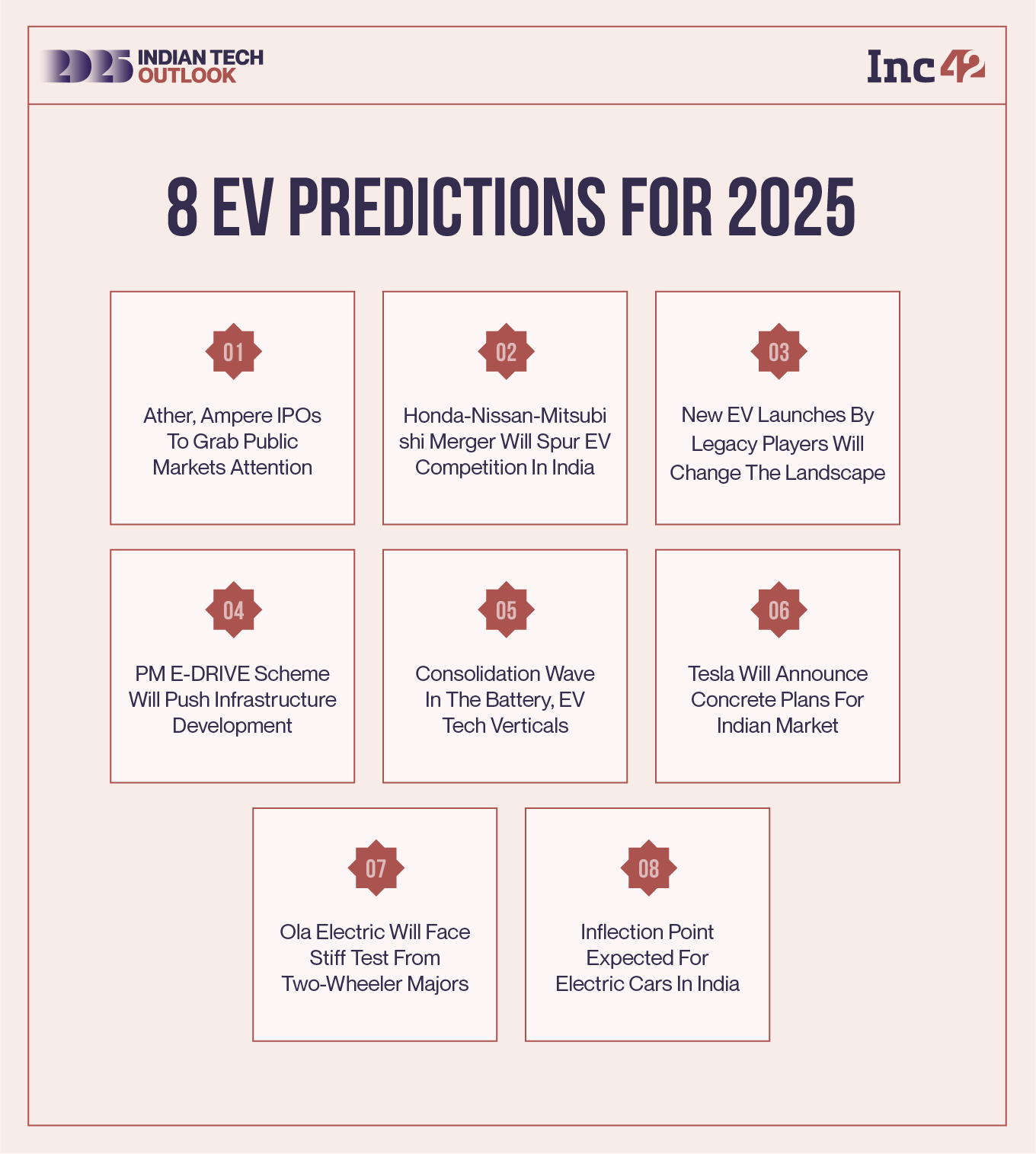
EV IPOs Will Grab The Attention
While Ola Electric successfully debuted on the bourses in 2024, other players are gearing up to go public in 2025. Among them, Ather Energy and Ampere Electric (Greaves Electric Mobility)—two of India’s top five electric two-wheeler manufacturers— are expected to land on the stock exchanges before the rest.
Ather Energy’s IPO will be keenly watched as the company is widely believed to be a pioneer in India’s EV ecosystem. However, the company’s slow sales growth is a major hurdle, as we have written over the past year.
Despite the overall growth in the market, Greaves Electric Mobility (GEM) witnessed a steep decline in market share, dropping from 12% in FY23 to just 3% in FY25 (till December 2024). In comparison, Ather’s market share was 10% in this period, down from 12% in FY24.
Discussing the upcoming IPOs, Ajesh Saklecha, co-founder of Ozone Motors, remarked, “The IPO momentum and subscription levels are high in the current stock market, and both companies are likely to achieve strong listings. However, in terms of performance, Ather holds an edge due to its high-performance scooters, in-house developed technology, and superior product quality. While their premium pricing may limit adoption in the short term, it positions them well for long-term growth.”
Saklecha also warned that both Ather and Ampere need to watch out for competitors like TVS and Bajaj, who are operating in stealth mode. “I remain neutral on both companies’ mid-term stock performance,” he added.
Key M&As: What The Honda-Nissan-Mitsubishi Merger Means For India
Key automakers Honda, Nissan, and Mitsubishi are in advanced discussions to merge under a joint holding company, aiming to establish the world’s third-largest automaker by 2026.
This alliance seeks to optimise shared resources and technologies, with a particular focus on electric vehicle (EV) development and carbon neutrality. The collaboration is designed to enhance competitiveness against industry leaders such as Toyota and Tesla.
The merger is also expected to accelerate EV plans for these brands and their sister brands globally, including in India. Honda has already launched the Activa EV two-wheeler, and plans to roll out the Elevate EV by 2026. The company is investing in battery-as-a-service (BaaS) infrastructure, with plans to establish 250 battery-swapping stations in Bengaluru, 150 in Delhi, and 100 in Mumbai by March 2026. Honda aims for 40% of its global sales to come from EVs and fuel cell electric vehicles (FCEVs) by 2030, scaling to 100% by 2040.
Randheer Singh, former director at NITI Aayog, noted that the merger could intensify competition in India’s EV market. While these companies currently have a limited EV presence in India, they bring robust engineering capabilities and combined resources. Singh told Inc42 that the collaboration could accelerate EV launches, leveraging shared platforms and technologies to deliver competitive pricing and expedite the deployment of hybrid-electric and battery-electric vehicles in India.
How The EV Infrastructure Landscape Will Shift In 2025
As of November 2024, India has installed 25,202 public electric vehicle (EV) charging stations with Karnataka leading the count at 5,765 stations, followed by Maharashtra with 3,728 and Uttar Pradesh with 1,989. This marks a significant increase from 12,146 public EV charging stations in January 2024, effectively doubling the infrastructure within a year.
The PM E-DRIVE scheme aims to further boost this momentum with a INR 2,000 Cr allocation for establishing additional public charging infrastructure across various vehicle categories. India’s largest E2W manufacturer, Hero Electric, has partnered with the leading EV charging network BOLT to set up 50,000 charging stations by 2025. Under this collaboration, BOLT chargers will be installed at more than 750 Hero Electric touchpoints nationwide, benefiting over 4.5 lakh customers.
Sandiip Bhammer, founder and managing partner of Green Frontier Capital, predicts that public-private collaborations will drive advancements in EV infrastructure in 2025. Developments such as ultra-fast charging networks, interoperable stations, and AI-optimised power grids will be key for infra penetration.
Ozone’s Saklecha believes that rapid and high-speed charging facilities will emerge along national highways and popular tourist destinations, including hotels. He also anticipates advancements in urban battery-swapping facilities and connected vehicle technology to provide actionable data for predictive and preventive maintenance.
Experts further suggest that battery-as-a-service (BaaS) models will gain significant traction in 2025. These models allow users to swap depleted batteries for fully charged ones, reducing EV acquisition costs and mitigating range anxiety. Honda’s Activa, India’s top-selling scooter for years, is expected to attract more buyers to the electric two-wheeler (E2W) segment with the launch of its Activa EV.
However, unlike competitors such as Ather and Ola, Honda has opted exclusively for battery-swapping technology in the Activa EV, without offering traditional charging options.
A senior executive at Honda Motorcycle & Scooter India told Inc42, “For E2Ws and E3Ws catering to micro-range mobility requirements, BaaS is the only viable solution. Spending four to five hours charging at home for a one-hour journey simply doesn’t make sense.”
New Launches: Mahindra, Hyundai, and Maruti Gear Up
2025 is set to be a game-changing year for EVs in India, according to industry experts, particularly when it comes to electric cars.
Mahindra recently unveiled two EV models, the BE 6 and XEV 9E, which are expected to hit dealerships by late January 2025, with customer deliveries scheduled between February and March. In addition to these, Mahindra plans to launch three more models—XEV 4E, XEV 7E, and BE 7—later in the year.
Suzuki and Hyundai are gearing up to introduce the e-Vitara and Creta EV, respectively, which are positioned as mass-market vehicles catering to Indian consumers. Tata Motors, the country’s leading EV maker in the four-wheeler segment, is also preparing to launch the Harrier EV and Sierra EV early next year.
In the E2W segment, several mass-market vehicles are slated for launch in 2025, including the Suzuki Burgman Electric, Activa E, Ola Adventure, Ola Cruiser, and the Chetak 35 series.
Former Niti Aayog official Singh highlighted three highly anticipated four-wheeler launches for 2025 that could change the EV game:
- Tata’s Harrier EV: Known for its safety, road presence, and features, the Harrier is expected to extend these strengths to its electric version while emphasizing sustainability.
- Hyundai’s Creta EV: As the EV counterpart to one of India’s highest-selling SUVs, the Creta EV has the potential to redefine consumer preferences in the segment.
- Maruti Suzuki’s eVX (Vitara): This launch marks Maruti’s long-awaited entry into the EV market. With its extensive dealership network and a focus on affordability, the eVX is poised to accelerate EV adoption in the mass market while supporting the expansion of charging infrastructure.
In the two-wheeler segment, Singh said, “I am closely watching Ola Electric’s upcoming lineup and Hero MotoCorp’s plans to leverage their brand name and extensive dealership network, particularly in rural areas.”
The line up could get much more interesting with Tesla set to make a significant push into the Indian market by 2025, focusing on affordability and local manufacturing. The company plans to introduce a mass-market electric vehicle, codenamed “Redwood,” targeted at Indian consumers.
Meanwhile, BYD is also bolstering its position in India’s EV market with plans to establish a local manufacturing facility by 2025. The company is gearing up to launch a sub-compact electric SUV priced at around INR 2 Mn, directly challenging models like the Hyundai Creta EV and Maruti Suzuki eVX. BYD will also showcase its global portfolio, including the BYD eMAX 7 and BYD SEAL sedan, at upcoming events like the Bharat Mobility Global Expo 2025.
However, regulatory challenges remain, as India’s stringent stance on Chinese investments has delayed BYD’s proposed $1 billion investment in the country. Despite hurdles, BYD’s strategy reflects its ambition to tap into India’s growing demand for advanced and affordable EVs.
Backed by PM E-DRIVE, experts believe new vehicles will play a critical role in establishing a long-term EV foothold in the Indian market.
Green Frontier Capital’s Bhammer asserted, “These vehicles will address untapped demographics, driving greater adoption. Coupled with advancements in battery technologies and extended driving ranges, these launches are likely to reshape consumer expectations and push legacy automakers to innovate more aggressively.”







