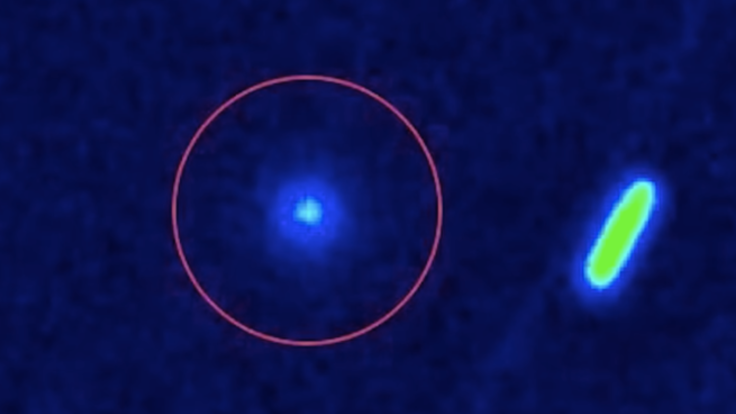
Harvard Scientist Suggests Comet 3I/ATLAS May Carry an Alien Connection
In an unexpected twist that has reignited debates about extraterrestrial life, renowned Harvard astronomer Avi Loeb has issued a stark warning regarding Comet 3I/ATLAS, also known as nasa cometa 3i atlas. The comet, predicted to pass approximately 167 million miles from Earth this December, has become the focus of global attention following claims that it may be emitting an unusual radio signal — one that could point to an interstellar or even alien origin.
Loeb, who previously stirred scientific controversy with his research on the interstellar object ‘Oumuamua, suggests that Comet 3I/ATLAS might not be an ordinary space rock. Instead, he argues it could be a fragment of advanced extraterrestrial technology, potentially a communication or reconnaissance probe from beyond our solar system.
NASA, on the other hand, has dismissed the idea, stating that there’s “no credible evidence” to support any extraterrestrial connection. Yet Loeb’s persistence and detailed analysis of data collected by the Hubble Space Telescope and the European Space Agency have reignited curiosity within the scientific community.
Unusual Anomalies Detected in Comet 3I/ATLAS
What makes Comet 3I/ATLAS particularly interesting is its list of anomalies. Unlike normal comets that release dust and gas in a direction away from the Sun, this one emits light and energy toward the Sun — a characteristic unseen in natural objects. Moreover, Loeb’s study indicates that the comet’s composition includes nickel and other aerospace-grade alloys, not typically found in interstellar ice bodies.
Adding to the mystery, the nasa cometa 3i atlas follows a near-perfect alignment within the ecliptic plane — the same flat, circular path where planets orbit the Sun. Statistically, Loeb notes, the odds of such alignment happening by chance are just one in 500. These coincidences, coupled with reports of a faint radio emission, have only deepened suspicions that the comet might be of artificial origin.
Avi Loeb’s Controversial Call for Open-Minded Science
Loeb has long argued that the scientific establishment often ignores outlier data, dismissing it as noise rather than potential discovery. Drawing a provocative analogy, he compared the current skepticism to intelligence oversights before major historical events, emphasizing that ignoring anomalies can have serious consequences.
“Even if the probability is small, the consequences are enormous,” Loeb explained during a recent podcast. “If Comet 3I/ATLAS turns out to be an alien artifact, it could redefine humanity’s place in the universe.”
The astronomer’s theories have also captured the imagination of the public. After reality TV star Kim Kardashian joked online about “getting the tea” on the comet, Loeb humorously invited her to join his research team — a move that drew media attention and underscored how science, pop culture, and curiosity are increasingly intersecting in the age of viral discovery.
NASA Responds as Public Interest Grows
While NASA continues to downplay the possibility of extraterrestrial involvement, the agency is monitoring 3I/ATLAS closely through its planetary defense network. A NASA spokesperson stated that there are “no indications of a threat to Earth” but confirmed that anomalous readings, including radio frequency spikes, are under review.
This acknowledgment has fueled online speculation and inspired a new wave of interest in interstellar science. Across social media, discussions about nasa cometa interestelar 3i atlas have surged, with space enthusiasts and skeptics debating whether this could be the breakthrough moment in the search for intelligent life.
Comet 3I/ATLAS: A New Frontier in Space Curiosity
The upcoming December 2025 flyby will provide scientists with the best opportunity to observe 3I/ATLAS and study its mysterious signals. The Harvard astrophysics department and several global observatories plan to coordinate a live observation campaign to capture real-time data.
Whether the radio signal turns out to be a natural phenomenon or evidence of something more extraordinary, Comet 3I/ATLAS has already achieved one remarkable feat — rekindling the human desire to explore the unknown and question what lies beyond our cosmic neighborhood.
As Professor Loeb noted, “Science should be about curiosity, not conformity. If this comet holds answers to the biggest question of all — are we alone — then it’s our duty to listen.”
Stay Updated on Space, Innovation, and Startup Stories
For more breaking news on space discoveries, tech innovation, and startup developments, visit StartupNews.fyi. Stay informed about the latest events shaping our future in science and business.