
10th Indian Delegation to Dubai, Gitex & Expand North Star – World’s Largest Startup Investor Connect
EV

India’s EV Startup Funding Landscape — Decoding The Shift From OEMs To Newer Sub-Segment


SUMMARY

Longer gestation periods associated with OEM investments, increasing competition, and heavy capital requirements are some of the reasons why many investors want to stay away from funding EV manufacturers

EV manufacturing is a long journey, which is why they now want to focus on allied sectors like batteries, EV infrastructure development, and other segments

According to data compiled by Inc42, the Indian EV sector has raised over $780 Mn so far this year as against $758 Mn in 2022

From marquee startup investors like Peak XV Partners (formerly Sequoia Capital) and Lightspeed to sector-focussed VCs such as AdvantEdge and Speciale Invest, there is hardly any VC or angel investor who does not want to bet on the country’s burgeoning EV story.

In fact, as against a total of 35 funding deals last year, the Indian EV ecosystem has already lapped up 32 deals so far this year, amid the ongoing funding winter. Further, according to data compiled by Inc42, the Indian EV sector has raised over $780 Mn so far this year as against $758 Mn in 2022.  

The aforementioned funding numbers and deal counts may look quite promising, along with the fact that Indian EV startups have raised a total of $2.6 Bn since 2015, with OEMs leading the show so far.
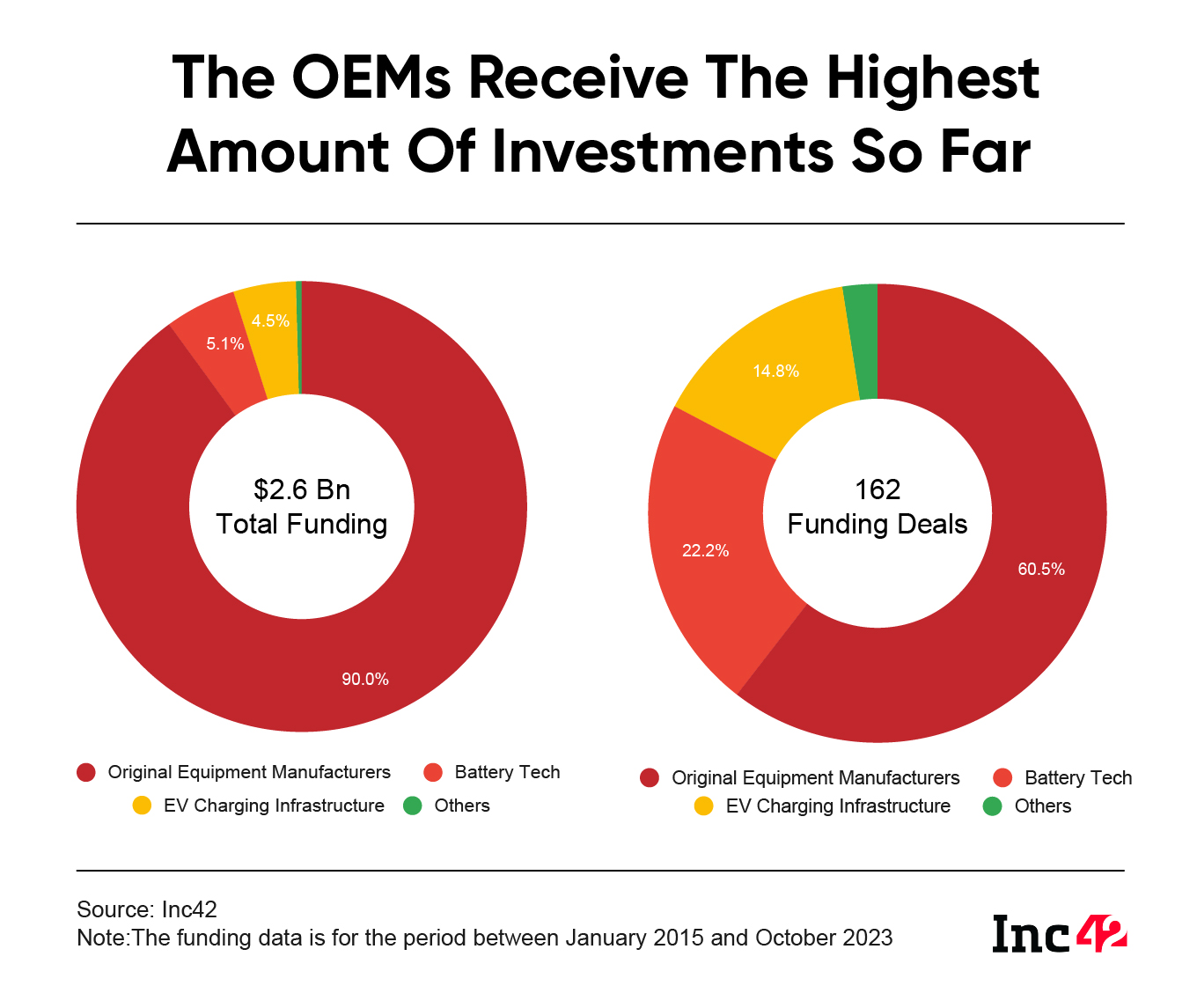
OEMs receive more funding so farOEMs receive more funding so far

However, a closer look at the current funding activities in the sector reveals that EV OEMs, once the lure of the Indian funding carnival, no longer look lucrative to investors. According to Inc42, over 41% of deals in the industry have been lapped up by non-OEMs so far this year.

Speaking with Inc42, a few investors revealed that the longer gestation period associated with OEM investments, increasing competition, and heavy capital requirements are some of the reasons why many investors want to stay away from funding EV manufacturers. However, amid this, investor focus is shifting towards industry sub-segments like EV financing, charging and infra, and battery technology.

“Both two-wheelers and three-wheelers have seen a proliferation of newer OEMs while in four-wheelers the incumbents have taken a large lead. Given the long timeframe to hit the market, extended working capital cycles and heavy competition, we are not bullish on entering an OEM as a venture investor at this point,” Romit Mehta, an investor at Lightspeed India said. 

Echoing similar sentiments, the managing partner of Speciale Invest, Vishesh Rajaram, told Inc42 that if OEMs have to start businesses today, they either need headstarts that Ather Energy or Ultraviolette had (given the founders’ years of experience in the mobility sector) or a huge capital investment like Ola. 

“If none is in place, it will be a tough battle for OEMs to catch up with the market. Hence, vehicle manufacturers that are starting afresh may not get much investor attention,” Rajaram said. 

Notably, Speciale Invest has investments in electric motorcycle manufacturer Ultraviolette, Li-ion battery recyclers Metastable Materials, electric flying taxi startup ePlane Company, and battery tech startup e-TRNL Energy.

Rajaram added that Speciale Invest will continue to remain laser-focussed on the entire electric mobility value chain.

Is The EV Funding Pattern Shifting?

According to industry experts, EV manufacturing is a long journey and investors understand this, and as a result, they now want to focus on allied sectors like batteries, EV infrastructure development, and other segments.

In addition, the country has already received the initial push in terms of EV adoption, and in a bid to keep this momentum going, the allied sectors will now require a significant backing from investors.  

Lightspeed’s Mehta looks at EV opportunities from two angles – the first is the initial adoption and the second is the proliferation. 

“Today, the pace of EV adoption is picking up, and we believe it is a great time for founders to make charging more accessible, innovate components and data stack for lifecycle management, and build a brand for financing,” he said.

Sharing his thoughts on emerging EV sub-segments and investors’ growing inclination towards them, Sandiip Bhammer, the founder and co-managing partner at Green Frontier Capital said that the same stems from the high potential for innovation and scalability in these allied areas.

“These emerging areas hold the key to solving the fundamental challenges in the ecosystem… Going forward, investments in electric mobility are likely to be aggressive, especially in the emerging technologies that will enhance range, reduce costs, and improve overall user experience,” Bhammer said.

According to Bhammer, investments in the development of efficient battery technology and businesses that support the EV ecosystem, like lending, SaaS-based business, and others, are well poised for growth.

Meanwhile, Mehta of Lightspeed believes that in terms of second-generation opportunities, which is proliferation, there is an emerging play in full-stack battery solutions, systems-level charging optimisation across the network, second-hand marketplaces, and distributed storage, among others.  

Notably, the charging and battery technology segment has recently seen startups like Exponent Energy and EMO Energy come up with quicker solutions to EV charging. 

Similarly, Bengaluru-based Vidyut was founded in 2021 to help commercial EVs with financing and vehicle lifecycle management solutions. 

This year, the former India CEO of CARS24, Kunal Mundra, launched a full-stack EV asset management and leasing startup, Electrifi Mobility

A Sneak Peek In 2023 So Far

It is pertinent to note that even after multiple safety issues and major policy changes in the EV ecosystem over the last one year, the funding in this space has only increased.

As per Inc42, the total amount of funding in EV startups since 2015 stood over $1.8 Bn in 2022 and more than $2.6 Bn so far in 2023. 
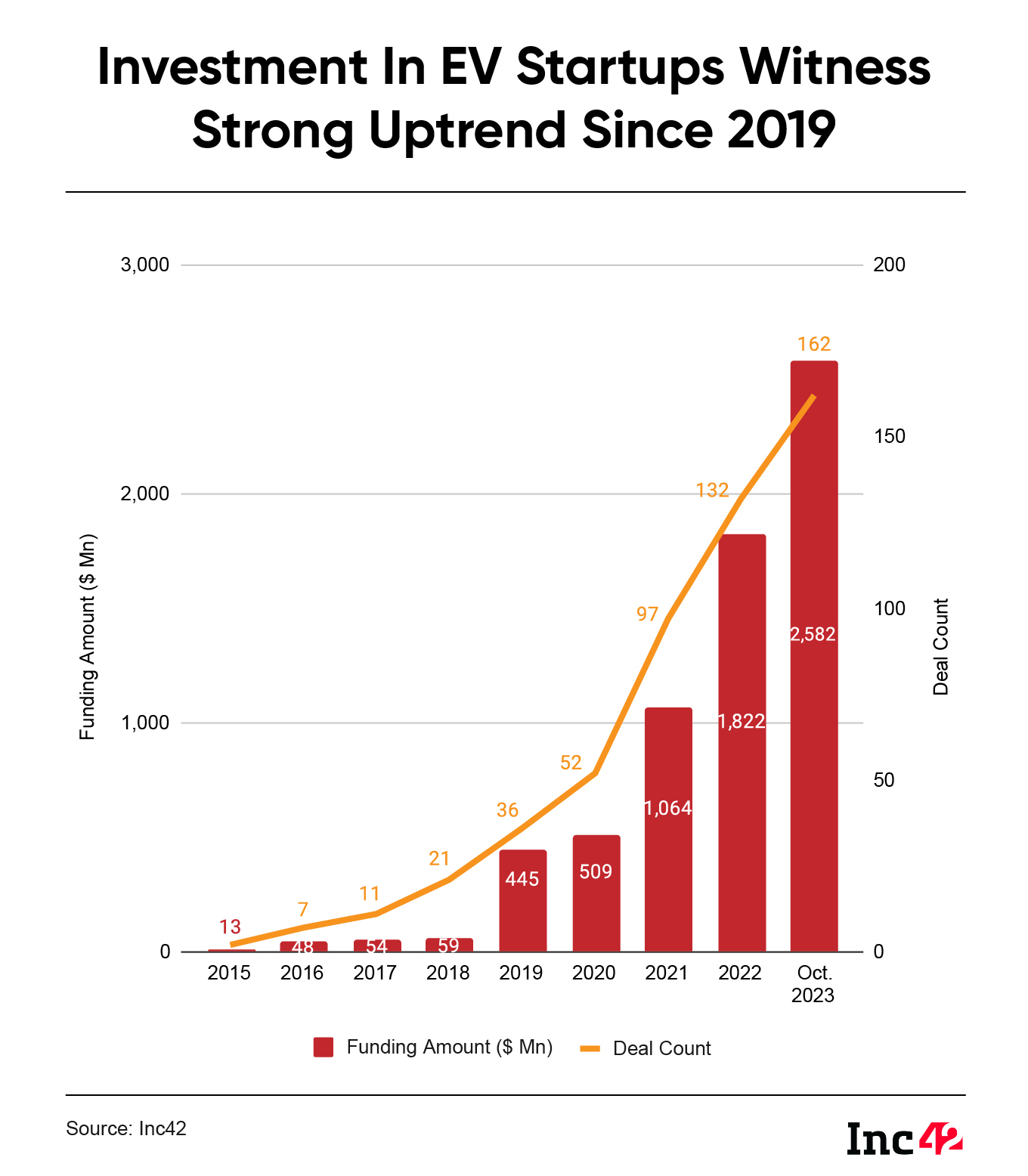
Investment rising in EV startups Investment rising in EV startups


Even after safety challenges and other issues that shrouded the Indian EV industry last year, several investors had told Inc42 that the initial problems would only be short-lived and that long-term opportunities in the sector set the stage for doubling investments.

Meanwhile, Green Frontier Capital’s Bhammer said that despite the funding winter, climate investments have grown, and currently, there are a lot of investors who are looking at the EV sector in India and its growth, which has been well-documented in terms of the growing number of EVs, and charging and swapping stations.

“We are finding a lot of foreign investors in the VC space. All have, in some form, taken an exposure to the industry… The fact is that the EV exposure is very much part of everyone’s portfolio whether it’s in financing, whether it’s a platform, whether it’s an OEM, and I feel that there is a lot more to come,” Bhammer added.

The founder of Green Frontier Capital has a point here, given that a lot is happening in this burgeoning space. Recently, Paytm founder and CEO Vijay Shekhar Sharma launched his maiden fund, VSS Investment Fund, with EV as one of the sectors in focus.

It is pertinent to note that while OEM giants like Ola Electric and Ather Energy raised more than $490 Mn until mid-November 2023, there were multiple other fundings across EV sub-segments.

For instance, EV financing startup Revfin bagged a debt funding of $5 Mn. Similarly, EV cab service provider Evera bagged $7 Mn as part of its Pre-Series A funding round, and lithium-ion (Li-ion) battery recycling startup Metastable Materials raised an undisclosed Seed round from Sequoia Capital’s Surge, Speciale Invest, and others.

Besides, some big investments in the non-OEM segments included EV battery startup Log9 Material’s $40 Mn Series B funding, EV charging startup CHARGE+ZONE’s $54 Mn Series A1 funding, and Magenta Mobility’s $22 Mn Series A1 round.

So far this year, India’s total EV registrations stand at 13.29 Lakh units compared to 10.24 Lakh in 2022, as per Vahan data.

As of now, the sheer rise in the number of EVs and investors’ willingness to give a much-needed investment boost to EV sub-sectors are some of the many tailwinds that the Indian EV industry is well-positioned to leverage going ahead.






Source link

EV
by Team SNFYI

Are you considering investing in an electric vehicle? If so, you have made the right decision. Electric cars are gaining popularity due to their numerous benefits. However, before you buy an electric car, you must consider the factors discussed in the following sections. They will help you make an informed decision. 6 Points You Must Consider While Buying Electric Cars  Let’s take a look at the important points you must consider before buying electric cars in India:  Ideally, an electric car has a driving range of over 100 km, which is sufficient for daily driving. However, high-end electric vehicles offer a driving range of over 400 km.   Considering the maximum distance the vehicle can travel on a single charge will help you determine whether the car meets your requirements. To make your purchase stress-free, research the prices of the cars and know your budget. Consider applying for an electric vehicle loan to help you fulfil your dream of owning a car without denting your savings. Use a car loan EMI calculator to calculate your monthly instalment and formulate a financial plan, considering other liabilities.  The formula for calculating electric car loan EMI is as follows: EMI = [P x R x (1+R)^N]/[(1+R)^N-1] Here,  P = Principal sum of the car loan  R = Rate of interest charged by the lender  N = Tenure of the loan in months  As you can see, the calculation procedure is time-consuming and prone to errors. So, you can use an online car loan EMI calculator to get accurate results quickly.  The battery is the most important component of an electric car, and it’s quite expensive. Therefore, it is essential to check the battery life before purchasing an electric vehicle. Find out details about the battery range and other specifications.  Moreover, check how long the battery can last and how much it will take to replace it.  Remember that you won’t find an electric vehicle charging station as easily as you find a fuel station. This is because the electric vehicle charging infrastructure has yet to establish a strong footing in India. Fast chargers are quite expensive to install in the car, and your city might have very few charging stations for them. On the other hand, standard and slow-charging systems are more reasonably priced. So, before buying an electric car, check which charging system suits your vehicle and meets your budget. Electric vehicles are equipped with software, which must be updated regularly. While some manufacturers provide the software for free, others may charge a fee for it. Moreover, remember to ensure that your electric vehicle has the latest software upgrades/updates.  You must maintain your electric vehicle regularly, just as you would a conventional car. Otherwise, its performance will be affected. Electric cars have few moving parts, requiring less maintenance effort. Also, buying spare parts for an electric car will be more expensive than for conventional cars. So, consider the maintenance costs of an electric vehicle before investing in one.  Additional Important Things to Keep …

by Team SNFYI

Bharatsure, one of India’s leading Insurtech companies offering Infrastructure as a Service (IaaS) solutions has raised INR 6 Crores from Inflection Point Ventures (IPV) and other investors including Capital A and Atrium Angels. Bharatsure is pioneering transformation in India’s insurtech landscape, unlocking vast market potential while advancing health security and insurance penetration. As an Infra-as-a-Service (IaaS) Insurtech, Bharatsure empowers ecosystem partners with seamless group and embedded insurance distribution solutions. Bharatsure has doubled its revenues in FY25 breaking even at CM3 and is gradually progressing toward EBITDA profitability by the end of this year. With a clear growth trajectory, Bharatsure has set ambitious revenue milestones, targeting INR 100 Cr by FY28 and INR 1000 Cr by FY34, reflecting its bold vision and long-term scalability in the market. Anuj Parekh and Sanil Basutkar are the co-founders of Bharatsure. Anuj, a CA and IIM-Bangalore alumnus, brings deep expertise in finance and scaling ventures, while Sanil, a CA and an ISB alumnus, employs his fintech background to drive product innovation and distribution. Coinciding with the fundraise, Bharatsure announced a new partnership with Battery Smart, India’s largest battery-swapping network for electric two- and three-wheelers, to launch natural calamity insurance exclusively for its station partners. The initiative offers protection against events such as fires, floods, earthquakes, and storms alongside personal accident coverages to safeguard individual livelihoods.  Mitesh Shah, Co-founder, IPV says, “As India moves towards a greener and sustainable future with the widespread adoption of EVs, and the infrastructure that supports it, it is time that we adapt our insurance frameworks to suit the changing needs. Bharatsure’s futuristic mindset and farsight offers financial protection and peace of mind in the face of unexpected events. In a world that doesn’t always go according to plan, insurance doesn’t just offer protection, it also carries the burden of social responsibility.” Anuj Parekh, Co-Founder & CEO of Bharatsure, added: “These station partners play a frontline role in advancing sustainable mobility, and we’re proud to design coverage that genuinely addresses their needs. The funding allows us to further develop our infrastructure too ”  With over 1,500 stations and 70,000+ drivers across 50+ cities, Battery Smart’s station partners form the backbone of India’s growing EV infrastructure. This insurance plan ensures partners are equipped with financial protection to overcome unforeseen disruptions while continuing to power the country’s EV transition.  “Our station partners are at the heart of our operations,” said Ms. Sumi Jain, AVP – Network Strategy and Operations, Battery Smart. “This insurance partnership is not just about protecting assets, it’s about empowering the individuals who are driving India’s EV revolution. Together with Bharatsure, we are fortifying the backbone of our network.”  As EV adoption picks up pace in India particularly across two- and three-wheelers, battery swapping stations are emerging as a critical part of the ecosystem. To strengthen safety for its partners, this insurance initiative complements Battery Smart’s existing safety framework, which includes a 24×7 support helpline, in-app issue reporting, mandatory onboarding training and ongoing awareness campaigns.   About Battery Smart:  Battery Smart …

EV
by Team SNFYI

Shanghai, June 2025 – In a move set to shake up the electric vehicle (EV) landscape, Tesla has officially introduced a 6-seater version of its popular Model Y SUV for the Chinese market. This marks the first time the automaker has offered this specific seating configuration in China, indicating a strong focus on capturing the growing demand for more family-friendly electric vehicles in the world’s largest EV market. The new Tesla Model Y 6 seater is expected to launch in Q3 2025 and will be manufactured at Tesla’s Gigafactory in Shanghai, which already produces Model 3 and Model Y units for the Asia-Pacific region. Family-Focused Configuration The Tesla Model Y 6 seater introduces a more versatile interior layout, offering two captain’s chairs in the second row instead of the traditional bench seat. This setup not only enhances passenger comfort but also provides easier access to the third row, making it ideal for families with children or those who frequently transport multiple passengers. Tesla’s design update is in line with customer feedback from China, where extended family travel is common, and functionality often outweighs minimalism in vehicle interiors. According to local sources, the 6-seater Model Y will also include upgraded air filtration systems and enhanced rear climate controls, catering to the preferences of premium Chinese buyers. Market Strategy in China China represents Tesla’s second-largest market after the United States, and this launch signals the company’s strategic intent to remain competitive against domestic giants like BYD and Li Auto, both of which offer flexible seating layouts in their best-selling SUVs. The addition of the Tesla Model Y 6 seater is expected to boost the brand’s presence among middle- to upper-income families who previously might have considered more spacious alternatives. Tesla is also planning a strong marketing push around the family-first messaging, emphasizing safety, comfort, and advanced self-driving features. Competitive Pricing and Delivery Timeline While official pricing has not been confirmed, early reports suggest the 6-seater Tesla Model Y will be priced slightly above the Long Range variant but remain competitive in its segment. Industry analysts expect the starting price to be around ¥350,000 (approx. $48,000), positioning it below traditional luxury competitors like Mercedes-Benz EQB or NIO ES6. Pre-orders for the Tesla Model Y 6 seater are expected to begin by late July, with deliveries starting as early as September 2025. What’s Under the Hood? Mechanically, the 6-seater Model Y will remain consistent with current dual-motor AWD versions. It is expected to feature a similar battery configuration with a range of up to 530 km (approx. 330 miles) per charge under CLTC testing standards. Tesla’s infotainment and software upgrades will also be included, featuring the latest Full Self-Driving (FSD) beta, real-time traffic visualization, and a theater mode for rear passengers—a feature well-suited to longer family drives. Final Thoughts With this latest addition, Tesla is not just responding to consumer demand—it’s setting the tone for how EVs can adapt to regional market needs. The Tesla Model Y 6 seater represents a smart blend of …

