

Five years ago, who thought that podcasts for kids would be a thing? While still a niche today, many parents want to add them into their kids’ bucket list. This trend is emerging from the fact that kids these days are more tech-savvy than ever. While exciting, it’s an area of concern for many parents.
One such concerned parent was Neha Sharma, whose biggest peeve became watching her daughter glued to screens during the lockdown. However, instead of just sitting and worrying about her kid, Sharma and her friend and neighbour, Sowmya Jagannath, took action, and together launched Vobble in 2023 — a screen-free audio entertainment platform for kids.
Vobble is an audio OTT platform that offers an immersive storytelling experience to kids between 4 and 12 years of age. Its content library stacks story series, music, audio shows, and kids’ podcasts.
“This is not your typical narrative audio like what you might find on Audible. We are creating 3D audio experiences, complete with sound effects and dialogues, and most of our content features kids’ voices. We have nearly 100 children in our cohort who lend their voices to the content, resulting in a high-quality, globally relevant product,” Sharma told Inc42.
Vobble earns its revenues from subscriptions. Customers have the option to purchase a 1 or 12-month plan with prices starting from INR 250 a month.
It releases new content weekly, either created in-house or in collaboration with renowned publishers like HarperCollins, Scholastic, Tinkle, Amar Chitra Katha, and Tulika. The startup also partners with brands such as Hasbro, Rebel Girls, the Australian Broadcasting Corporation, and Owl Field, utilising their content IPs.
In addition, its flagship product, The Vobble Box, includes the app’s subscription and kids-friendly headphones.
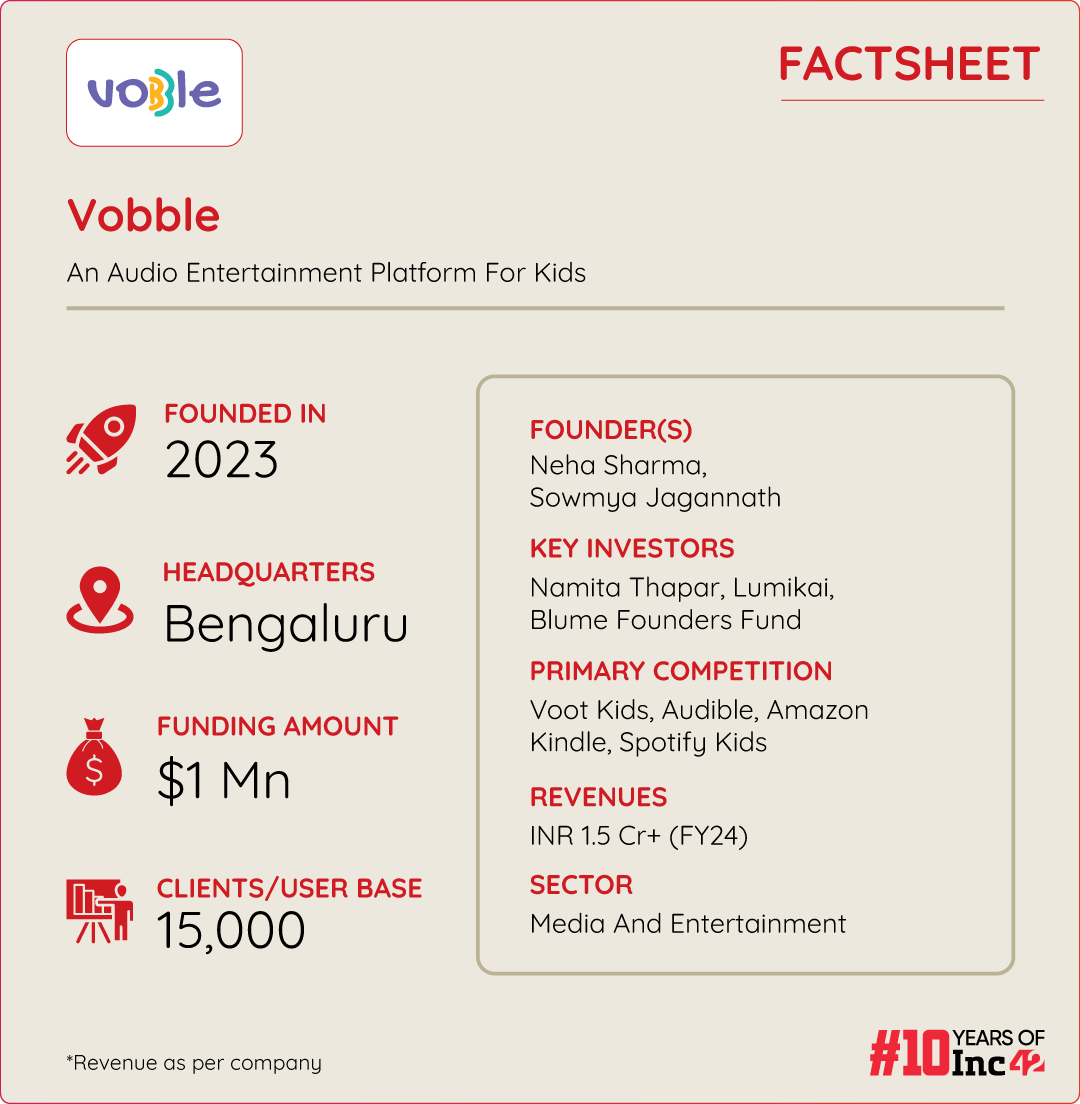
The startup’s shot to fame was its appearance on “Shark Tank India” (Season 3) where it bagged INR 25 Lakh from Emcure Pharmaceuticals’ ED Namita Thapar. In March, the Bengaluru-based startup raised $1 Mn in its seed funding round, which was led by early-stage VC fund Lumikai, with participation from Blume Founders Fund and angel investors.
According to the founder, the startup reported a revenue of INR 1.5 Cr in FY24 and claims to have a monthly recurring revenue (MRR) of INR 13 Lakh.
Vobble’s Origin Story
When the Covid-19 hit the world, Sharma had already been working for 17 years. She has enjoyed stints at companies like Pepsico, Unilever, and EssilorLuxottica. Given her successful career journey, floating a startup was never part of the plan.
However, during the peak of the pandemic, when there was little to do and explore, especially for kids, she found her daughter becoming addicted to screens, be it a laptop, TV or smartphone.
When she discussed the concern with Jagannath, she found that the problem was not limited to her alone and other parents, too, were experiencing the same.
To free kids from the growing addiction of screens, the duo of friends decided to do something about it. They quit their handsomely paying jobs and started spending time researching possible cures.
Next, the founders decided to introduce their kids to audiobooks and audio stories. To their surprise, kids responded quite well to their moms’ little experiment. Consequently, the time spent on watching screens reduced significantly as the founders’ kids got engaged in listening to the content of their choice.
The founders then talked to 80 kids across cities like Singapore, Bengaluru, Mumbai, and a few in the US. They realised that audiobooks were making a great impact on kids and that they were spending a lot of time listening to audios, all while multitasking.
But this realisation was not enough to launch a startup. At this point, Sharma’s strongest motivation came from her husband Tushar Vashisht, the cofounder of HealthifyMe.
“It was because of my husband that I had some insight into what it’s like to be a founder and the experiences that come with it,” Sharma said, adding that it was time to take that entrepreneurial leap by launching Vobble.
The founders said that they wanted Vobble to be more than just a typical audio platform, so they decided to make it more interactive.
Next on the cards was to hire a team, develop content, and create a product. Vobble eventually became operational in September 2023.
What Sets Vobble Apart
The founders not only wanted to create a unique business but also offer something beyond what was already available in the market. According to Sharma, the content on most platforms is often monotonous and created by adults.
“However, our focus has been on making content that’s interactive, engaging, and immersive, designed specifically to fit within kids’ attention spans,” the founder said.
To achieve this, they began developing the product in January 2023 and launched the first iteration of the Vobble Box in August 2023.
This box included 10 hours of highly immersive content on the Vobble app, along with headphones and activity books. Just after the launch, the founders experimented with different types of subscription + headphone business models.
As the hardware + subscription model was new for the Indian market, they decided to move to a more straightforward model with 12-month subscription.
The latest version of Vobble Box comes with bluetooth headphones, allowing children to fully experience the immersive nature of their audio content. Additionally, it includes activity books with colouring and activities related to the audio they’re listening to.
This box is priced at INR 3,500. After the 12-month subscription, the startup provides an unbundled subscription model. This allows customers to purchase a trial month or a full 12-month subscription without the headphones and activity books if they prefer.
The startup currently produces 10 hours of content monthly, and updates the content on a weekly basis. In the backend, the startup uses AI to help with scripting, mixing, and mastering. It also has a recommendation engine and gamification feature to make its app more engaging.
“We are currently preparing for the next generation of Vobble, where we will provide kids with their own device. This device will allow them to access content independently and will feature a microphone, enabling them to create their own content. It will be portable, so they can take it anywhere,” the cofounder added.
Vobble’s Future Roadmap
The startup achieved its first major milestone by getting featured on “Shark Tank India” (Season 3). According to the cofounder, the startup saw a 15X increase in website traffic and a significant boost in sales following the show.
The company has formed multiple partnerships with various publishers and producers. For instance, it launched Peppa Pig on the Vobble app in collaboration with Hasbro and produced an audio series for Tinkle’s popular characters in January-February 2024.
Earlier this year, it introduced stories from the well-known US content producer, Rebel Girls, featuring figures like Michelle Obama and Taylor Swift. Furthermore, the startup has collaborations with brands like Mokobara and Gini & Jony for exclusive travel audio series.
With about 15,000 users in a year, the founders take pride in Vobble’s content, which, as per Sharma, is the key differentiating factor.
Meanwhile, the founders, as mothers, are very mindful of using AI and are making sure that appropriate guardrails are in place to protect kids’ privacy.
The cofounders also plan to leverage AI by enabling kids to create their own audio content. Collaborating with companies like 11 Labs, Vobble aims to integrate advanced AI tools to enhance its platform. “Eventually, we may develop our own language model, specifically designed for kids’ safety,” said Sharma.
In the short term, the founders will be looking to enter the US market. The startup also aims to expand across genres. For this, it is producing podcasts, quizzes, and weekly news updates. Every week, they release trend-based content, covering various genres to build a rich catalogue.
All in all, Vobble has enough scope to expand in the Indian audio OTT market that is expected to reach a size of $1.1 Bn by the end of FY25 and $2.5 Bn by the end of FY30. In this space, the startup has crafted its niche with audio content for children.
While platforms like Voot Kids, Audible, Amazon Kindle, Spotify Kids, Pocket FM and Google Play Books provide a range of audiobooks for young audiences, Vobble wants to rule the roost with content that’s interactive, engaging, and immersive and its partnerships with the publishers of shows that are popular among kids. A prime example is Peppa Pig.
Amid the growing cut-throat in the Indian OTT space, will Vobble be able to make the cut?
[Edited By Shishir Parasher]







