Tragic Failure in Sichuan Province Raises Questions About Infrastructure Safety
A major engineering disaster struck southwest China this week as the Hongqi Bridge in Sichuan Province collapsed into a river just months after it officially opened to traffic. The dramatic failure of the Hongqi Bridge, a symbol of China’s infrastructure ambitions, has reignited debate about construction quality and safety oversight in the country’s rapidly expanding transportation network.
According to Chinese state media reports confirmed by Reuters, the Hongqi Bridge collapse occurred around 3 p.m. local time on November 11, 2025, near the G317 National Highway in Maerkang County, an important route linking central China to Tibet. Thankfully, early reports indicate no casualties, as traffic had been halted hours earlier after cracks appeared on the bridge’s surface and slope.
Cracks Detected Before Collapse
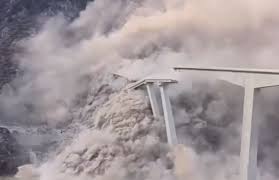
Authorities had reportedly noticed visible cracks on the bridge’s deck and supporting slope on Monday afternoon, prompting local officials to impose temporary traffic controls. Despite quick intervention, the bridge gave way the next day, with footage on Chinese social media showing massive sections of concrete and steel plunging into the river below.
Witnesses described a huge plume of dust rising from the gorge as the Hongqi Bridge collapsed, with steel beams and concrete slabs breaking apart and tumbling into the water. The incident occurred near a major hydropower station, raising concerns about potential secondary effects on nearby infrastructure.
Symbol of China’s Infrastructure Ambition
Completed earlier this year, the Hongqi Bridge was a 758-meter-long cantilevered beam bridge, part of the G317 National Highway expansion project designed to enhance connectivity between Sichuan Province and Tibet. Standing 625 meters above the riverbed with 172-meter-high piers, the bridge was a remarkable feat of modern engineering — and a key project in China’s efforts to modernize its western regions.
Built by the state-backed Sichuan Road & Bridge Group, the project aimed to promote tourism and trade across China’s rugged mountain ranges. The Hongqi Bridge collapse, however, now stands as a sobering reminder of the challenges involved in large-scale construction in geologically unstable areas.
Investigation Underway Into Hongqi Bridge Collapse
Local authorities have launched an immediate investigation to determine the cause of the collapse. Preliminary assessments point to geological instability as a possible factor, though design or construction flaws have not been ruled out.
State-run outlets emphasized that no vehicles or pedestrians were on the bridge when it fell, as precautionary closures had been enforced hours earlier. Investigators from China’s Ministry of Transport and provincial engineering experts have been dispatched to assess the site and collect samples for structural analysis.
The Hongqi Bridge collapse follows a series of infrastructure incidents across China in recent years, intensifying public scrutiny of construction practices and quality control.
Public Reaction and Online Response
Footage of the Hongqi Bridge collapse quickly went viral on Weibo, with millions of users expressing shock and concern. Many questioned how such a high-profile project — opened just months earlier — could fail so catastrophically.
Several users compared the event to past China bridge collapse incidents, highlighting broader worries about overambitious construction schedules and lack of long-term maintenance. Others called for greater transparency in public works projects, especially those built in challenging terrains like Sichuan’s mountainous Maerkang region.
Bridge Collapse Reflects Broader Risks
The Hongqi Bridge collapses case has drawn international attention as well, with analysts suggesting it could spark renewed safety audits of major infrastructure nationwide. Engineering experts note that western China’s geology — prone to landslides and earthquakes — requires more extensive monitoring and adaptive design.
Despite China’s global reputation for rapid infrastructure development, this event underscores that even state-backed mega-projects are not immune to failure.
Looking Ahead
As rescue teams and engineers continue to inspect the site, the Hongqi Bridge collapse serves as both a cautionary tale and a call for reform. China’s Ministry of Transport has promised a full report and pledged to enhance oversight of bridge construction and inspection protocols.
For now, traffic along the G317 Highway remains suspended as authorities evaluate alternative routes and ensure safety for nearby hydropower operations.
The tragic fall of the Hongqi Bridge — once hailed as an engineering triumph — highlights the delicate balance between ambition and safety in modern infrastructure development.
Stay informed about global news and technology updates at StartupNews.fyi.