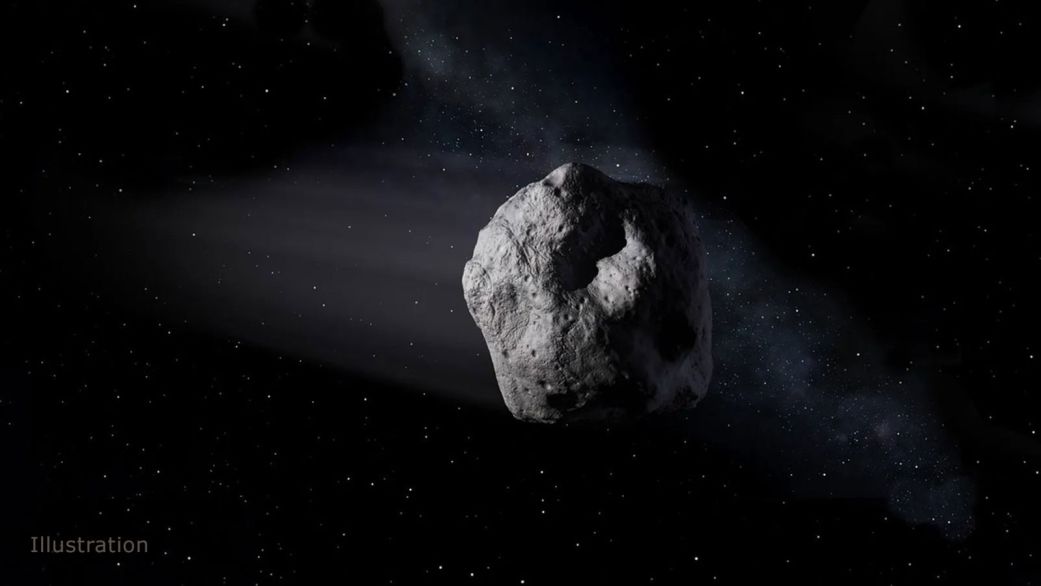
A Rare Orbital Companion Will Travel With Earth for the Next 50 Years
NASA has officially confirmed that Earth has gained a new quasi-moon, designated 2025 PN7, a celestial companion that will orbit alongside our planet for at least the next half-century. This discovery has captivated astronomers and space enthusiasts worldwide, marking a significant moment in near-Earth astronomy.
A quasi-moon is not a true moon like our familiar lunar companion but a small asteroid that orbits the Sun in a synchronized pattern with Earth. These objects remain gravitationally linked to our planet, following it around the Sun in a complex orbital dance. NASA’s latest data shows that 2025 PN7 will continue this synchronized path for roughly 50 years, making it one of the most stable quasi-moons ever identified.
What Exactly Is a Quasi-Moon?
A quasi-moon is a type of near-Earth object that shares Earth’s orbital period around the Sun. It doesn’t orbit Earth directly, but its path is influenced enough by our planet’s gravity that it appears to circle Earth from our perspective.
Characteristics of quasi-moons include:
- They orbit the Sun, not Earth
- They remain gravitationally linked to Earth
- Their orbits resemble looping patterns around our planet
- They are temporary companions, staying for decades or centuries
NASA has documented only a handful of quasi-moons over the past few decades, making the discovery of 2025 PN7 a significant scientific event.
Details About 2025 PN7
Early observations indicate that the asteroid measures between 50 and 80 feet in diameter — comparable in size to previous known quasi-moons. Its orbit is extremely stable, meaning it’s expected to remain in a looping pattern around Earth until at least the 2070s.
NASA scientists note that:
- 2025 PN7 poses no risk of impacting Earth
- Its orbit is well understood and predictable
- It provides a rare opportunity to study near-Earth asteroids up close
- It may serve as a potential future exploration target
Researchers emphasize that 2025 PN7 is not on a collision course with Earth, a detail that often sparks public concern when new celestial objects are identified.
Why This Discovery Matters
The confirmation of a new quasi-moon offers exciting opportunities for scientific study. Because quasi-moons remain close to Earth for extended periods, they allow researchers to examine:
- Asteroid composition
- Near-Earth orbital mechanics
- Long-term orbital stability
- Potential future asteroid-capture missions
Quasi-moons also provide rare natural laboratories for understanding the origins of asteroids and their long-term interactions with planetary bodies.
How 2025 PN7 Was Discovered
The object was first detected by near-Earth tracking systems used by NASA and international observatories. Its unusual looping trajectory quickly caught astronomers’ attention, prompting deeper orbital analysis.
After weeks of observation, NASA’s Center for Near-Earth Object Studies (CNEOS) confirmed that 2025 PN7 meets all requirements for classification as a quasi-moon.
Will Quasi-Moons Replace Earth’s Moon?
No — quasi-moons do not behave like traditional moons and cannot replace our natural satellite. Earth’s true Moon is far larger, more stable, and gravitationally dominant. Quasi-moons are temporary visitors and much smaller, often only tens of meters across.
Still, their presence is scientifically valuable and enriches our understanding of the dynamic environment around our planet.
Could We Visit 2025 PN7 in the Future?
Space agencies have expressed interest in exploring small near-Earth asteroids, and 2025 PN7 presents a unique opportunity. Because its orbit keeps it close to Earth for decades, mission planners believe it could be an accessible target for:
- Robotic sample-return missions
- Surface-composition studies
- Testing new landing or capture technologies
- Astronaut training for future asteroid missions
Such missions could help prepare humanity for long-term asteroid-defense strategies and deep-space exploration.
A Rare and Fascinating Celestial Event
The confirmation of Earth’s new quasi-moon adds another chapter to our planet’s ongoing relationship with near-Earth objects. While small and temporary, these companions help scientists unlock secrets about our Solar System’s evolution and the behavior of asteroids that share our orbital neighborhood.
With 2025 PN7 set to accompany Earth for the next 50 years, astronomers are eager to study its movement, structure, and long-term stability.For more breaking science updates, space discoveries, and tech innovations, visit StartupNews.fyi.