

Nearly two years after the end of FY22, BYJU’S finally showed its financial picture for that fiscal year. The irony, given the losses of nearly $1 Bn in FY22 (INR 8,245 Cr to be precise), is that the company has had an even worse time of it.
In the past nearly 24 months, we have seen and reported about issues such as:
Almost all of this happened after FY22, but even then, the opening pages of the company’s FY22 financials and the notes from auditors is a sea of red flags — five separate violations of sections of Companies Act, 2013, and several instances of statutory dues and bad loans to subsidiaries.
For instance, the auditor claims that the consolidated financial statements provide details regarding key adverse financial parameters of the group as of March 2022, such as continuing net losses from operations, accumulated losses, and uncertainty related to the litigation with the Term Loan B lenders.
“These events and conditions indicate that a material uncertainty exists that may cast significant doubt on the group’s ability to continue as a going concern,” M S K A & Associates said in the filings.
Even though the auditor claims that the management has undertaken various measures to improve its operating financial condition and is in the process of securing necessary funding arrangements and exploring sale of assets as needed, there are serious concerns about how long BYJU’S can continue to survive at the pace it set in FY22.
The situation for BYJU’S is further complicated by the fact that it had a lengthy list of dues to be recovered (nearly INR 3,800 Cr) at the end of FY22, the final status of which cannot be confirmed.
A large part of the dues receivable are from subsidiaries (Toppr and WhiteHat Jr among others) which have borrowed huge sums from the parent. The auditor’s notes before the financial statements show exactly how deep a hole BYJU’S finds itself in when it comes to recovering these dues, many of which are to loss-making entities.
The others are potential statutory dues owed by the company to tax authorities, for provident fund payments, and even some potential dues for violation of sections of the Companies Act, 2013.
Loss-Making Subsidiaries Prove Costly For BYJU’S
Let’s start with the smallest loan amount due for repayment by a subsidiary. BYJU’S parent company Think & Learn Private Limited acquired Mumbai-based Toppr for a reported $150 Mn in July 2021.
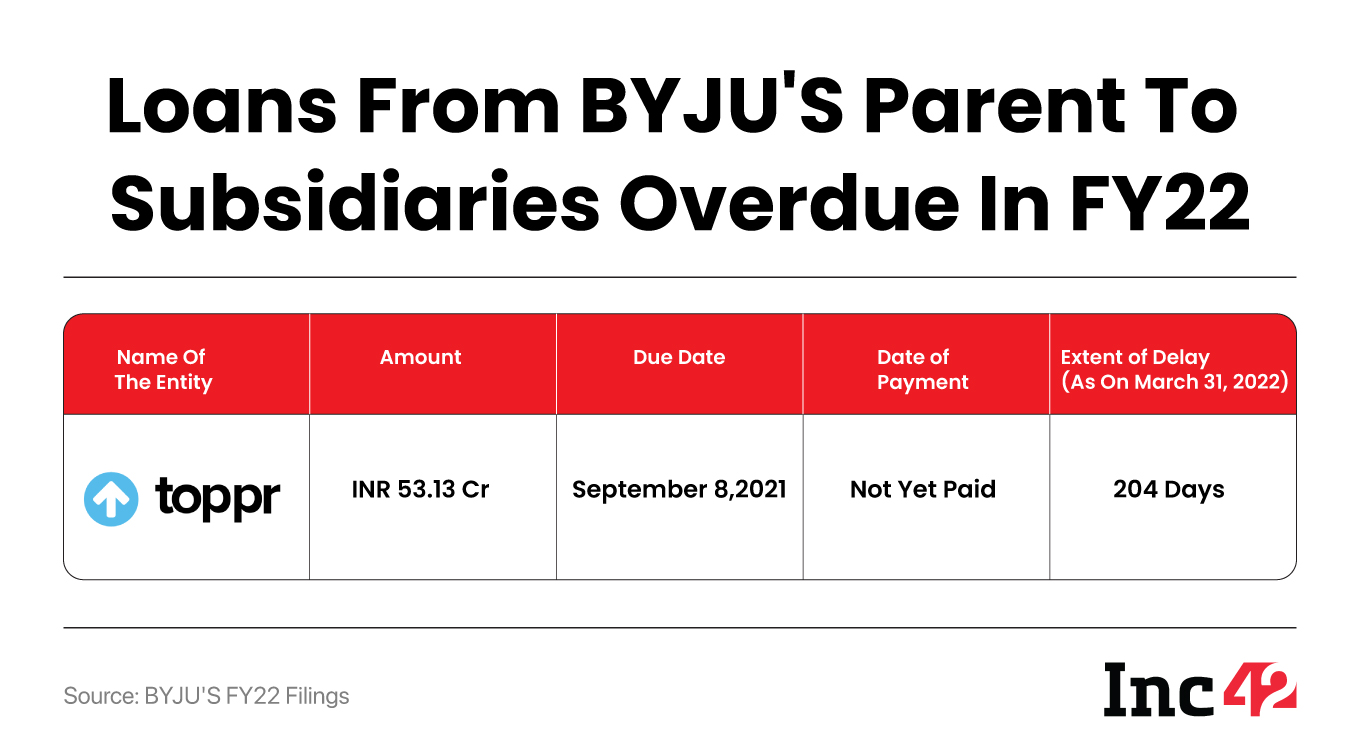
Since then, Toppr borrowed more than INR 280 Cr from Think & Learn. Of this, INR 53.13 Cr in principal amount and interest is due from Toppr for 204 days (as of March 31, 2022). “The borrowers have not repaid the principal amount as stipulated and have also not been regular in the payment of interest to the Company,“ the auditor said.
Besides this, Think & Learn granted a loan of INR 233 Cr to Toppr in violation of Section 185 of the Companies Act, 2013. As per this section, shareholders’ resolution needs to be passed before a loan is granted. However, the shareholders’ resolution was only passed in July 2022, i.e., in FY23, nearly a year after Toppr was acquired.
BYJU’S was on an unprecedented acquisition spree in 2021 when it acquired 10 companies, most of which are loss-making even today.
Section 185 violations were also noted in one of the loans given to WhiteHat Jr as well as another loan to Grade Stack Learning Private Limited, the parent company of GradeUp.
BYJU’S lent INR 2,526.40 Cr to WhiteHat Jr in FY22, of which INR 1,735.05 Cr was due as of March 31, 2022. GradeUp borrowed INR 96 Cr from BYJU’S in the fiscal year, all of which was due at the end of FY22.
Incidentally, GradeUp is one of two companies stated as being under liquidation in FY22. We covered the company’s FY23 financial statements, which indicate the liquidation was not completed at least till March 2023.
WhiteHat Jr, a $300 Mn (approximately INR 2,100 Cr at the time of acquisition) purchase, has also seen itself being named in a violation of Section 186 of the Companies Act, 2013. This section governs loans to subsidiaries at interest rates lower than prevailing yield of a 5-year government bond.
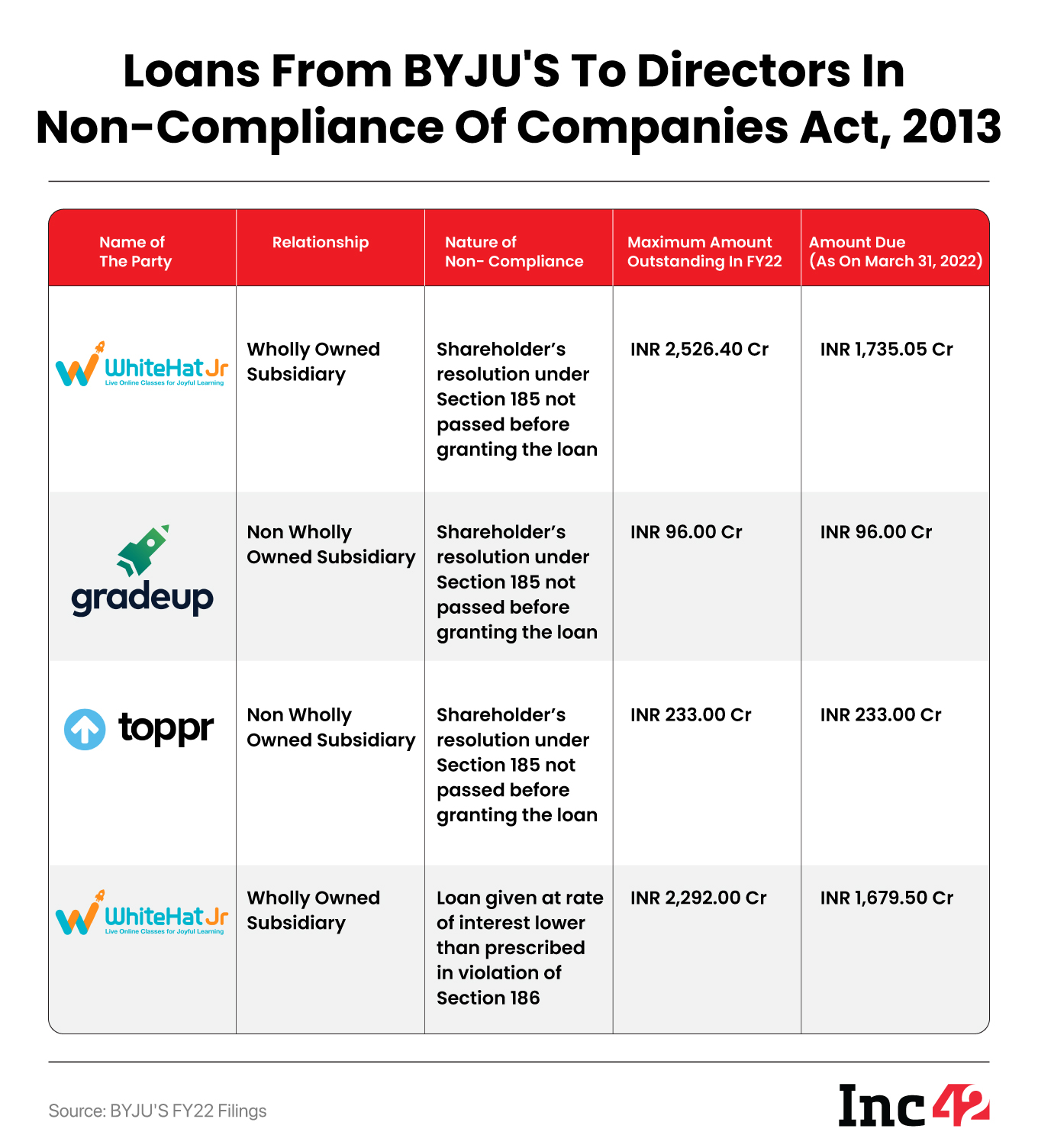
“Total loan amount granted INR 2,292.90 crores and balance outstanding as at balance sheet date INR 2,292.90 are prejudicial to the Company’s interest on account of the fact that loan has been granted at an interest rate of 6.25% per annum which is lower than the prevailing yield of 7.20% per annum,” as per the auditor.
Of the INR 2,292 Cr borrowed by WhiteHat Jr, an amount of INR 1,679.50 Cr was due as of the end of FY22. It’s not clear whether this has been repaid by WhiteHat Jr, which has not filed its standalone financials for FY23.
However, in FY22, the coding edtech startup saw a 25%+ drop in revenue from INR 484 Cr to INR 356 Cr, and WhiteHat Jr’s standalone losses increased to INR 2,692 Cr from INR 1,690 Cr. The acquisition has continued to underperform for BYJU’S despite being one of the biggest deals in the Indian startup ecosystem.
Statutory Dues, Potential FEMA Violation
The borrowings by subsidiaries are significant but BYJU’S has also been among the headlines for violating sections of the Companies Act pertaining to statutory dues and contributions by a registered company.
“In respect of provident fund, during the year, the company is irregular in depositing the amounts with the authorities with delays ranging from 1 to 604 days,” said the auditor.
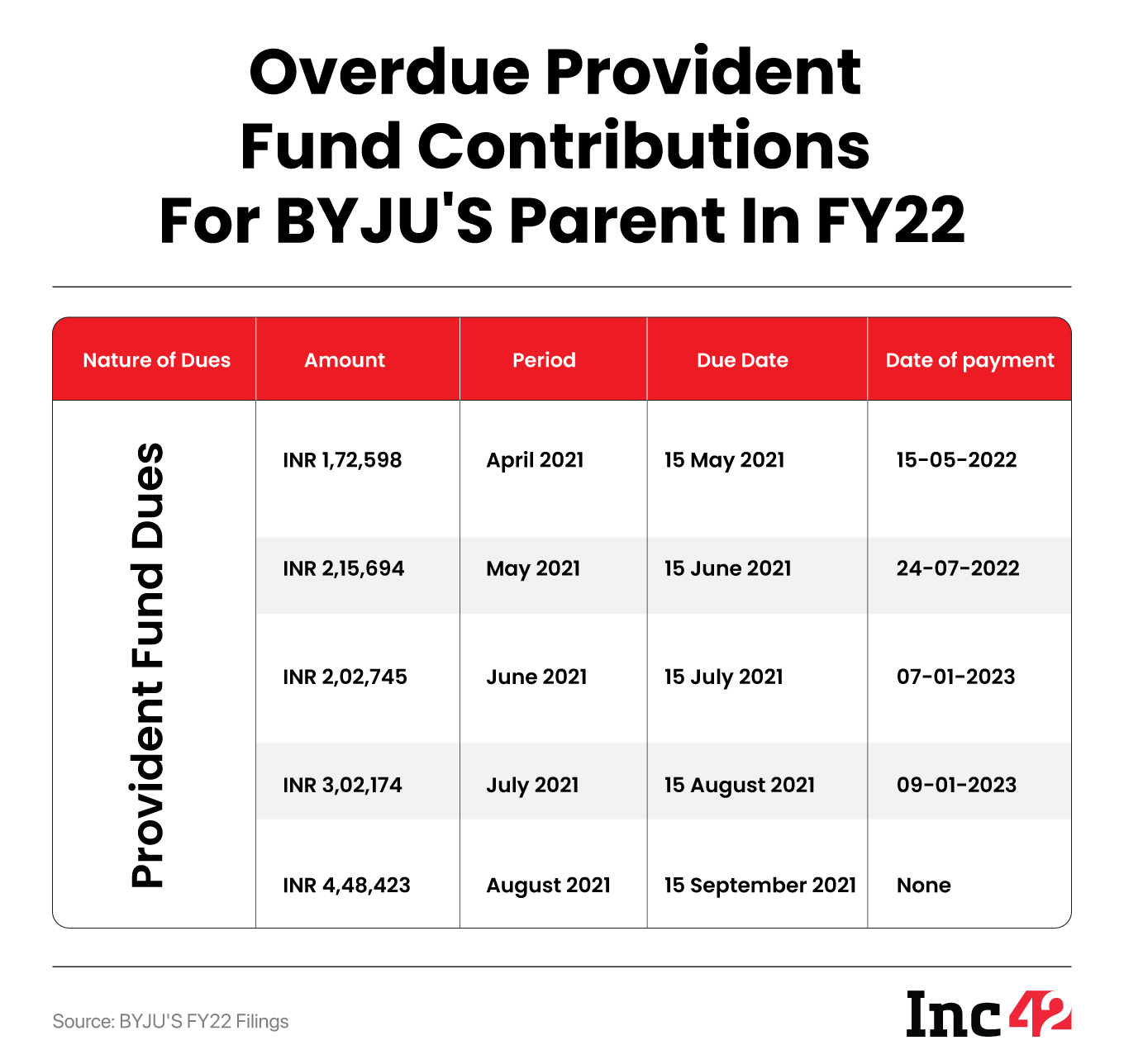
Of the five entries for delayed PF contribution deposits, the largest sum is yet to be paid by the company. The other four delayed payments were made in FY23, as per the filings.
Even after FY22, PF contributions have not regularised. In late 2023, it emerged that the company did not deposit its contribution in the EPFO accounts of employees since August despite deducting the amount from their salaries.
The company deposited INR 63.8 Cr for the first six months of 2023, as against INR 200.6 Cr for calendar year 2022.
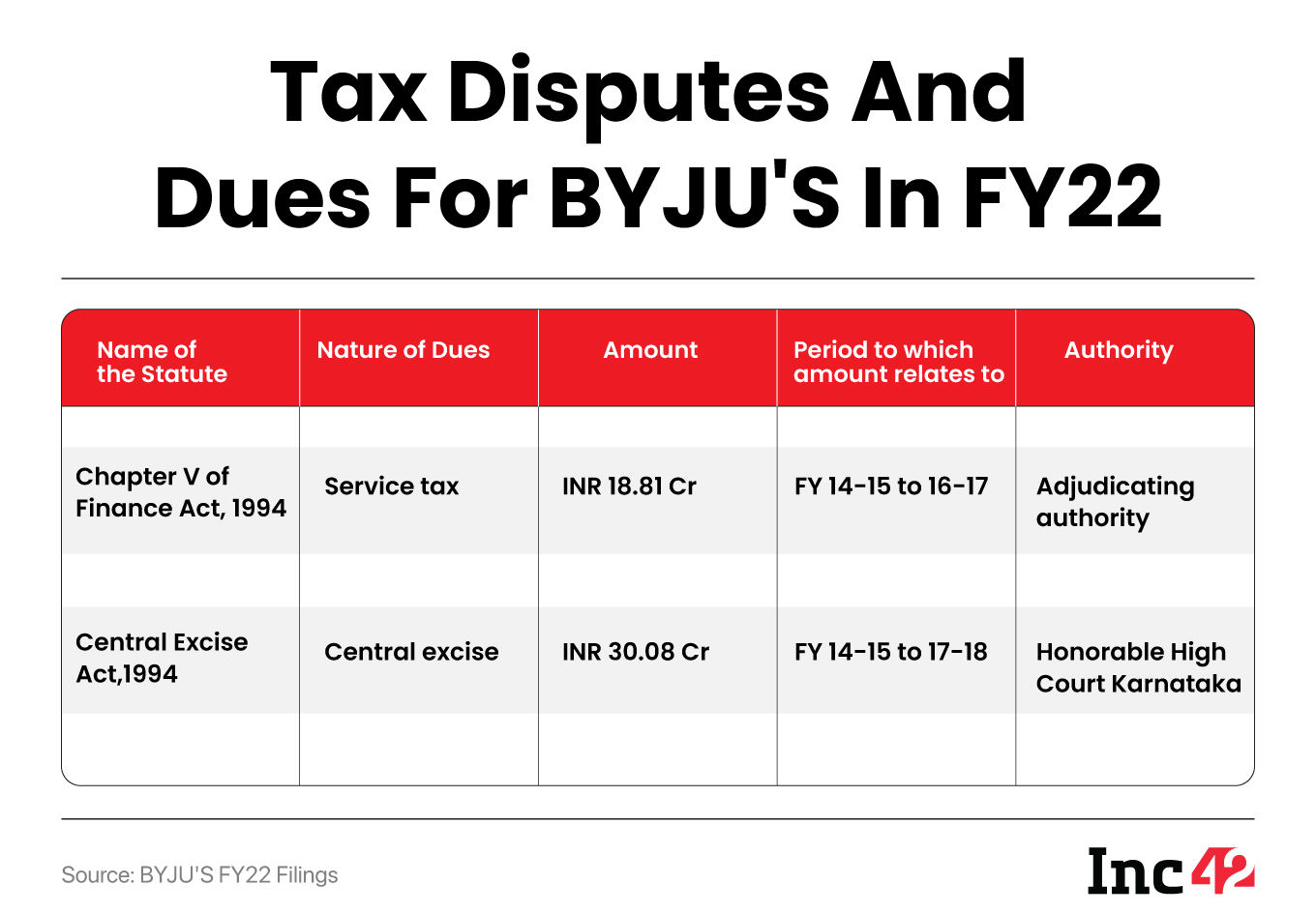
Besides this, the company told auditors it has not deposited some statutory dues because of disputes with tax and excise authorities.
Finally, there is a major red flag pointed out by the auditor. This is potentially linked to the show cause notices sent to BYJU’S parent Think & Learn Private Limited and group CEO Raveendran by the Enforcement Directorate (ED).
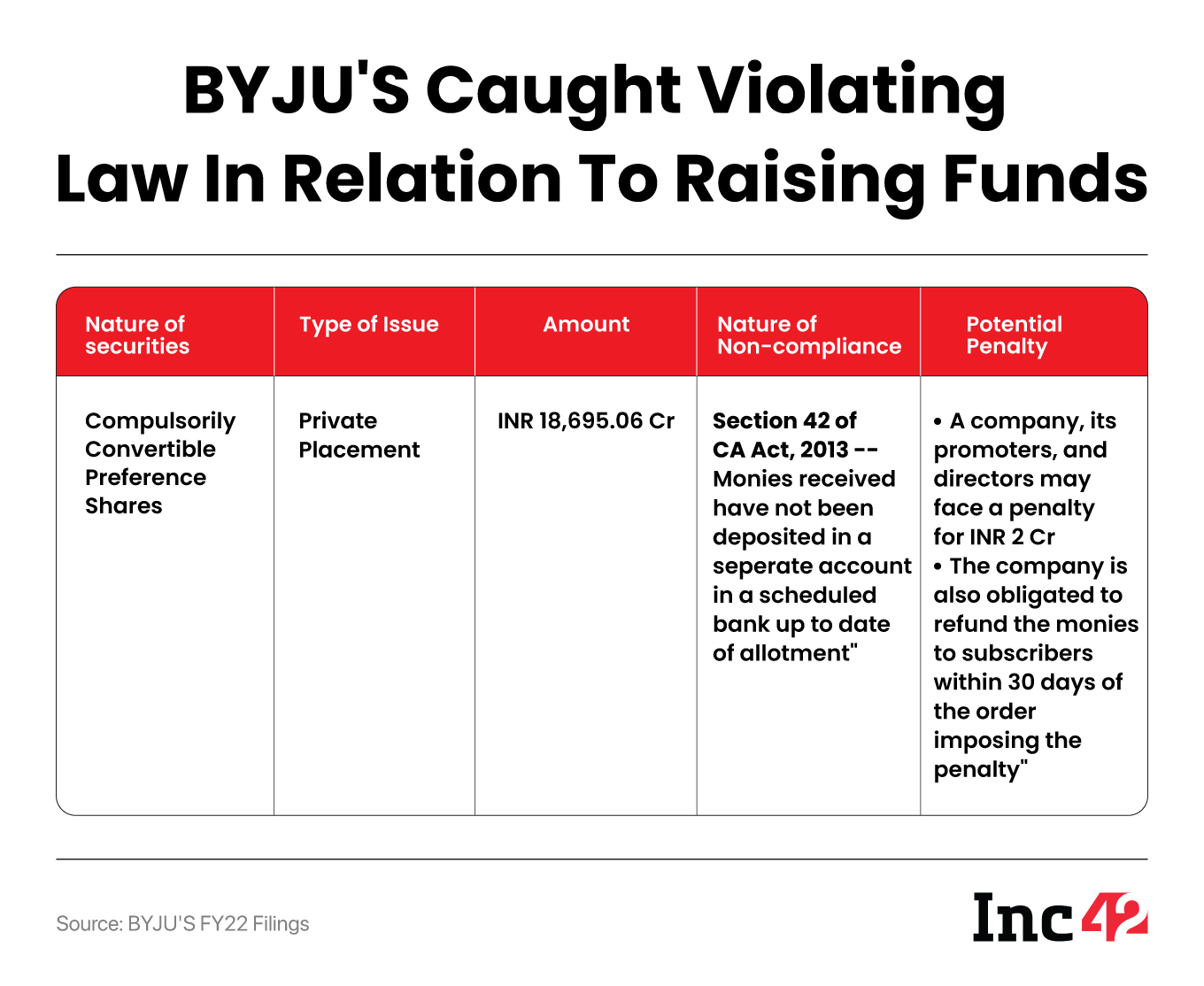
Referring to non-compliance with Section 42 of the Companies Act, BYJU’S auditor said that the company raised funds through a private placement offer but the monies received were not deposited in a separate bank account.
In November last year, the adjudicating authority under the Foreign Exchange Management Act (FEMA), 1999 issued show cause notices on the basis of the complaint filed by the Enforcement Directorate (ED). The company is alleged to have contravened the provisions of FEMA to the tune of INR 9,362.35 Cr.
Interestingly INR 9,362 Cr is roughly half of the total amount of INR 18,695 Cr flagged by BYJU’S auditor for FY22.
Violators of Section 42 could face a maximum penalty of INR 2 Cr, while companies are also obligated to refund the monies raised to subscribers (aka investors) of the issue within 30 days of the order for penalty.
Does the FEMA notice indicate that BYJU’S violated the clauses pertaining to refunding the capital to subscribers?
Even though the auditor has also stated that the management of the company has undertaken various measures to improve its operating financial condition and is in the process of securing necessary funding arrangements, these observations still have to be seen from the lens of FY22.
We know the situation at the company has not changed much in the past two years. There’s still the matter of the FY23 financials where we are likely to get a fuller picture, but there’s still no certainty on when that will come.
In the meanwhile, since FY22, the company’s governance situation has worsened; there’s a new leadership in place; layoffs at BYJU’S are becoming more and more frequent. The financials just confirm how deep the rot is.







