
10th Indian Delegation to Dubai, Gitex & Expand North Star – World’s Largest Startup Investor Connect
Travel

CaratLane Founder Mithun Sacheti Sets Up Investment Firm


SUMMARY

Besides Mithun Sacheti, his brother Siddhartha Sacheti, the CEO of the family-owned Jaipur Gems, is part of the new entity

Registered in Chennai, Finqube will handle the duo’s investments in early and growth stage companies, according to sources

Mithun Sacheti declined to elaborate on Finqube Capital’s plans, and told Inc42 that there are no plans to launch a separate fund at the moment

Caratlane founder Mithun Sacheti and brother Siddhartha Sacheti, CEO of Jaipur Gems, have set up an investment firm Finqube Capital Private Limited looking to institutionalise their angel investments, as per sources familiar with the matter.

Registered in Chennai, Finqube will handle the duo’s investments in early and growth stage companies.

As per sources, the two investments by the Sacheti brothers, including their participation in listed gaming giant Nazara’s INR 900 Cr preferential rights issue as well as the investment in Ippopay are from the new firm, which could take on the shape of a family office or a corporate venture fund.

Mithun Sacheti declined to elaborate on Finqube Capital’s plans, and told Inc42 that there are no plans to launch a separate fund at the moment.

However, as per incorporation documents of Finqube Capital Private Limited, the company has been registered as an investment firm for acquisition, investment purposes. It’s not yet clear what structure will be adopted by Finqube.

“This could be a private investment vehicle or a corporate venture fund backed by Jaipur Gems. The brothers are in the process of setting up teams for this firm,” sources close to the Sacheti family said.

It must be noted that Jaipur Gems is the legacy business set up by the Sacheti family in 1974. While the brothers joined this family business initially, Mithun went on to set up CaratLane as a new-age jewellery platform.

Siddhartha’s son Yash Sacheti is closely involved with Finqube and is the primary contact for the entity, as per MCA disclosures. Plus, according to his LinkedIn profile, Yash is currently the head of the Sacheti Family Office.

Notably, Mithun and Siddhartha are both active angel investors in Indian startups. Their portfolio includes investments in Ippopay, Bombay Shirt Company, Nazara and Oro. Besides investing with his brother in these startups, Mithun has separately backed home decor startup Arrivae, cybersecurity SaaS platform Securden, marketing tech startup Paperflite among others.

In February this year, Titan completed its acquisition of CaratLane, which gave Mithun a remarkable exit, netting returns of INR 4,621 Cr for his 27% stake.

Mithun has publicly stated his ambition to become a full time investor and is looking to add to his various investments across fintech, SaaS, gaming, ecommerce and other sectors.  He also said that he is keen on investing in startups in the INR 100 Cr-INR 200 Cr revenue range in the D2C category.

While Finqube Capital is yet to launch officially, Mithun is the general partner at Singularity Growth Ventures, which is backed by Madhusudhan Kela. The CaratLane founder is also an anchor investor or limited partner in early stage fund Xeed Ventures.

Sacheti Brothers Double Down On Investments
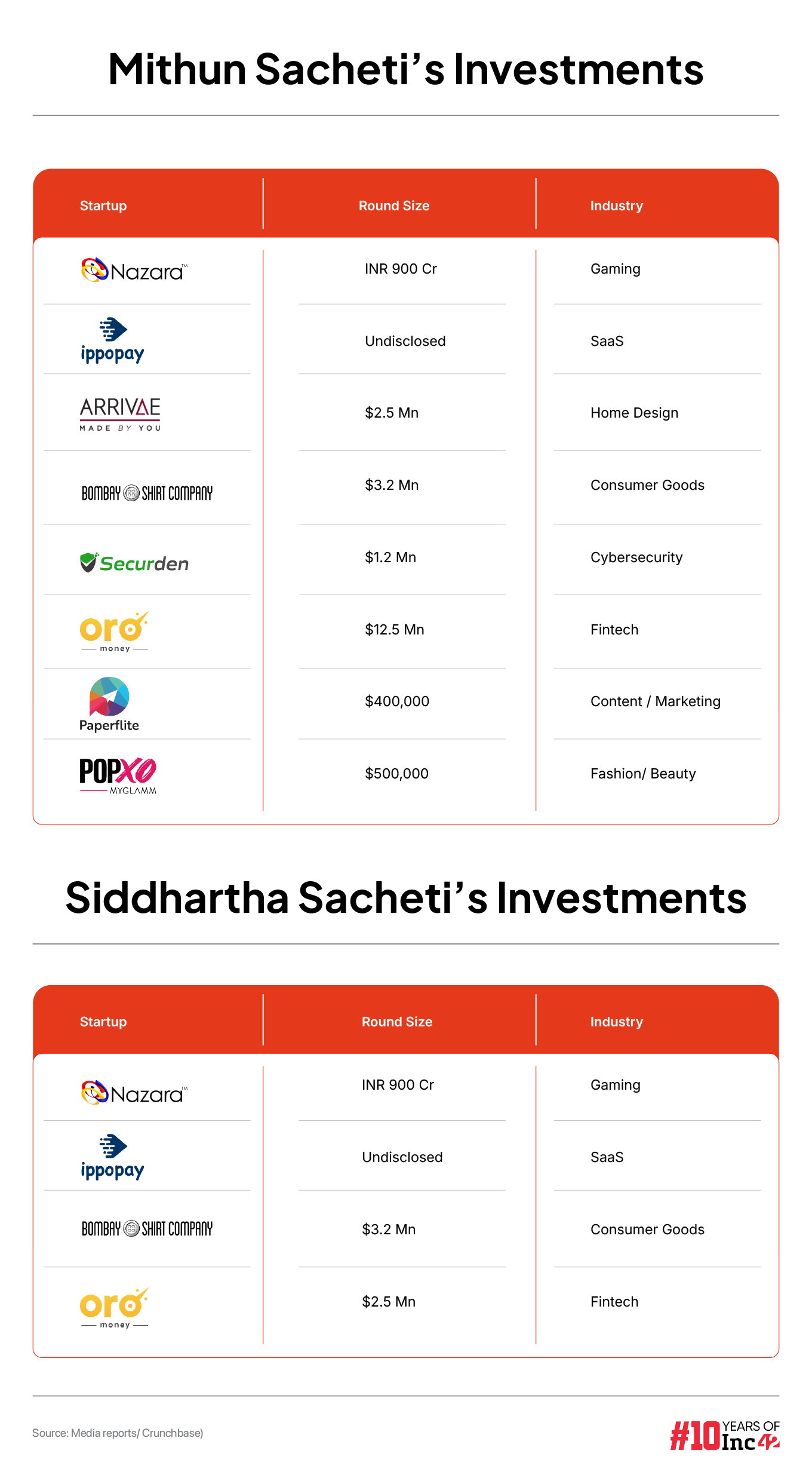
It looks like the Sacheti brothers are following the playbook created by Zerodha founders Nithin Kamath and Nikhil Kamath who set up Rainmatter Fund in 2016. Over the past few years, Rainmatter has invested in fintech, climate tech, media and agritech sectors. Rainmatter currently has a corpus of INR 1000 Cr

Besides Rainmatter, Nikhil announced the launch of WTF Fund to invest in entrepreneurs under the age of 25.

While Zerodha was a completely bootstrapped business, the Sacheti brothers have the experience of running a legacy family business for many decades.

“There is a similar trajectory, and Sacheti brothers could very well follow the Kamath brothers. Nithin and Nikhil Kamath were both active angel investors before they formally launched Rainmatter” a fintech founder turned VC manager added.

Modelled as a corporate venture fund, Rainmatter has deployed INR 400 Cr across various portfolio companies, mostly early-stage bets.

Sacheti has often talked about the need for more VCs with an operator or founder mindset as this allows them to take nuanced bets on startups.

Mithun’s exit from CaratLane is one of the largest in the Indian startup ecosystem for a founder, after Sachin Bansal and Binny Bansal made a huge windfall from the Walmart acquisition of Flipkart in 2018.

Sachin Bansal and Binny Bansal have gone on to become serial investors in many startups after their successful exit from Flipkart. Other entrepreneurs such as Freshworks CEO Girish Mathrubootham have also floated funds. Mathrubootham’s Together Fund largely invests in early stage SaaS startups.

Similar to the Sacheti brothers, Snapdeal founders Rohit Bansal and Kunal Bahl set up Titan Capital to manage their angel investments, which were being managed separately previously. Titan Capital has gone on to become an institutional VC firm with multiple funds, and has a SEBI-registered AIF licence for its growth-stage fund.

[Edited By Nikhil Subramaniam]



Source link

by Honey

Jetstar’s Big Move: Avalon Takes Off Internationally In a major win for Victorian travelers, Jetstar Airways has unveiled an ambitious expansion plan at Avalon Airport, set to reshape regional aviation from 2026 onward. The low-cost carrier announced it will launch its first-ever international flights from Avalon, connecting the airport directly to Bali (Denpasar) — one of Australia’s most popular leisure destinations. Alongside this exciting addition, Jetstar will also reinstate its Avalon–Adelaide route, which was suspended during the COVID-19 pandemic, and increase the frequency of Avalon–Brisbane services to meet surging passenger demand. The announcement represents a pivotal milestone for both Jetstar and Avalon Airport, which has long sought to expand its global footprint. The introduction of international routes marks the next phase of Avalon’s growth strategy — positioning it as a strong secondary airport option to Melbourne’s Tullamarine. Avalon Airport: From Domestic Hub to International Gateway Avalon Airport’s journey toward becoming an international gateway has been a long time coming. The introduction of Jetstar’s Bali flights cements its status as a crucial player in regional connectivity and tourism development. For Geelong and western Melbourne residents, the new service provides convenient and affordable access to one of Asia’s most beloved holiday destinations. According to Avalon Airport management, the Avalon–Bali route will not only attract thousands of leisure travelers but also strengthen tourism and economic ties between Victoria and Indonesia. Local businesses, particularly in the hospitality and tourism sectors, are expected to benefit from increased visitor flow. “The demand for outbound leisure travel remains exceptionally strong, and Bali continues to be a top destination for Australians,” said a Jetstar spokesperson. “Avalon is ideally located to serve both regional Victoria and Melbourne’s west, and these new services will make international travel more accessible and affordable for everyone.” Reconnecting Australia: Adelaide and Brisbane Routes Boost Domestic Travel Beyond international expansion, Jetstar’s decision to restart the Avalon–Adelaide route has been welcomed by frequent flyers and regional businesses alike. The route, which ceased operations during the pandemic, had long been a staple connection between Victoria and South Australia. Its return highlights Jetstar’s commitment to rebuilding domestic travel networks that were disrupted by COVID-19. Additionally, the airline plans to add more Avalon–Brisbane flights, responding to a sharp rise in domestic travel demand. This move will enhance connectivity between key eastern cities, providing travelers with more flexible and cost-effective options. Analysts believe Jetstar’s growing presence at Avalon could lead to more destinations being added in the coming years, transforming the airport into a vital hub for both domestic and short-haul international routes. Infrastructure Upgrades: Avalon Gets a Public Transport Link To complement Jetstar’s expansion, Avalon Airport is also set to receive a long-awaited public transport connection, improving accessibility for passengers traveling from Geelong and Melbourne. The new bus service will make it easier for travelers to reach the airport, which has previously faced criticism for limited transport options. The introduction of this link is seen as a crucial step toward making Avalon more competitive with larger airports. “Connectivity has …

by Honey

Jetstar’s Big Move: Avalon Takes Off Internationally In a major win for Victorian travelers, Jetstar Airways has unveiled an ambitious expansion plan at Avalon Airport, set to reshape regional aviation from 2026 onward. The low-cost carrier announced it will launch its first-ever international flights from Avalon, connecting the airport directly to Bali (Denpasar) — one of Australia’s most popular leisure destinations. Alongside this exciting addition, Jetstar will also reinstate its Avalon–Adelaide route, which was suspended during the COVID-19 pandemic, and increase the frequency of Avalon–Brisbane services to meet surging passenger demand. The announcement represents a pivotal milestone for both Jetstar and Avalon Airport, which has long sought to expand its global footprint. The introduction of international routes marks the next phase of Avalon’s growth strategy — positioning it as a strong secondary airport option to Melbourne’s Tullamarine. Avalon Airport: From Domestic Hub to International Gateway Avalon Airport’s journey toward becoming an international gateway has been a long time coming. The introduction of Jetstar’s Bali flights cements its status as a crucial player in regional connectivity and tourism development. For Geelong and western Melbourne residents, the new service provides convenient and affordable access to one of Asia’s most beloved holiday destinations. According to Avalon Airport management, the Avalon–Bali route will not only attract thousands of leisure travelers but also strengthen tourism and economic ties between Victoria and Indonesia. Local businesses, particularly in the hospitality and tourism sectors, are expected to benefit from increased visitor flow. “The demand for outbound leisure travel remains exceptionally strong, and Bali continues to be a top destination for Australians,” said a Jetstar spokesperson. “Avalon is ideally located to serve both regional Victoria and Melbourne’s west, and these new services will make international travel more accessible and affordable for everyone.” Reconnecting Australia: Adelaide and Brisbane Routes Boost Domestic Travel Beyond international expansion, Jetstar’s decision to restart the Avalon–Adelaide route has been welcomed by frequent flyers and regional businesses alike. The route, which ceased operations during the pandemic, had long been a staple connection between Victoria and South Australia. Its return highlights Jetstar’s commitment to rebuilding domestic travel networks that were disrupted by COVID-19. Additionally, the airline plans to add more Avalon–Brisbane flights, responding to a sharp rise in domestic travel demand. This move will enhance connectivity between key eastern cities, providing travelers with more flexible and cost-effective options. Analysts believe Jetstar’s growing presence at Avalon could lead to more destinations being added in the coming years, transforming the airport into a vital hub for both domestic and short-haul international routes. Infrastructure Upgrades: Avalon Gets a Public Transport Link To complement Jetstar’s expansion, Avalon Airport is also set to receive a long-awaited public transport connection, improving accessibility for passengers traveling from Geelong and Melbourne. The new bus service will make it easier for travelers to reach the airport, which has previously faced criticism for limited transport options. The introduction of this link is seen as a crucial step toward making Avalon more competitive with larger airports. “Connectivity has …

by INC42

When Thirukkurungudi Vengaram Sundram Iyengar, the Indian industrialist who founded the TVS Group, introduced intercity passenger bus service in Tamil Nadu in 1912, India barely had any organised bus services. At the time, most people relied on trains for long-distance travel and bullock carts for shorter routes, while motor cars were accessible only to a wealthy few. Today, 40% of India’s road-based travel demand comprises buses. While a large part of this percentage consists of unorganised, local players, tech-driven companies are… Source link






