

Is there anything better than a flawlessly crafted cup of coffee? While the question is rhetorical, what could disappoint a coffee lover is the quest to find a cup of speciality coffee that is not only brewed to perfection but also gentle on the pocket.
While traditional players like Nestlé, HUL and Tata rule the instant coffee domain with an iron fist in the country’s rapidly expanding $500 Mn coffee market, new-age D2C brands, such as SLAY Coffee, Third Wave Coffee, Rage Coffee, and Blue Tokai, are making waves with unique blends, aromas, and innovative cultivation and processing techniques.
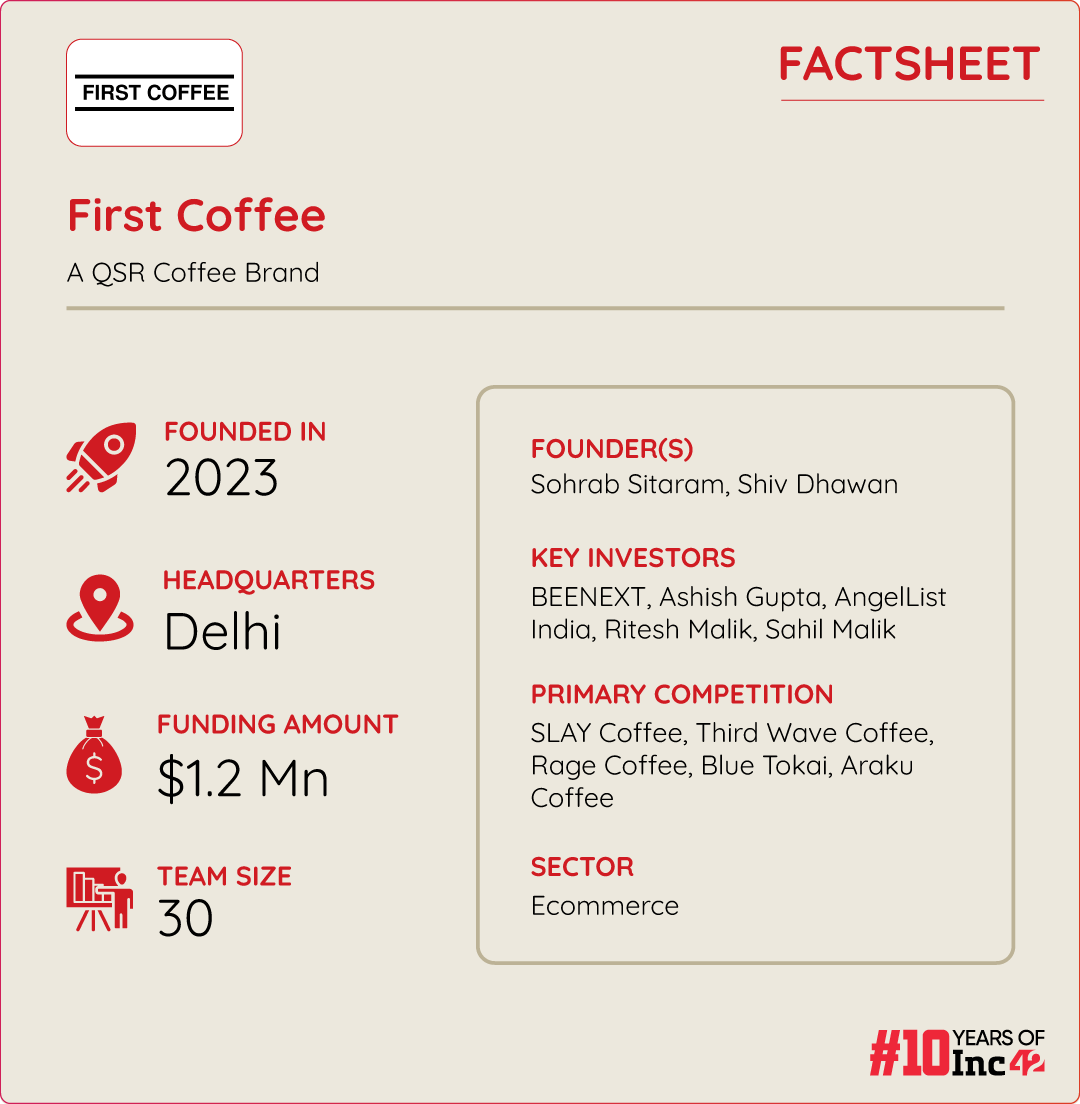
In this crowded space, a new entrant has emerged with its ‘grab-and-go’ concept to establish its dominion over the market. Founded in 2023 by entrepreneurs Sohrab Sitaram and Shiv Dhawan, First Coffee is a speciality coffee brand that claims to offer high-quality coffee at competitive prices.
“Everyone in the market was focussing on large-format stores, selling coffee at around INR 250-INR 300. We realised we could disrupt the market with our expertise, all while focussing on the product rather than the store experience and keeping the prices competitive,” Shiv Dhawan cofounder of First Coffee said.
The brand is currently 25% cheaper than other speciality coffee players in the market but is priced higher than existing grab-and-go coffee brands like UpCoffee. The company claims to source its beans from Harley Coffee Estate in Chikkamagaluru, Karnataka.
Currently operating in Delhi NCR, First Coffee has three outlets and plans to launch delivery services this month through Zomato, Swiggy, and Magicpin. Besides speciality coffee, First Coffee offers packaged beans, powder, and merchandise.
With a core target on the younger generation, the brand also has its merchandise range, which comprises t-shirts, caps, tumblers, mugs, cups, and totes.
In September, the quick-service restaurant (QSR) chain raised $1.2 Mn in a seed round led by early-stage investment firm BEENEXT. The round also saw participation from investors such as Ashish Gupta of Helion Venture Partners, AngelList India, Innov8 Capital’s cofounder Ritesh Malik, and Da Milano’s Sahil Malik.
Brewing Up First Coffee
The journey of First Coffee began in 2022 when childhood friends Dhawan and Sitaram reunited after about a decade. Little did they know that their reunion would spark the creation of First Coffee.
At the time, Dhawan, an early-stage investor with 25-30 years of experience in retail and hospitality, had just returned to India after completing his MPhil from Cambridge and Sitaram was busy running his successful milkshake brand and chain of restaurants and kiosks, Keventers, as a cofounder.
During this time, Dhawan told Sitaram that he was looking to launch a venture, and as luck would have it, Sitaram, too, was looking to try something new. Therefore, the duo decided to combine their expertise in QSR and retail to start a new venture.
However, the next challenge was deciding what to launch, although they were certain of one thing — to create something unique that the country was missing. After extensive research, they zeroed in on entering the coffee market.
“Everyone was following the large-format store model and selling coffee at a very high price point. From Starbucks to Third Wave, everyone was doing something similar, but we wanted to do something different,” the cofounder said.
From there, the cofounders delved deeper to find a differentiation for the brand and started exploring plantations across India and travelling to countries in Southeast Asia, Europe, and America. They visited numerous coffee shops, met coffee entrepreneurs and attended several coffee events and festivals.
Soon after their research, they concluded three things. First, they wanted to target the GenZ population and craft brand communication that resonated with them. Second, they aimed to bring in specialty coffee, which as per the brand, only a few were doing. Lastly, they realised that the new wave of coffee consumers prioritised product quality over in-store experience. Therefore, they opted for a grab-and-go business model instead of large-format coffee cafes.
Finally, in June 2023, they brought the idea of First Coffee to life, but the startup became operational only in April 2024 with the launch of its three stores.
How First Coffee Found Its Perfect Coffee Roast
Although the founders had a clear vision for the product and experience they wanted to offer, the real journey began once they brought all these concepts together.
For starters, they knew that to stand out as a speciality coffee brand, they needed to excel on the Specialty Coffee Association (SCA) scale, where Araku had the highest ranking.
This challenge was soon overcome after they met Chandani, the owner of the 300-year-old Harley Coffee Estate, who is also an investor in the brand.
With the help of Chandani, the cofounders developed a coffee roast that scored 91 on the SCA scale, surpassing the then-89 score of Araku coffee.
According to the founders, First Coffee brews coffee that consistently scores between 85 and 91 on the SCA’s 100-point scale, which evaluates brewed coffee based on its aroma, sweetness, and acidity.
Once their speciality coffee was finalised, the cofounders shifted focus to the retail model. “We didn’t want to go for a large retail store model with high SKUs and several people working in the kitchen. Instead, we opted for the ‘grab and go’ concept, considering that it is preferred by the younger consumers,” the cofounder said.
With this in mind, they launched a grab-and-go truck in DLF Cyberpark (Gurugram), which is also their most popular outlet. Their second outlet is at Pacific Mall in Jasola. It attracts higher traffic on weekends, while the third is a smaller cafe in Delhi’s Netaji Subhash Place.
To engage Gen Z customers, the founders launched a merchandise range of about 300 items, which has completely sold out since the start. Besides this, the startup aims to invest heavily in technology. Currently, it uses advanced Eversys coffee machines to ensure that all the flavour of its speciality coffee is preserved.
As per the brand, these machines are known for their precision and consistency and deliver uniform quality with every cup. These machines use cutting-edge technology, such as automated tamping and milk frothing, which replicate the skills of a trained barista. This technology ensures that each cup is made to perfection, with minimal human error.
What’s Next For First Coffee
In the highly competitive coffee market, the brand aims to position itself as a GenZ-centric brand. To achieve this, it aggressively pursues loyalty programmes to onboard customers, focussing on events and concerts. The brand wants to be present at every rap and rock concert, including the Diljit Dosanjh concert.
It seems like this strategy is proving effective so far for the cofounders. It’s only been five months since the launch, and the brand claims to have already generated INR 1 Cr in revenue across its three stores.
According to the founder, the average order value is approximately INR 380 to INR 400, with daily sales ranging from 90 to 120 cups.
“Our current three stores have seen 25% month-on-month growth and with the deliveries starting soon we will be able to exceed INR 40 Cr in FY25,” said Sitaram.
The founders are also planning to launch 30 to 35 stores by the end of 2025. According to the founder, most of these stores will be staffed by only two people, as they do not want to overstaff the locations and focus more on the technology front. They are also working on developing an app that will serve as its primary platform for ordering. Moreover, going forward the startup will also be focusing heavily on merchandising, as the founders are seeing a lot of traction in this area.
Overall, First Coffee seems to have cracked the code of the country’s booming coffee market with its grab-and-go model, a commitment to price and quality, and a strong focus on connecting with Gen Z.
By focusing on product quality and technology, the brand aims to make speciality coffee more accessible and attractive to a new generation of coffee enthusiasts. As First Coffee scales, its journey will be one to watch, especially as it continues to bring a fresh vibe to India’s coffee culture.
[Edited By Shishir Parasher]







