

“You either die a hero or live long enough to see yourself become the villain.” – The Dark Knight (2008)
That’s the sentiment of many BluSmart customers this week, as the EV cab-hailing startup introduced what it describes as ‘Rush Hour pricing’. Naturally, now many are asking how BluSmart is different from Ola or Uber, the duopoly that it was touted to break.
The Delhi NCR-headquartered company ruffled quite a few feathers, but as we have been saying for months now, the introduction of Rush Hour pricing was expected. The current market conditions do not afford companies the luxury to sit on their revenue pile and burn cash to acquire new users. BluSmart is just doing what a lot of other consumer tech and services companies started last year.
- GenAI’s Moment To Shine: From which niches Indian startups can occupy to new AI-centric leadership roles and global AI regulations opportunity, here is what will make the generative AI revolution tick in 2024
- Ola Electric’s IPO Bumps: Having failed to impress in the grey market, Ola Electric seems to have a number of red flags for investors and there are serious questions about the IPO pricing and valuation
- ChrysCapital’s India Playbook: How the 25-year-old PE firm has fueled the growth of IPO-bound Awfis and FirstCry as well as unicorns such as Dream11 and Lenskart and where it sees Indian tech going next
BluSmart’s ‘Rush Hour’ For Revenue
BluSmart is losing some of the karma that it has painstakingly gained in the past few years. Here’s how the company’s tack has changed with regards to Rush Hour pricing as BluSmart calls it.
June 2019: BluSmart cofounder Punit K Goyal said, “Our service will not have surge pricing and also Blu Smart cabs will be placed strategically so that they reach the user in 5-10 minutes and hence mitigate the two biggest customer pain points of long waiting times and costly price structure on the existing ride-hailing platforms.”
January 2024: The other BluSmart cofounder Anmol Singh Jaggi tweeted: “Surge price is unpredictable, our pricing is just a true and transparent reflection of effort by driver partners during rush hours. Surge is non-transparent & arbitrary, what BluSmart has done is to make it clear & upfront on what the pricing would be.”
Even as the company claims that this is a more transparent system, several customers pointed out that Rush Hour pricing is just a different label for Surge pricing.
BluSmart has designated certain times of the day as Rush Hour for airport rides and intracity rides. The explanation is that this is the time when demand is highest. This is essentially the same rationale used by Ola or Uber for Surge pricing.
“BluSmart has introduced an industry-first fixed pricing structure for different times of the day for a transparent pricing future. Our new pricing policy ensures that our customers pay what they see on the app, maintaining fairness and consistency,” cofounder Anmol Singh Jaggi told Inc42.
BluSmart’s new fares for distances up to 3 Km is INR 199 during rush hours and INR 149 during relaxed hours. Incidentally, a few months before introducing Rush Hour pricing, BluSmart also reduced the base distance for its fares from 5 Km to 3 Km. The change introduced in October 2022 essentially means BluSmart’s minimum fare is applicable for a shorter distance, so a lot more users would be paying the minimum fare.
We asked BluSmart why it decided to add this premium to certain rides at this point of time, when it is already more expensive compared to Ola and Uber. It seems like a major departure from its earlier steadfast defending of its ‘No surge pricing’ label.
BluSmart says it has taken into consideration many factors while deciding rush and relaxed hours, like consumer behaviour, time of the day, to understand the pattern of supply and demand through the day.
We also questioned how BluSmart distributes this premium from customers to its driver-partners. The company claimed it offers transparent and fixed pay and incentives to its drivers, but BluSmart driver partners in Delhi NCR have alleged from opacity in the incentive structure in recent months.
“Our Driver Partners compensation is competitive, and we undergo regular benchmarking exercises to ensure they are compensated well for their work. Our current driver partner earnings are a 50:50 between incentive component and fixed pay,” Jaggi clarified.
What’s clear is that Rush Hour pricing only makes BluSmart more expensive for its most active users. Of course, this won’t be the last consumer services platform — mobility or any other sector — to look at such strategies to get that all-important revenue boost.
In 2022, the company also launched an invite-only subscription plan which is now called Blu Elite (formerly Blu Prive). Customers can subscribe for a month, three months or six months to get perks such as extra waiting time when boarding a ride, ‘ride delay guarantees’, birthday discounts, intercity rides and also the ability to book recurring rides.
The Rush Hour pricing is regardless of whether a customer is a Blu Elite member or not.
Banking On Platform Fees
BluSmart is just the latest to introduce an additional fee for consumers. Consumer services giants across sectors are relying on extraneous charges for every order.
Food delivery rivals Swiggy and Zomato set the ball rolling with platform fees for every order, which have been doubled in less than a year. In many ways, this kind of price-fixing should attract the eye of the Competition Commission Of India.
The platform fee charged in addition to delivery fees, packaging fees and other variable costs for consumers is also applicable for Zomato Gold and Swiggy One loyalty programmes users. It’s arbitrary to say the least, since the actual charges are not fixed and change from restaurant to restaurant.
Besides this, we have seen Uber add a Booking fee, BigBasket charge handling fees, Zepto adding a convenience fee and even a surge fee just like Zomato-owned Blinkit or Swiggy’s Instamart. Myntra charges customers for product returns, once touted as the killer feature of the fashion ecommerce giant. Dunzo added additional costs such as handling fees, convenience charges and more even as it has not paid vendors and employees.
The era of platform fee has also resulted in new models such as Ola Prime Plus — a premium charged for no cancellations — or Namma Yatri’s subscription plans for driver-partners.
It’s a massive concern that platforms with millions of users and consumers can flip the switch arbitrarily without any notice on pricing and premium charges.
As we said last week, consumer services have long been loss-making because of the high cost of acquiring customers and retaining them. Platform fees, Surge charges or Rush Hour pricing are just different names to make each transaction more profitable. In the long run, this might very well be the key to becoming profitable.
Funding Blues
Coming back to BluSmart, the EV ride-hailing company has struggled to expand its fleet as per its past claims. In July 2022, the startup told Inc42 that it is in the process of raising $250 Mn from impact investors and PE firms, but this has not panned out.
“The $250 Mn round couldn’t close due to differences in the terms between the current and incoming shareholders. It was to come in Q3 FY23, despite that not happening with the fundraise the company has achieved fantastic growth. We have grown from 2,000 cars in Q3FY23 to close to 6,000 in Q3FY24,” the BluSmart cofounder revealed.
Ola and Uber seem to be on track to outpace BluSmart’s EV fleet in the next year. Uber made investments in Everest Fleet to add to its EV capacity, while Ola has twin acquisition channels — Ola Electric in the next few years and current electric car makers in India.
Ola and Uber have the scale needed to make a bigger EV push than BluSmart since they have pan-India operations, whereas BluSmart is currently only in Delhi NCR and Bengaluru. And it doesn’t help that a number of smaller EV ride-hailing companies are competing in the same markets as BluSmart.
The competition in its existing markets makes it harder for BluSmart to compete on pricing because users simply move to another EV platform. Plus, it would not be inexpensive to reacquire users after they have left for rivals.
BluSmart In Bullish Lane
In the past 16 months, BluSmart has raised just over $66 Mn in two rounds with some of this amount being venture debt. A bulk of this funding has come from the company’s founders and founding teams. The two cofounders hold approximately 35% stake in the company. Anmol Singh’s brother Puneet Singh Jaggi has 4% stake in BluSmart.
The $24 Mn round in December 2023 saw participation and over-subscription from its existing investors, founders and leadership team, the company claimed. Similarly, nearly 50% of its previous $42 Mn round in May 2023 was subscribed by the founders and leadership team.
Does this indicate shrinking interest from external investors who have not exactly been shy about backing electric vehicle operations and models? Or are investors turned off by the fact that BluSmart will continue to face stern competition from Uber and Ola even when it comes to EVs?
“Surge fees worked for Ola and Uber because there really weren’t many alternatives around at that time that could compete with them. BluSmart does not have this luxury, and it needs to open the revenue tap, especially if it hasn’t been able to raise funding to grow and expand,” says one mobility-focussed investor.
But cofounder Jaggi is confident about breaking even. The company claims gross trip value (GTV) was INR 162 Cr and loss of INR 215 Cr in FY23, and the fleet size had increased more than 3X between 2022 and 2023.
“The GTV has increased by 7X and our loss increased only by close to 2X. Thus, with large scale, BluSmart was able to achieve higher utilisation and bring down its losses. Within the first 6 months of FY24, we have already surpassed the entire GTV that we did in FY23,“ he added.
Now the real test for BluSmart would come in the months ahead when its relatively young business goes through the customer litmus test of Rush Hour pricing. Can the Ola-Uber rival keep its ride going?
Startups In The Spotlight: The Best Of Inc42’s ‘30 Startups To Watch’
Inc42’s much-watched ’30 Startups To Watch’ series touched another milestone in 2023, with 1200+ startups being discovered over the 42 editions since inception in 2020.
And to cap off 2023, we decided to turn the spotlight on 20 of the most promising 300+ startups that featured in our monthly lists throughout last year.
From GenAI sensations such as Giga ML, Portkey and Fundamento to consumer-focussed new-age businesses such as GoldPe, Studio Sirah and Seekho, these are the startups that best capture the vibrancy of the early stage ecosystem.
Sunday Roundup: FounderX Returns, Startup Funding, Tech Stocks, & More
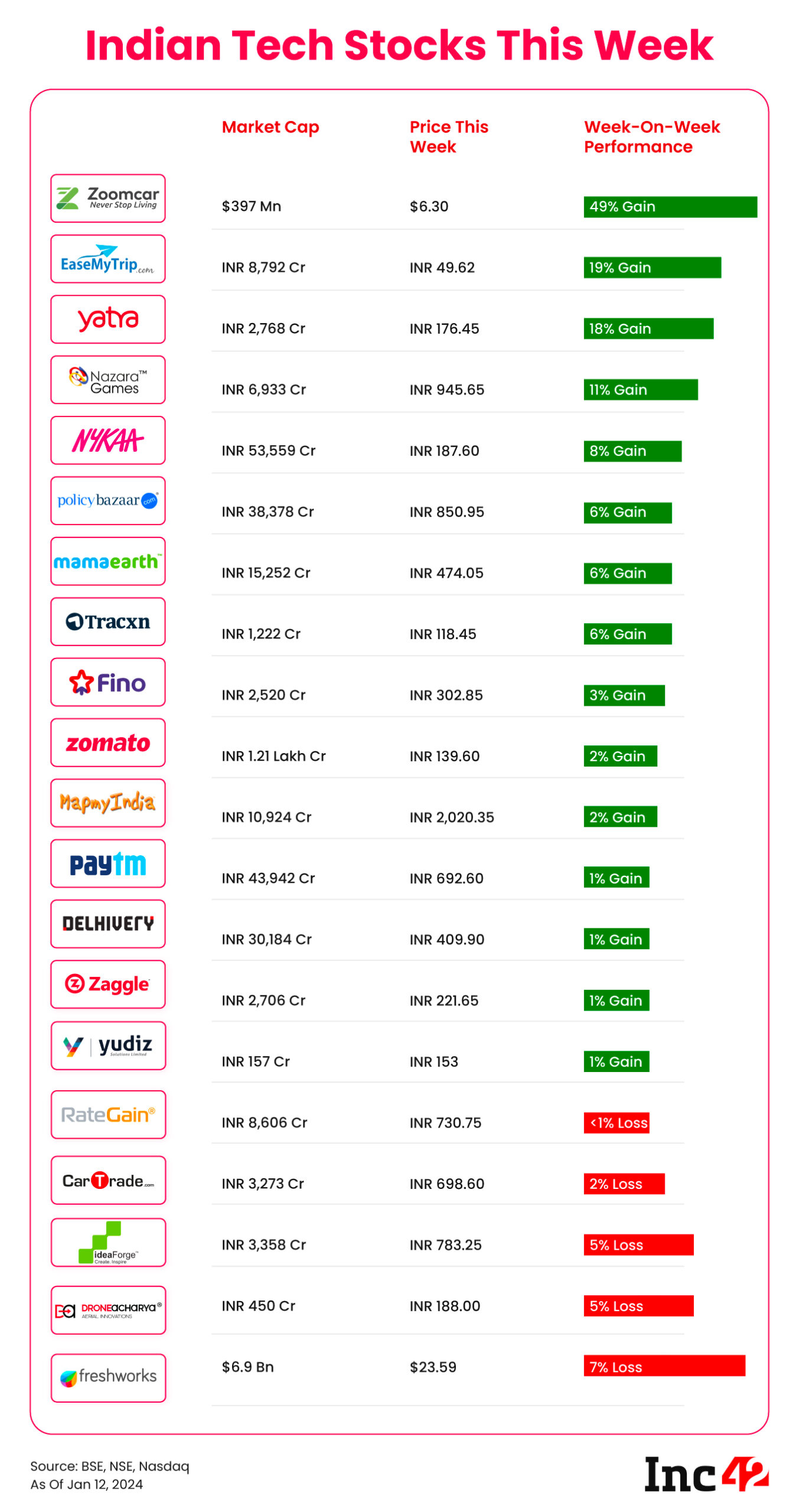
That’s all for this Sunday. Inc42 Weekly Brief will be back next week with more insights, stories and updates from the Indian startup ecosystem.







