


Do you want a side of socials with your fast food? Spain’s Glovo, a food delivery and quick commerce service where the bulk of orders are for ready-to-eat food, is experimenting with adding a bundle of social features to drive more in-app activity.

Advances in DNA sequencing and the vast amounts of genomic data being produced by next-generation sequencing (NGS) technology have created a startup opportunity to build software for biologists so they can more easily analyze this big data and take the next leap. It could help when it comes to developing new vaccines, cancer treatments and so on.

A love of food — and, well, cheese — has landed German fermentation startup Formo‘s co-founder Roman Plewka and its team a hefty $61 million Series B round to keep scaling production of their climate-friendly, animal-free cheese.

The energy transition is a marathon, not a sprint. But opportunities for acceleration are growing. Swedish startup Greenely* has just spotted one. It’s closing an €8 million Series A funding round to expand its energy management platform into neighbouring Nordic countries (so around $8.7M at current exchange rates).

What is AI good for? Automating repetitive tasks for the very busy people running small businesses, reckons Berlin-based startup Synthflow, which is announcing a $7.4 million seed round for its SME-focused no code platform for AI voice assistance.

The eyes aren’t just a window into the soul; tracking saccades can help doctors pick up a range of brain health issues. That’s why French-Belgian medtech startup neuroClues is building accessible, high-speed eye-tracking technology that incorporates AI-driven analysis. It wants to make it easier for healthcare service providers to use eye tracking to support the diagnosis of neurodegenerative conditions.
The company is starting with a focus on Parkinson’s disease, which already typically incorporates a test of a patient’s eye movement. Today, a doctor asks a patient to “follow my finger,” but neuroClues wants clinicians to use its proprietary, portable headsets to instead capture eye movements at 800 frames per second, after which they can run an analysis of the data in just a few seconds.
The 3.5-year-old outfit’s co-founders — both neuroscience researchers — point to high rates of misdiagnosis of Parkinson’s as one of the factors informing their decision to focus on the disease first. But their ambitions do pan wider. They paint a picture of the future in which their device becomes a “stethoscope for the brain.” Imagine, for example, if your annual trip to the optician could pack in a quick scan of brain health, and compare you against standard benchmarks for your age. According to the startup, which says it aims to help 10 million patients by 2023, eye tracking protocols could also help test for other diseases and conditions including concussion, Alzheimer’s, MS and stroke.
So how does the device work? Today, a patient looks through the headset and sees a screen where dots appear. A clinician then tells them to follow the dots with their eyes, after which the device extracts data that can be used as disease biomarkers by recording and analyzing their eye movements, measuring things like latency and error rate. It also provides the clinician with a standard value expected from a healthy population to compare with the patient’s results.
“The first scientific paper that is using eye tracking to diagnose patients is 1905,” neuroClues co-founder and CEO Antoine Pouppez told TechCrunch in an exclusive interview, noting the technique was initially used for diagnosing schizophrenia. In the 1960s, when video eye trackers arrived, there was a boom in research into the technique for tracking neurological disorders. But decades of research into the usefulness of eye-tracking as a diagnostic technique has not translated into widespread clinical uptake because the tech wasn’t there yet and/or was too expensive, said Pouppez.
“That’s where this technology comes from: The frustration of my co-founders to see that eye tracking has a lot of value — that’s been demonstrated in research that has been clinically proven on thousands of patients in research setups — and it’s still not used in clinical practice,” he said. “Doctors today use their fingers — and literally say ‘follow my finger’ — whereas an eye is moving at 600 degrees per second. You’re doing three eye movements per second. And so it’s very, very difficult — close to impossible — to evaluate how well you’re moving around [by human eye alone].”
Others have similarly spotted the potential to do more with eye tracking as a diagnostic aid.
U.S.-based Neurosync, for example, offers a VR headset combined with FDA-cleared eye tracking software it says can analyze the wearer’s eye movements “as an aid to concussion diagnosis.”The product is geared toward football players and athletes in other contact sports who face elevated risk of head injury.
There are also mobile app makers — such as BrainEye — pitching consumers on smartphone-based eye-tracking tech for self testing “brain health.” (Such claims are not evaluated by medical device regulators.)
But neuroClues stands out in a variety of ways. First, it says its headset can be located in a regular clinician’s office, without the need for a dark room set-up nor specialist computing hardware. It’s not using off-the-shelf hardware but instead developing dedicated eye-tracking headsets for eye testing designed to record at high speed and control the recording environment. The outfit’s founders further argue that by building its own software, neuroClues enjoys unrivaled speed of data capture in a commercially deployed, non-static device.
To protect these ostensible advantages, neuroClues has a number of patents granted (or filed) that it says cover various aspects of the design, such as the synchronization of the hardware and software, and its approach to analyzing data The startup is also in the process of filing an application for FDA approval and hoping to gain clearance for use of its device a clinical support tool in the US later this year. It is working on the same type of application in the European Union and anticipates gaining regulatory approval in the EU in 2025.
“We are the only one on the market today that is recording an 800 frames per second on a portable device,” said Pouppez, noting that the research “gold standard” is 1,000 frames per second. “There is no clinical or non-clinical product that is doing it at that frame rate, which meant that we had to lift barriers that no one had lifted before.”
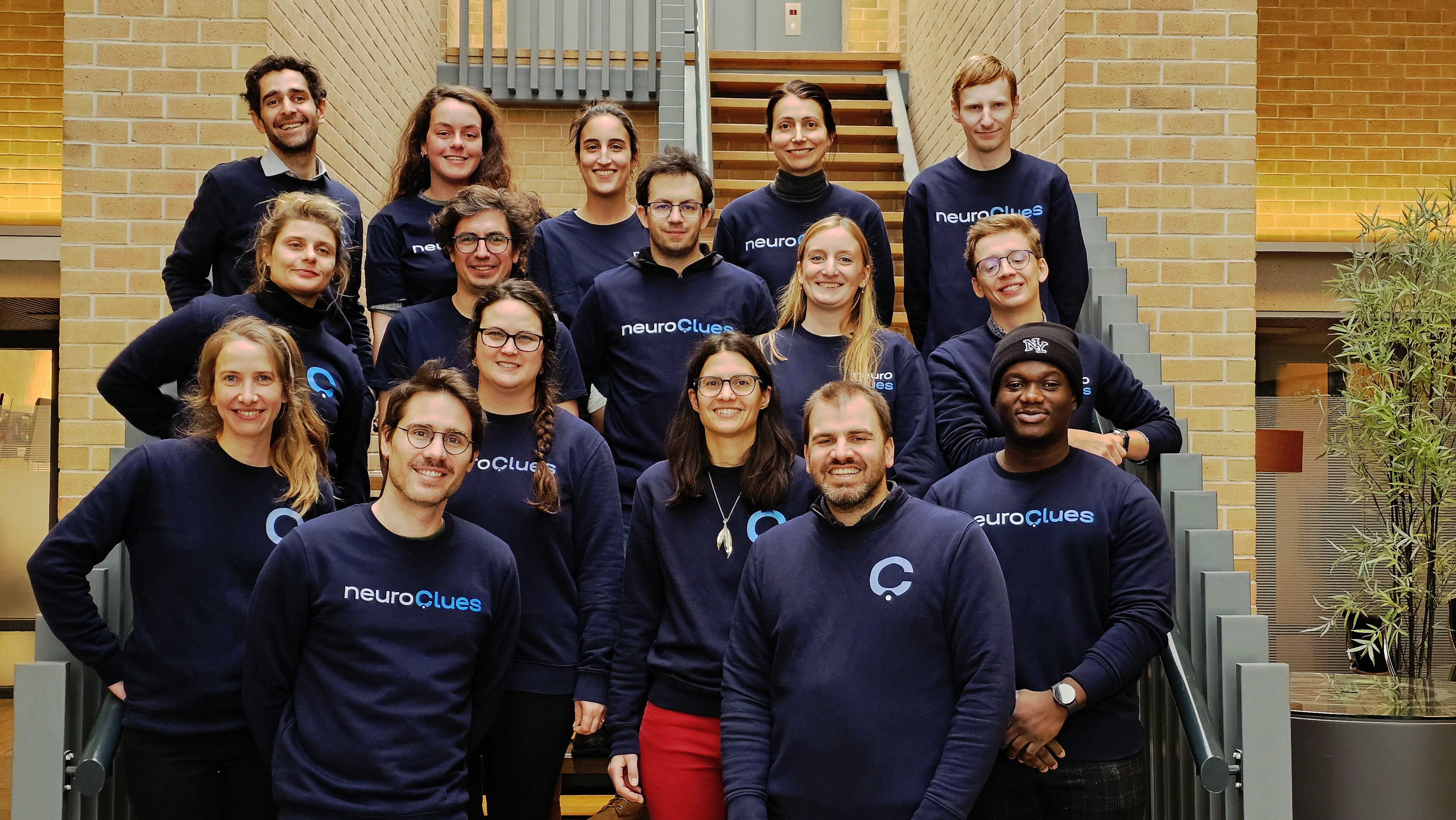
Image credit: neuroClues
neuroClues, which was incubated in the Paris Brain Institute, expects the first eye-tracking headsets to be deployed in specialist settings such as university hospitals, so for use on patients who have already been referred to consultants. It notes the service will be reimbursable via existing health insurance codes as eye tracking tests are an established medical intervention. The company says it’s also talking to a number of other outfits in the U.S. and Europe that are interested in its hardware and software.
This first version of the device is designed as a diagnostic aid, meaning that a human clinician is still responsible for interpreting the results. But Pouppez said the team’s goal is to evolve the technology to serve up interpretations of the data, too, so the device can be deployed more broadly.
“Our goal is quickly to move down to bring that diagnostics capabilities to practitioners,” he told us. “We hope to be on the market with such a device in ’26/’27. And so to broaden up our market perspectives and really be in [the toolbox of] every neurologist in US and in Europe.”
The startup is announcing close of a €5 million pre-Series A round of funding, led by White Fund and the European Commission’s EIC Accelerator program. Existing investors Invest.BW, plus a number of business angels, including Fiona du Monceau, former Chair of the Board at UCB, Artwall, and Olivier Legrain, CEO of IBA, also participated. Including this round neuroClues has raised a total of €12M since being founded back in 2020.
Pouppez said it will be looking to raise a Series A in the next 12 to 18 months. “Our existing investors and the European Commission have already shown interest in participating, so basically i’m looking for a lead investor,” he added.

The U.K.’s competition watchdog has sounded a warning over Big Tech’s entrenching grip on the advanced AI market, with CEO Sarah Cardell expressing “real concerns” over how the sector is developing.
In an Update Paper on foundational AI models published Thursday, the Competition and Markets Authority (CMA) cautioned over increasing interconnection and concentration between developers in the cutting-edge tech sector responsible for the boom in generative AI tools.
The CMA’s paper points to the recurring presence of Google, Amazon, Microsoft, Meta and Apple (aka GAMMA) across the AI value chain: compute, data, model development, partnerships, release and distribution platforms. And while the regulator also emphasized that it recognizes that partnership arrangements “can play a pro-competitive role in the technology ecosystem,” it coupled that with a warning that “powerful partnerships and integrated firms” can pose risks to competition that run counter to open markets.

Image Credits: CMA’s Foundation Models Update Paper
“We are concerned that the FM [foundational model] sector is developing in ways that risk negative market outcomes,” the CMA wrote, referencing a type of AI that’s developed with large amounts of data and compute power and may be used to underpin a variety of applications.
“In particular, the growing presence across the FM value chain of a small number of incumbent technology firms, which already hold positions of market power in many of today’s most important digital markets, could profoundly shape FM-related markets to the detriment of fair, open and effective competition, ultimately harming businesses and consumers, for example by reducing choice and quality, and by raising prices,” it warned.
The CMA undertook an initial review of the top end of the AI market last May and went on to publish a set of principles for “responsible” generative AI development that it said would guide its oversight of the fast-moving market. Although Will Hayter, senior director of the CMA’s Digital Markets Unit, told TechCrunch last fall that it was not in a rush to regulate advanced AI because it wanted to give the market a chance to develop.
Since then, the watchdog has stepped in to scrutinize the cozy relationship between OpenAI, the developer behind the viral AI chatbot ChatGPT, and Microsoft, a major investor in OpenAI. Its update paper remarks on the giddy pace of change in the market. For example, it flagged research by the U.K.’s Internet regulator, Ofcom, in a report last year that found 31% of adults and 79% of 13- to 17-year-olds in the U.K. have used a generative AI tool, such as ChatGPT, Snapchat My AI or Bing Chat (aka Copilot). So there are signs the CMA is revising its initial chillaxed position on the GenAI market amid the commercial “whirlwind” sucking up compute, data and talent.
Its Update Paper identifies three “key interlinked risks to fair, effective, and open competition,” as it puts it, which the omnipresence of GAMMA speaks to: 1) Firms controlling “critical inputs” for developing foundational models (known as general purpose AI models), which might allow them to restrict access and build a moat against competition; 2) tech giants’ ability to exploit dominant positions in consumer or business facing markets to distort choice for GenAI services and restrict competition in deployment of these tools; and 3) partnerships involving key players which the CMA says “could exacerbate existing positions of market power through the value chain.”
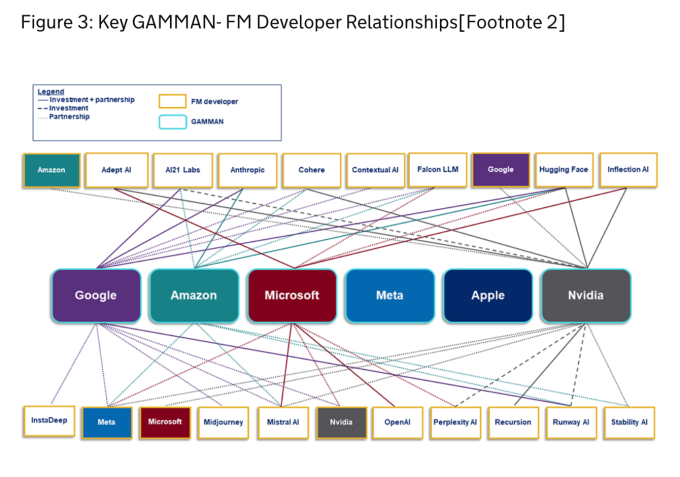
Image Credits: CMA
In a speech delivered Thursday in Washington, D.C., at a legal event focused on generative AI, Cardell pointed to the “winner-take-all dynamics” seen in earlier web dev eras, when Big Tech built and entrenched their web 2.0 empires while regulators sat on their heels. She said it’s important that competition enforcers don’t repeat the same mistakes with this next generation of digital development.
“The benefits we wish to see flowing from [advanced AI], for businesses and consumers, in terms of quality, choice and price, and the very best innovations, are much more likely in a world where those firms are themselves subject to fair, open and effective competition, rather than one where they are simply able to leverage foundation models to further entrench and extend their existing positions of power in digital markets,” she said, adding: “So we believe it is important to act now to ensure that a small number of firms with unprecedented market power don’t end up in a position to control not just how the most powerful models are designed and built, but also how they are embedded and used across all parts of our economy and our lives.”
How is the CMA going to intervene at the top end of the AI market? It does not have concrete measures to announce, as yet, but Cardell said it’s closely tracking GAMMA’s partnerships and stepping up its use of merger review to see whether any of these arrangements fall within existing merger rules.
That would unlock formal powers of investigation, and even the ability to block connections it deems anti-competitive. But for now the CMA has not gone that far, despite clear and growing concerns about cozy GAMMA GenAI ties. Its review of the links between OpenAI and Microsoft — for example, to determine whether the partnership constitutes a “relevant merger situation” — continues.
“Some of these arrangements are quite complex and opaque, meaning we may not have sufficient information to assess this risk without using our merger control powers to build that understanding,” Cardell also told the audience, explaining the challenges of trying to understand the power dynamics of the AI market without unlocking formal merger review powers. “It may be that some arrangements falling outside the merger rules are problematic, even if not ultimately remediable through merger control. They may even have been structured by the parties to seek to avoid the scope of merger rules. Equally some arrangements may not give rise to competition concerns.”
“By stepping up our merger review, we hope to gain more clarity over which types of partnerships and arrangements may fall within the merger rules, and under what circumstances competition concerns may arise — and that clarity will also benefit the businesses themselves,” she added.
The CMA’s Update report sets out some “indicative factors,” which Cardell said may trigger greater concern about and attention to FM partnerships, such as the upstream power of the partners, over AI inputs; and the downstream power, over distribution channels. She also said the watchdog will be looking closely at the nature of the partnership and the level of “influence and alignment of incentives” between partners.
In the meanwhile, the U.K. regulator is urging AI giants to follow the seven development principles it set out last fall to steer market developments onto responsible rails where competition and consumer protection are baked in. (The short version of what it wants to see is: accountablity; access; diversity; choice; flexibility; fair dealing; and transparency.)
“We’re committed to applying the principles we have developed and to using all legal powers at our disposal — now and in the future — to ensure that this transformational and structurally critical technology delivers on its promise,” Cardell said in a statement.

A few weeks after defeating Elon Musk’s attempt to silence it in court, anti-hate research nonprofit, the Center for Countering Digital Hate (CCDH), is back with a new piece of research into Musk’s social media platform X (formerly Twitter). The study builds on earlier work investigating his impact on online speech by spotlighting how policy changes Musk enacted are actively rewarding hate speech posters with increased reach, engagement and even direct payouts through X’s subscriber feature.
The latest CCDH research takes the form of a case study looking at growth rates for ten influential accounts which are paying for X Premium and have posted anti-Jewish and/or anti-Muslim hate speech since the Israel-Gaza conflict sparked by Hamas’ attack on Israel on October 7, 2023. Some of the accounts pivoted to war hate posts after previously posting COVID-19-related conspiracy theory content, per the report.
The ten accounts tracked for the study — which is entitled ‘Hate Pays: How X accounts are exploiting the Israel-Gaza conflict to grow and profit’ — are: Jackson Hinkle; Dr. Anastasia Maria Loupis; Censored Men; Jake Shields; Dr. Eli David; Radio Genoa; Ryan Dawson; Keith Woods; Way of the World; and Sam Parker.
The CCDH found these accounts were able to boost their reach on X after posting hateful content targeting the war. The report discusses examples of hate speech posted by the accounts, such as tweets depicting antisemitic tropes like the blood libel or seeking to dehumanize Palestinians by depicting them as rats.
“Each of the accounts showed slow follower growth in the four months before October 7th, for a combined growth of approximately 1 million followers. However, in the four months after the outbreak of the conflict, they collectively gained 4 million new followers,” the CCDH wrote, saying it represents nearly 4x growth collectively vs the four months before the war.
Growth rates for individual accounts gaining new followers over the period varied, with the highest growth multiple recorded being 9.6 (for Dawson’s account), followed by 8.3 (for Hinkle), and 7.1 (for Parker). At the lower end, Way of the World grew its followers 1.7x over the period.
The report includes a potted history of the tracked accounts’ notoriety, noting for example that Hinkle is banned by WhatsApp, YouTube and PayPal. Or that the Censored Men (anonymous) account used to generally post in defence of toxic masculinity influencer, Andrew Tate — but, since October 7, has focused on the Israel-Gaza conflict. While Dawson, a Holocaust denier who also believes the 9/11 terrorist attacks were carried out by Israel, was previously banned from X but had his account reinstated in 2023 under Musk.
Since taking over Twitter, as X still was back in October 2022, the billionaire has reversed a number of legacy account bans, including welcoming back notorious white supremacists and neo nazis. Coupled with policy changes Musk has pushed in areas like content moderation, account verification and premium features (such as prioritized ranking for paid accounts’ posts), the upshot is a polarizing speech platform where it’s increasingly difficult to distinguish genuine information from lies, and where the tone of posts all-too-often skew towards conversational outrage (or worse).
The CCDH contends this is intentional; a deliberate strategy by Musk to profit from tragedy. It’s accusing him of embracing hateful accounts and configuring X so that purveyors of hate speech are able and encouraged to turn war and human suffering into an opportunity to raise their profile on the service and earn revenue from posts that exploit violence and misery.
Six of the 10 accounts it looked at have enabled X’s subscriptions feature, meaning their followers can pay them to access additional content. The report also records a post by Hinkle in early October when he shared a screenshot in which he appeared to have made $550 in ad revenue over the course of a month — directly profiting from engagement driven by hateful posts.
In another finding, the CCDH said its analysis of the accounts showed that even critical resharing — such as quote tweets denouncing hateful content — raised their visibility and reach (potentially boosting revenue-generating opportunities). Such critical reshares contributed as much as 28% to the reach of hateful posts, per the report, which suggested the figure is a conservative estimate as it does not take account of X’s own algorithmic response to these reshares, which applies further amplification aimed at harvesting even more engagement for ad profit.
Ad-funded business models that earn revenue based on user engagement ultimately drive this anti-social outrage mechanism. In X’s case, Musk’s erratic behavior has alienated some advertisers. But not all: The CCDH found ads being served alongside hateful posts made by all the tracked accounts. “We found ads for Oreos, the NBA, the FBI and even X itself placed near hateful posts,” it wrote.
“Under Elon Musk’s ownership, X appears to be pursuing a strategy of hosting as much controversial content as possible,” a CCDH spokesperson told TechCrunch, responding to questions about the research. “We know that this controversial content is addictive, not just for users who approve of it but also for users who criticize it too. The potential benefit to X is that these controversies could ramp up user time spent on the platform and increase ad revenue — but only if brands are willing to pay for ads that could be displayed near toxic content.”
“The accounts studied by our report have grown sharply despite posting false or hateful content, showing that posting such content is no impediment to growth on X. This is not unique to the Israel-Gaza conflict but it is the latest example of the problem. Our previous research into accounts that were reinstated following Musk’s takeover of Twitter shows that X stands to make significant ad revenue by welcoming users posting a range of topical hate and disinformation, from brutal misogyny to anti-vaccine conspiracies.”
Commenting on the report in a statement, Imran Ahmed, CEO and founder of the CCDH, added: “The public and advertisers need to know more about the symbiotic, profitable relationship between X and hate-peddling ‘influencers’. Lawmakers must act to enforce greater transparency and accountability from platforms and to allow these companies to be held responsible for harming the civil rights and safety of Jews, Muslims and other minority communities.”
Musk has previously claimed hate speech has decreased on his watch but earlier CCDH research debunked his claim.
X is also currently under investigation in the European Union for a string of suspected breaches of the bloc’s online governance and content moderation regime, including over its response to illegal content — which may include hate speech. Penalties for confirmed breaches of the EU’s Digital Services Act can reach 6% of global annual turnover.

A flagship European Union digital market regulation appears to be shaking up competition in the mobile browser market.
It’s been a little over a month since the Digital Markets Act (DMA) came into application and there are early signs it’s having an impact by forcing phone makers to show browser choice screens to users.
On Wednesday, Reuters reported growth data shared by Cyprus-based web browser Aloha and others that it said suggests the new law is stirring the competitive pot and helping smaller browser makers gain share or at least grab more attention than they were.
But it’s early days for DMA implementation, with choice screen rollouts still a work in progress, and many EU users haven’t even seen one yet. While Aloha is not the only other browser reporting a boost in interest since the DMA compliance deadline kicked in on March 7 — Brave, Opera and Vivaldi also shared positive stories of increased interest — several others, including DuckDuckGo and Firefox, told us it’s too soon for them to be able to assess the regulation’s effect.
TechCrunch reached out to 16 alternative browser makers with questions, as well as Apple and Google, to inform our reporting. We also contacted the European Commission to ask about its own tracking of the DMA’s impact in this area — but it declined to share any data.
Neither Apple nor Google responded to questions asking about any changes in regional usage of their own browsers since the choice screens began being shown to mobile users.
Opting for choice screens
The EU’s goal for the DMA is to boost competition against internet “gatekeepers” whose control of dominant platforms gives them many operational advantages over smaller rivals. The regulation does this through a list of “dos and don’ts” that tech giants must comply with. In the case of browsers, it obliges the likes of iOS maker Apple and Google’s Android to display browser choice screens — forcing them to point users to alternatives to Apple’s Safari and Google’s Chrome.
Choice screens are intended to work against platform dominance and self-serving defaults by alerting consumers there are other options. But users do still need to decide to switch to an alternative app in order for choice screens to boost competition. The design of screens is also important.
Some alternative browser makers remain concerned the design of choice screens isn’t where it needs to be. We suspect this is leading to reluctance by some underdogs to share data on early impact, especially as the EU is currently investigating Apple’s choice screen design for suspected noncompliance.
In other words, some browser makers may be playing a waiting game in the hopes of encouraging Commission enforcers to push for a stronger implementation. At the same time, some really small browser players may see more gains to be had from good old-fashioned publicity — for example, sending out a press release trumpeting early interest — as a tactic to raise their profile to try to drive more downloads through increased awareness.
Overall, it’s still very early. Many regional mobile users may not have even seen a choice screen appear on their handset yet. Google, for instance, says screens are being displayed on newly launched Android devices but for existing Android handsets it’s up to the makers of the devices to push out the choice screens to their users. So there isn’t a clear implementation timeline on Android.
While in the case of iOS, Apple says it’s been displaying choice screens to users of iOS since iOS 17.4. But users who haven’t updated to this version also won’t have seen any yet.
Mozilla, maker of the Firefox browser, told us it estimates that less than a fifth of iOS users have been shown a choice screen so far. It reckons even fewer Android users have seen one in the wild as yet.
With this patchy Android rollout picture in mind, it seems likely that more iOS users will have seen choice screens than Android users so far — even though Google’s platform has a larger regional market share.
Measuring the impact of the DMA on alternative browsers’ market share is further complicated by variations in the apps that mobile users see in different EU countries. Some alternatives, such as Firefox, can appear on the iOS choice screen in every EU market. Whereas others are far more limited: Vivaldi, for example, can only appear in eight countries. So exposure to potential users can vary substantially depending on the browser. (Apple lists the options it’s currently showing in each market here.)
Alt browsers on the up?
Aloha, a browser that focuses on privacy and claims not to track users, told us it’s seen 250% growth in new users (i.e. app downloads) since the DMA came into effect last month. It reports having approximately 10 million active monthly users globally — and estimates that around 1 million of those are located in the EU. So it remains a very small player.
However, since Aloha says it does not collect any personal data, including location data, it told us it cannot be precise about where its users are located. Yet it told Reuters the EU had moved up from being its 4th largest market to its 2nd largest since the DMA compliance deadline kicked in.
Aloha also claimed to have seen an uptick in users in the US since the DMA came into effect — yet the regulation does not apply in the US market so US users aren’t encountering it via browser choice screens. Aloha told TechCrunch it believes privacy awareness is rising generally, but also suggested growth in new installs in the EU may be helping to raise its position in the US App Store.
Norway-based Opera, meanwhile, is also claiming market share gains since the DMA started to bite on March 7. Per new metrics shared with TechCrunch Wednesday, Opera said new user growth from February to the end of March was 63% — so it’s reporting a substantial uptick in people downloading Opera and giving it a try.
It is also reporting a 39% growth in users on iOS selecting its browser as their default specifically, from March 3 until April 4.
Previously (as of March 18), Opera reported 164% growth in the inflow of new EU users on iOS after the deadline for Apple to implement the DMA-enforced choice screen. So there actually appears to have been a drop in the growth rate it’s seen over this period — i.e. after a bigger initial spike of interest.
Regardless, Opera is sounding very happy with the extra level of interest it’s seeing. In a statement, Jørgen Arnsen, its EVP of mobile, said the DMA “is working to even the playing field”, adding: “We’re excited to see that it has become easier for users to express their browser choice and for that choice to be respected.”
Another browser maker with a positive experience since DMA compliance day is Vivaldi, which is also developed out of Norway.
It told TechCrunch it’s seen an increase of 36.7% in downloads in the EU (in total) since the iOS choice screen came into effect. But the boost in downloads is even bigger when you look at the eight markets where Vivaldi is actually being shown on iOS choice screens. In those markets it said downloads have increased 69.6% since the choice screen started being pushed at users.
Despite this uptick in downloads, Vivaldi is unhappy with the current design of Apple’s choice screen.
“There are significant flaws with its implementation, including when it is shown and what is shown,” a company spokeswoman told us. “Users can only see the choice screen when they click Safari. The list of browsers does not show additional information and that does not help users to make a meaningful choice. If the user has already selected a browser of their own choice, the choice screen can actively try to push them away from it, and may not even include it in the list that it presents to the user.”
“We think the priority should be given to cross-platform browsers, so that the same browser can be used on all of the user’s devices,” she added. “Apple looks at it very narrowly, per platform and country. We believe the main browser choices should be visible and we are not. And we should be on the list for all countries.”
We also heard positive things from Brave. The US-based privacy-focused browser said it’s seen “a significant uptick” in installs since the DMA came into effect. (Although it does not report users per region so declined to break out total usage figures for the EU.)
“The daily installs for Brave on iOS in the EU went from around 7,500 to 11,000 with the new browser panel this past March,” per a company spokeswoman. “In the past few days, we have seen a new all time high spike of 14,000 daily installs, nearly doubling our pre-choice screen numbers.”
“Regarding retention, users who are choosing Brave from the DMA screen are being retained equally to or better than our average,” she added, arguing that, overall, the uptick in interest it’s seeing “confirms that users want choice”.
On the flip side, three other alternative browsers which we contacted — DuckDuckGo, Ecosia and Firefox — suggested it’s too early to tell whether the DMA is helping them.
Veteran privacy-focused browser maker DuckDuckGo declined to share any data, saying it’s too soon to draw meaningful conclusions.
“While we’ve seen some positive signs, the choice screen rollout is ongoing and for a competitor like us that sees billions of searches and millions of downloads a month, we need more time to make an accurate impact assessment at scale,” it said in a statement.
DuckDuckGo also told us it lacks access to “key information” to be able to assess the DMA’s impact, saying for example that it has no way of knowing how many people have seen a search engine or browser choice screen.
“This is key because it would help us understand our selection rate on a choice screen and how widespread the rollout has been,” it noted, adding: “We’re at the beginning of this journey, not the end.”
Another alt player, the not-for-profit, tree-planting and eco-action focused Ecosia, also told us it doesn’t have enough data to make an accurate assessment of the regulation’s impact. “We have not received selection rates or any other meaningful datasets, so it is hard for us to solidly report on the effectiveness of the choice screen at this stage,” said Sophie Dembinski, its head of public policy and climate action.
She emphasized Ecosia isn’t happy with the current iOS choice screen, which it believes is hampering potential growth — also pointing to the Commission’s open case investigating Apple’s implementation.
“While Ecosia has jumped to 2nd and 3rd position in some European markets for utility apps in the Apple app store, our search numbers have barely changed,” she said. “This is due to several design issues within Apple’s choice screen — such as showing the choice screen to users who have already selected an alternative choice to Safari; an overly complex installation process which loses a large number of users; and keeping the Safari browser app in the best position on the home screen.”
Another veteran browser player, Firefox, is also keeping its powder dry when it comes to assessing early impact.
“We are not currently sharing absolute numbers, both because we have some serious concerns about the current choice screens and because we estimate that less than 20% of users on iOS and likely less on Google have been exposed to them thus far,” said Mozilla’s Kush Amlani, global competition and regulatory counsel.
“The DMA represents a once-in-a-generation opportunity to create competition and choice for EU consumers. Whether that potential is realized depends on the gatekeepers’ compliance and the European Commission’s enforcement,” he also emphasized, also referencing the Commission’s probes into suspected gatekeeper non-compliance.
“While we’re seeing many thousands of people select Firefox on the choice screens, we don’t think this should distract from the fact that the iOS choice screen has significant flaws that block people from making genuine choices,” Amlani added. “The critical challenge is that powerful and deep-pocketed gatekeepers are incentivized to protect their existing closed ecosystems and fight the implementation of the DMA, which will open them up to competition.”
TechCrunch’s outreach to browser makers which may benefit from the DMA choice screens also yielded one report of no meaningful impact since the requirement kicked in: Yandex, a Russia-based browser which can appear on the iOS choice screen anywhere in the EU, told us it hasn’t seen “any meaningful changes in the user metrics in the region so far”.
In Yandex’s case, it’s possible disinterest in switching could be linked to consumer concerns about using or supporting software that’s developed in Russia in light of the Ukraine war.
Newer Posts