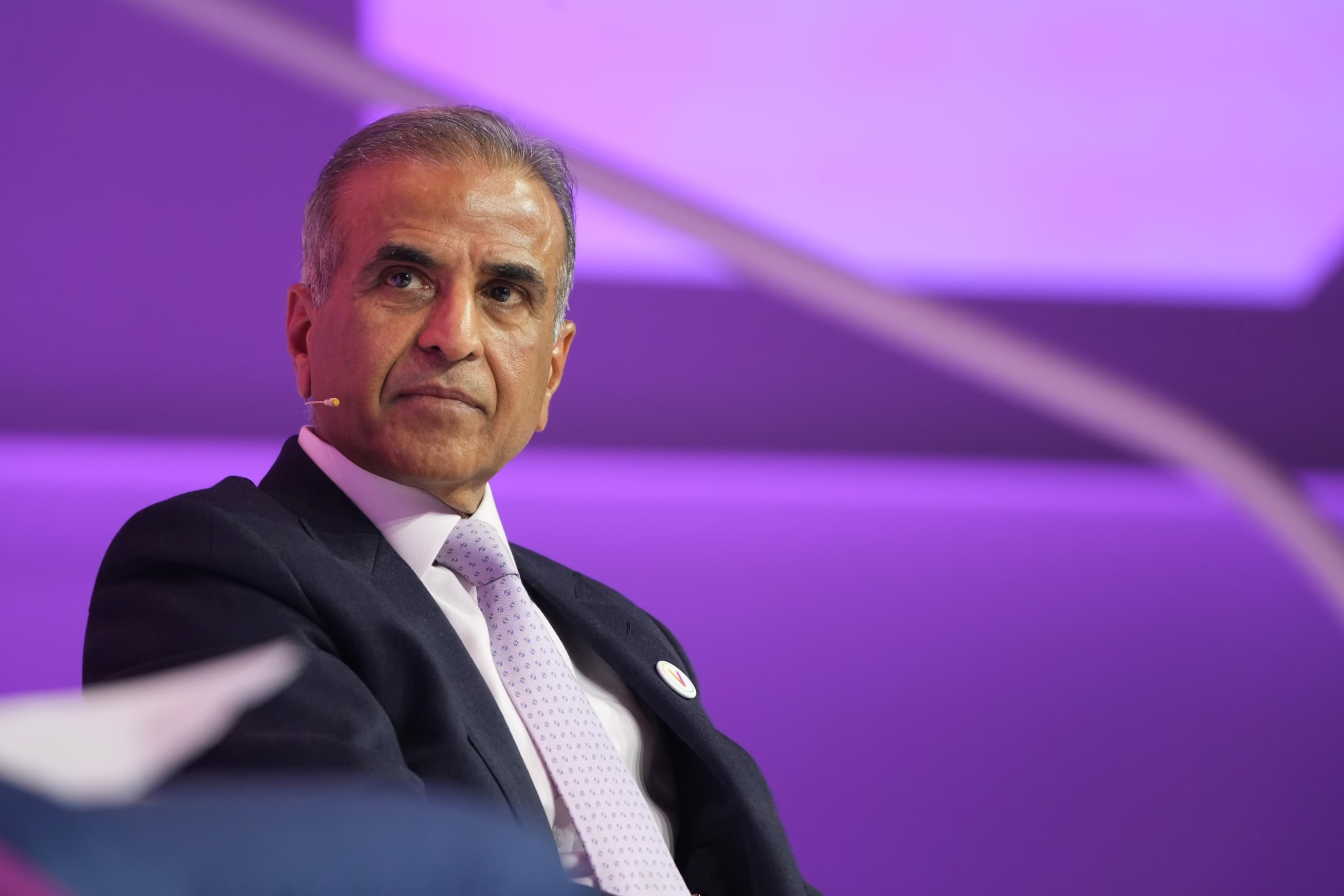
Sunil Mittal, Chairman of Bharti Airtel, has urged major telecom operators in India—Reliance Jio, Vodafone Idea (Vi), and BSNL—to join forces in tackling the rising threat of telecom-related cybercrimes. The appeal comes in light of concerning figures, with cyber frauds in India resulting in losses exceeding ₹11,000 crore and over 1.7 million complaints registered in the first nine months of 2024 alone. As part of the proposed initiative, Airtel suggests creating a joint framework for telecom service providers to share real-time intelligence and coordinate efforts to detect and prevent fraud. A key aspect of the plan involves developing a centralized data-sharing platform, akin to the Distributed Ledger Technology (DLT) system, to track enterprise connections used in commercial calling and reduce spam and unsolicited communications. Additionally, Airtel has introduced a fraud detection system that automatically blocks scam links and malicious content across platforms like WhatsApp, Telegram, Facebook, and Instagram for all its users. The proposal has been shared with the Department of Telecommunications (DoT) and the Telecom Regulatory Authority of India (TRAI), highlighting the need for a unified industry response. The broader goal is to enhance consumer protection and rebuild trust in digital communications by curbing phishing scams, fake offers, and other fraudulent tactics.
Team SNFYI
Urgent! XRP hashrate window only 47 days left: A complete guide to building a passive income pipeline with Richminer
As XRP breaks through its historical high, a “passive income revolution” is quietly emerging in the cryptocurrency field. As Ripple’s cooperation with global financial institutions deepens, XRP’s long-term value logic becomes clearer, and the evolution of the Richminer platform opens a new window for ordinary investors to participate without technical barriers and low risk – through Richminer’s intelligent configuration of computing power contracts and strategies, the goal of $100,000 in passive income per year has changed from being out of reach to a replicable wealth path.
XRP uses Richminer to achieve compound interest on income
XRP itself cannot be mined directly, but through cloud mining platforms such as Richminer, users can rent computing power to participate in the mining of Bitcoin, Litecoin and Dogecoin, and automatically convert the income into XRP to form a passive income stream.
How to start Richminer passive income:
1. Use an email address to create an account, register and get a $15 reward, and the daily income is about $0.6.
2. Maximize profit configuration:
Choose RichMiner high-computing power contracts: give priority to renting Bitcoin or Dogecoin mining machines because of their high profit stability; the following potential high returns and flexible investment options.
For example, New User Experience Contract (invest 100, potential total profit of 106 in 2 days).
For example, Canaan Avalon A15XP (invest 600, potential total profit of 650.82 in 7 days).
For example, Bitdeer SealMiner A2 (invest 1,600, potential total profit of 1,897.92 in 14 days).
For example, Bitmain Antminer L9 (invest 12,000, potential total profit of 19,140 in 35 days).
For example, Antspace HK3 V6 (invest 110,000, potential total profit of 228,250 in 50 days), with an average daily return rate of more than 2.15%. Click richminer.com for more details on mining contracts.
3. Compound interest reinvestment model:
The cloud mining income is regularly invested in the purchase of contracts to form a positive cycle of “income → purchase more cloud mining contracts → higher income”. Assuming an investment of $5,400, if the monthly rate of return reaches 45%, the principal plus income can reach about $7,843 after one month. Through compound interest reinvestment, the initial funds can grow rapidly. Through the use of the above strategies, the goal of $100,000 in passive income can be achieved efficiently.
RichMiner core advantages
1. Fully automated operation: The platform integrates intelligent AI technology to automatically process mining, optimization and income distribution, and daily income is automatically credited.
2. Sustainable development of green energy: The platform uses renewable energy mines, which are in line with ESG trends and ensure long-term income stability.
3. Multi-currency support and instant withdrawal: Supports mining and settlement of mainstream currencies such as BTC, ETH, XRP, DOGE, etc., with a withdrawal threshold as low as $100, daily processing of user withdrawal requests, and support for multiple protocols such as TRC20/ERC20.
4. Professional team and global service: A team of blockchain experts and IT engineers provides 24/7 technical support. The platform interface supports 8 languages and covers users in 132 countries.

Industry-leading security and compliance guarantee
Fund security: 95% of user funds are stored in cold wallets, using McAfee® and Cloudflare® encryption technology to prevent hacker attacks.
Compliance certification: Holds the UK FCA license and the US MSB compliance certification, funds are entrusted to HSBC Bank, and there has been no security incident record for 3 consecutive years.
Summary:
XRP cloud mining is reshaping passive income, and daily income compounding is achieved with the help of Richminer’s green energy mining pool. Behind the goal of $100,000 is actually the accurate capture of Richminer trends and AI intelligent management. The future has come, and only the wise can control the craze with reason and anchor their own golden coordinates in the wave of XRP. Will you be the next wise man to control the XRP craze?
Take action now: Visit the RichMiner official website, receive a $15 reward, and start your cloud mining journey!
17 Bahraini Companies to Expand into the Saudi Market through Tamkeen’s Overseas Expansion Program in Partnership with AstroLabs

AstroLabs, the Gulf’s leading business expansion platform, in partnership with the Labour Fund (Tamkeen), continues to accelerate the regional growth journey of Bahraini enterprises with the onboarding of a second wave of companies into its Overseas Expansion Program. Since the launch of the initiative, AstroLabs and Tamkeen have successfully onboarded two cohorts of high-potential businesses, all poised to solidify their presence in the Saudi market – a market with high growth opportunities and a strategic gateway to regional expansion.
Tamkeen’s partnership with AstroLabs aligns with its strategic priorities for 2025, which focus on enhancing the position and competitiveness of Bahrainis in the private sector, equipping Bahrainis with suitable skills for career development in the private sector, and prioritizing enterprise growth, digitization and sustainability and supporting the development of the ecosystem surrounding the labor market and private sector.
On this occasion, Mr. Joe Kobrianos, Chief Strategy Officer at AstroLabs, stated:
“We’re excited to work alongside Tamkeen to help Bahraini businesses on their regional-growth journey, and expand into the fast-growing Saudi market. Tamkeen has played a key role in enhancing the competitiveness of Bahraini companies, setting the stage for their next steps. These businesses have demonstrated strong growth and are now ready to scale into Saudi Arabia. At AstroLabs, we focus on building strong growth corridors and seamless soft-landing experiences, supporting high-growth businesses, from business registration all the way to making key introductions and unlocking access to the local market, we’re here to guide them.”
Mrs. Marwa AlEskafi, Director of Workforce, Enterprise, and Startup Enablement at Tamkeen, commented: “Our partnership with AstroLabs reflects Tamkeen’s commitment to empowering Bahraini entrepreneurs, equipping them with the necessary tools to scale their operations, and unlocking new opportunities for regional growth. We continue our commitment in supporting Bahraini entrepreneurs through our various programs and initiatives, and we are proud to see the positive impact of this program on the previous Cohort and are looking forward to witnessing the growth prospects it will bring to this new batch of innovative businesses.”
The first cohort with AstroLabs brought together a dynamic group of ten leading Bahraini companies. These include United Paper Industries (Bahrain Pack), a prominent manufacturer of paper and corrugated cardboard packaging solutions; Right Calories, a renowned food services provider offering balanced dietary plans; Xtrude, an innovator in advanced 3D manufacturing processes; and City Glass, a specialist producer of premium architectural and decorative glass products. The cohort also featured Tanami Capital, a firm delivering Sharia-compliant global investment solutions; Oreem, a comprehensive logistics provider; Boxon Vision, a creative agency delivering advertising and design solutions; Cinqo Media, a strategic communications and advertising provider; and Al-Anzour Physiotherapy and Rehab Complex that offers quality physiotherapy and rehabilitation services.
Building on this momentum, AstroLabs and Tamkeen are proud to announce the onboarding of Cohort 2, a new wave of equally ambitious and high-growth Bahraini enterprises. Among these are – Creative Matter Advertisement, a dynamic creative agency with a decade-long legacy in Bahrain, specializing in branding, digital marketing, and content creation; Fathom Media, a Bahrain-based marketing and technology agency founded in 2013, joins with its 30-strong team delivering innovative branding, web and app development, and strategic marketing services; Gems Industrial Services W.L.L., established in 2016, brings its expertise in engineering, maintenance, and industrial services, catering to Bahrain’s vital oil and gas sectors; Braxtone Group W.L.L, a regional insurance service provider, offers industry-leading insurance solutions with deep local market expertise; DOO, an AI-powered platform, is transforming customer engagement through intelligent automation solutions tailored to startups, SMEs, and enterprises; Alfaa Graph, a specialist engineering office, delivers architectural scale models and 3D design services to real estate developers and investors. Nexcel Computer Solutions W.L.L, a leading IT solutions provider offering a broad range of technology products and services to businesses of all sizes. And Loyale, a mobile loyalty app that ensures customers always have their loyalty cards handy while enabling businesses to effortlessly track customer activities.
These companies have shown strong market leadership and strategic ambition, with many already operating in Saudi Arabia. Their next step is to formalize their presence by setting up legal entities and enhancing operations. AstroLabs will support this expansion with end-to-end services, including business registration, compliance, and growth support, along with access to digital tools and expert consultancy.
Through this partnership, the Bahraini companies from both cohorts join a growing network of over 800 international firms that have expanded into Saudi Arabia with AstroLabs’ support. Working hand-in-hand with public and private sector partners, AstroLabs designs tailored programs that foster innovation, bridge industry gaps across key sectors in the Gulf, and facilitate market expansion into emerging economies. To date, AstroLabs has empowered over 1,800 companies to scale across the region, providing a robust and professional business environment that ensures seamless market entry, particularly in Saudi Arabia and the UAE.
Tamkeen continues to offer a range of programs and initiatives that are designed in line with labor market needs and is driven by its strategic priorities and support initiatives which include employment support, career development support and enterprise support programs.
Visa2Fly: Transforming Visa Processing Through Travel Tech Innovation

As the global travel industry continues to evolve in the digital age, the often-overlooked domain of visa processing is finally catching up. At the heart of this transformation is Visa2Fly, a travel tech platform that’s redefining how individuals and businesses approach international mobility.
From simplifying visa applications to introducing AI-driven automation, Visa2Fly is leading the shift toward smarter, faster, and more accessible global travel.
The Pain of Traditional Visa Systems
Anyone who has applied for a visa the old-fashioned way knows how cumbersome it can be. Endless paperwork, confusing requirements, embassy appointments, long queues, and no clear visibility into application status—these are just a few of the pain points that travelers have long endured.
Recognizing the gap between traveler expectations and outdated systems, Visa2Fly has built a modern, scalable, tech-enabled platform to remove the friction.
A Tech-First Approach to Visa Services
Visa2Fly operates on a simple principle: travel documentation should be as smooth and digital as booking a flight. By combining user-centric design, automation, and reliable backend processes, Visa2Fly offers visa solutions that are fast, intuitive, and transparent.
Through its platform, users can:
- Apply for tourist, business, transit, and student visas for 70+ countries
- Get real-time updates and notifications on visa status
- Upload documents securely and track application progress online
- Perform checks like a Dubai visa check instantly, without needing to visit government portals.
All of this is wrapped in a clean, digital interface designed for both individuals and enterprises. The platform also supports embeddable B2B modules for partners in the travel, HR, and education industries.
AI-Powered Efficiency
Visa2Fly is not just a form-filling service. It is actively integrating AI and machine learning to streamline the visa journey even further. Here’s how:
1. Smart Document Verification
Users often get stuck because of missing or incorrect documentation. Visa2Fly’s AI-based document checker flags common errors, mismatches, and compliance gaps in real-time—helping reduce rejections and resubmissions.
2. Predictive Visa Approval Insights
Using anonymized application data and embassy trends, the platform is developing tools that help users estimate their chances of approval before submission. This predictive engine aims to give travelers more control and confidence in their travel planning.
3. Automated Form Generation
Rather than filling out long embassy-specific forms, users can input their core details once. The platform auto-generates embassy-compliant forms, cover letters, travel itineraries, and sponsorship documents.
This AI-first vision ensures Visa2Fly isn’t just a facilitator—it becomes a travel intelligence layer that supports better decisions and outcomes.
Built for Individuals, Scaled for Businesses
While Visa2Fly is user-friendly enough for individual travelers, it’s also designed to scale with business needs. Travel agencies, educational consultancies, corporate mobility teams, and HR departments can all integrate Visa2Fly’s APIs or partner solutions to streamline operations.
For example:
- A travel agency can offer white-labeled visa services with real-time application dashboards.
- A university can use Visa2Fly to manage international student applications in bulk.
- A company hiring global talent can process work and travel visas with automated compliance workflows.
This dual B2C and B2B model makes Visa2Fly more than a travel tool—it becomes part of the infrastructure that supports international movement.
Global Coverage with Local Precision
Different countries, different rules—that’s one of the major headaches in international visa processing. Visa2Fly localizes its services for each destination, ensuring up-to-date embassy requirements, supported document templates, and local support.
The Road Ahead: Deeper AI and a Borderless Future
Looking to the future, Visa2Fly is actively investing in technologies that go beyond basic automation. The roadmap includes:
- Conversational AI Assistants for multilingual, personalized visa support
- Smart Alerts for embassy rule changes and policy shifts
- Biometric Integration for faster identity validation
- Visa-as-a-Service APIs for enterprise clients in travel, education, and logistics
The goal is clear: to remove friction from cross-border travel and empower people to move freely, legally, and confidently—without being overwhelmed by bureaucracy.
Conclusion
In an age where digital convenience is expected at every touchpoint, Visa2Fly stands out by addressing one of the most outdated components of travel—visa processing. Through its innovative tech-driven platform, AI integration, and commitment to user empowerment, Visa2Fly is not just making visas easier—it’s helping define the future of global travel.
Google DeepMind CEO Urges Teens to Embrace AI or Risk Falling Behind

As the world races into an AI-powered era, Google DeepMind CEO Demis Hassabis has a powerful message for teenagers: start learning about AI now — or risk being left behind. Speaking on the Hard Fork podcast and at the recent Google I/O event, Hassabis emphasized that artificial intelligence is rapidly evolving and will significantly reshape the job landscape in the next five to ten years.
DeepMind, known for breakthroughs like the Gemini chatbot, is leading Google’s efforts to develop Artificial General Intelligence (AGI) — a form of AI with human-level reasoning capabilities. Hassabis believes AGI may be less than a decade away.
He described generative AI as the defining force for Gen Alpha, just as the internet was for millennials and smartphones for Gen Z. While AI will disrupt certain jobs, he noted it will also create newer, more interesting roles — especially for those who prepare early.
Hassabis encouraged students to immerse themselves in AI tools, become proficient in coding, and cultivate broader skills like creativity, adaptability, and resilience. He stressed that learning how to learn and embracing change will be key to thriving in the AI age.
While technical expertise remains important, Hassabis warned that many hard skills are already being handled more efficiently by AI. Instead, he urged students to develop “meta skills” and use their time in university to explore emerging technologies, experiment beyond textbooks, and stay ahead of the curve.
His core message: AI is already transforming the world — and those who understand and innovate with it will be best positioned for the future.

AI Is Making Coding Jobs Feel Like Assembly Line Work, Say Amazon Engineers
Since the Industrial Revolution, workers have feared that machines would replace them. But historically, automation didn’t always eliminate jobs—it often made them more repetitive and high-speed, breaking complex roles into simpler, faster tasks. This trend, known as job “degradation,” appears to be happening now in the tech industry, particularly in software engineering.
AI Is Changing the Nature of Coding
As artificial intelligence becomes widely adopted, particularly tools like GitHub Copilot, many coders are not being laid off but are instead seeing their work become faster, more routine, and less creative. A Microsoft-backed study showed AI tools boosted coder productivity by over 25%.
At Amazon, which is heavily investing in generative AI, this shift is especially clear. CEO Andy Jassy recently emphasized that AI is key to increasing productivity and cost efficiency. Engineers report higher expectations, tighter deadlines, and a growing push to rely on AI tools—even building new ones during internal hackathons.
Faster Work, Less Thinking
Some engineers say what once took weeks to build must now be done in days. AI helps speed things up, but also removes time for reflection, collaboration, and deeper thinking. Much of the creative, problem-solving aspect of coding is being replaced with reading, reviewing, and editing AI-generated code.
This mirrors Amazon’s warehouse model: robots didn’t eliminate jobs but made them faster and more repetitive. Similarly, engineers now feel they are being monitored more closely, with performance reviews tied to output targets that AI is expected to help meet.
Impact on Junior Developers and Career Growth
AI also affects career development. Tasks like testing and writing technical memos—once opportunities to learn and grow—are increasingly automated. Junior engineers may miss out on critical experiences needed for advancement.
While Amazon says AI is just a tool to assist engineers, not replace them, some worry it’s diminishing the skill-building process and making developers bystanders in their own roles.
A Broader Industry Trend
Amazon isn’t alone. Shopify now considers AI usage a performance metric, and Google is hosting company-wide hackathons encouraging AI tool development. Over 30% of Google’s code suggestions now come from AI.
Some experts argue that AI is simply evolving the role of coders, much like machines in factories once redefined physical labor. AI could even democratize software development, allowing faster prototyping and innovation, especially for small-scale creators.
Workplace Frustrations Are Mounting
At Amazon, some engineers have joined advocacy groups like Amazon Employees for Climate Justice, using them to voice broader concerns—including stress from AI’s rapid integration and its impact on job quality.
Though there’s no unionization push yet among Amazon coders, parallels to past labor movements are hard to ignore. Just as factory workers once rebelled against the “speed up,” some software engineers today fear a loss of autonomy, creativity, and meaningful work.
Elon Musk’s Starlink Set to Launch in India with Plans Starting at ₹840/Month

Starlink Set to Launch in India with Plans Under ₹840/Month, But Regulatory and Capacity Hurdles Remain
India is gearing up for the entry of satellite internet services, with Elon Musk’s Starlink preparing to roll out unlimited data plans priced below ₹840 per month (approximately $10). The low-cost offering marks an aggressive push to capture a broad user base—up to 10 million subscribers over time—helping the company absorb high spectrum and licensing expenses through scale.
While satellite broadband is traditionally costlier than terrestrial alternatives, companies like Starlink are expected to shake up the market with competitively priced plans aimed at rural and underserved populations.
However, the road ahead is not without challenges. The Telecom Regulatory Authority of India (TRAI) has proposed a regulatory framework that includes a ₹500 monthly urban user charge, a 4% levy on adjusted gross revenue (AGR), a minimum annual fee of ₹3,500 per MHz of satellite spectrum, and an 8% license fee. These recommendations are still pending final government approval.
Analysts caution that Starlink’s current satellite network—designed to support around 4 million users globally—may limit its reach in India. Projections suggest only about 1.5 million users in the country could be served by 2030, unless infrastructure rapidly expands.
Although Starlink has secured approval from the Department of Telecommunications, it still awaits final clearance from the Indian National Space Promotion and Authorization Center (IN-SPACe). Similar entrants like OneWeb and Jio Satellite Communications have faced regulatory processes that can stretch over two years.
If successful, Starlink’s affordable internet rollout could revolutionize digital access across India’s remote regions. However, regulatory green lights and infrastructure upgrades remain critical to unlocking its full potential.
Otipy Halts Operations Due to Severe Cash Crunch, Despite WestBridge Backing
Otipy Shuts Down Amid Financial Struggles, Leaves 300 Jobless
Delhi NCR-based farm-to-fork startup Otipy ceased operations on May 17, leaving nearly 300 employees jobless. During a town hall the same day, cofounder and CEO Varun Khurana informed staff that the company could no longer sustain its operations and encouraged them to seek new opportunities.
“It felt like the ground slipped beneath our feet,” a former employee said, recounting the abrupt announcement.
The company has reportedly not paid salaries for the past 1.5 months, and Khurana mentioned that Otipy will attempt to liquidate assets to clear outstanding dues. Vendors have also complained about unpaid bills, some dating back several months, and claim communication from the founders dried up in recent months.
Customers were also notified about the closure, with refunds for wallet balances promised within 60 to 90 days.
Founded in 2020 by Varun Khurana and Prashant Jain, Otipy—operated under parent company Crofarm Agriproducts—functioned as a B2B2C platform delivering fresh vegetables, fruits, dairy, and groceries to consumers’ doorsteps.
The closure comes just months after the startup began piloting electric carts in Gurugram, aiming to expand across Delhi NCR and Mumbai with 5,000–7,000 carts by 2026.
The primary reason behind the shutdown appears to be a failed funding attempt. Otipy was reportedly looking to raise $10 million in an extended Series B round, but there’s no confirmation on whether it secured the funds.
Previously, Otipy had raised a total of $44 million, including a $32 million Series B round in March 2022 led by WestBridge Capital, with participation from SIG and Omidyar Network.
In FY24, Otipy reported INR 160 Cr in revenue (a 68% rise from FY23) and reduced its losses by 28% to INR 52 Cr. The news follows a pattern—Fraazo, another WestBridge-backed vegetable delivery startup, had also shut down in 2022.
Byju’s App Pulled from Play Store as AWS Payment Woes Disrupt Services

Byju’s Faces Major Disruptions as AWS Payment Issues Take App Offline
Edtech giant Byju’s is grappling with a significant service outage, with its Android app no longer available on the Google Play Store and its website stripped down to a basic landing page, according to Moneycontrol. Users with the app already installed have reported being locked out of paid subscriptions and video content, while most of the website’s SEO-optimized content is currently inaccessible.
The root of the disruption appears to be delayed payments to Amazon Web Services (AWS), which hosts Byju’s cloud infrastructure. A source close to the matter confirmed that these payment delays have led to the suspension of core services, impacting app content, web functionality, and video delivery.
Even the Think & Learn Premium app — another product by Byju’s that remains on the Play Store — is non-functional, with many users complaining of being unable to access any learning materials. On iOS, while the app is still listed, critical features are down due to backend issues.
At the time of reporting, Byju’s and its court-appointed resolution professional had not responded to queries.
The company is currently under immense financial and operational strain, including investor delays, legal battles, and auditor exits. With insolvency proceedings underway, control has been handed over to a resolution professional by the NCLT.
This disruption coincides with recent public statements from CEO Byju Raveendran, who has been promoting a renewed vision dubbed “Byju’s 3.0.” In interviews and online posts, Raveendran has acknowledged past errors — such as overleveraging — and outlined a plan to return to the startup’s roots by focusing on personalized, AI-powered learning for students and teachers.
Despite the turmoil, Raveendran has expressed hope for the future, emphasizing that the company’s true place is in “classrooms, not courtrooms,” and has promised to compensate students affected by service interruptions.
Robots and Human-Centric AI Dazzle at Opening of BEYOND Expo 2025
Pioneering Asian tech unveiled as industry leaders call for global cooperation
22nd May, 2025 – Macau, China: The 5th BEYOND Expo opened it door to visitors today at The Venetian® Macao’s Cotai Expo as over 800 pioneering Asian companies and tech leaders gathered to showcase leading innovations in robotics, human-centric AI, mixed reality and climate solutions under the theme “Empowering Asia, Connecting the World”. VIPs and industry leaders from across Asia came together to share their perspectives about the importance of international cooperation, cross-cultural dialogue and globalization to create mutually beneficial economic and investment opportunities.
Asian companies displayed pioneering tech across a wide range of sectors from AI, HealthTech, Clean Energy and Robotics to Lifestyle Tech, SportsTech, FinTech and more, wowing business owners, investors and dignitaries who had come to Macao for the Expo. Realising BEYOND Expo’s vision of “Empowering Asia, Bridging the World” the BGlobal Summit opened with a keynote from H.E. Djauhari Oratmangun, Indonesian Ambassador to China, who highlighted the growing economic and investment opportunities in Indonesia and across Asia. Takeo Kawamura – 76th Chief Cabinet Secretary of Japan – highlighted the importance of international cooperation, cross-cultural dialogue, and Japan’s evolving approach to globalization. Throughout the Expo’s exhibitor booths and event stages, conversations focused on the need to leverage human-centered tech solutions to tackle global challenges.
Xpeng Aeroht demonstrates AEROHT at BEYOND Expo 2025 Source: BEYOND Expo
Panel sessions today included Green Building Conference; BGlobal Summit; Japan Tech Forum; Middle East-Asia Forum; Asia-Europe Tech Forum; International Industrial Design Forum; Founder Talk; Demo session; ORIGIN Southeast Asia Tech Forum; and SheTech Summit.
Encouraging Innovation – BEYOND Expo Awards
BEYOND Expo co-founders Jason Ho and Dr. Lu Gang presented BEYOND Best Choice awards to 25 companies. Since its inception in 2021, the BEYOND Awards have received more than 1,500 nominations, of which more than 200 innovative pioneers have been included in the list. This year’s award combines technological breakthroughs, business potential, social value and other dimensions.
In order to nurture startups, BEYOND Expo offers Innovation Awards to support entrepreneurs and discover outstanding individuals or technical products and services. The BEYOND Impact Awards honor companies that are driving meaningful change in the realms of environment, society, economy, and technology in line with the United Nation’ 17 Sustainable Development Goals. Other awards include Gen Z Innovators: The New Force, which focuses on Gen Z entrepreneurs in China looking out towards Asia, BEYOND Medical Technology Excellence Awards and BEYOND Healthy Living Products Innovation Awards which focuses on excellence in medical technology companies and health consumption products.
Visitors flock to BEYOND Expo 2025 Source: BEYOND Expo
Visit BEYOND Expo 2025 at The Venetian® Macao’s Cotai Expo
BEYOND Expo 2025 is being held at The Venetian® Macao’s Cotai Expo. Since opening, Cotai Expo has been a leading conference, meetings and exhibition venue in Macao, and is one of the largest MICE venues in Asia, with approximately 71,000 square metres of exhibition space. It is also part of Sands® Resorts Macao, which attracts top event planners from around the world due to its 150,000 square metres of MICE space, world-class entertainment venues, award-winning accommodation, spectacular recreation and leisure options, unrivalled shopping experiences, and dynamic dining options. Sands Resorts Macao’s newest hotel, located within The Londoner® Macao, is Londoner Grand, which marks a bold new chapter in luxury for discerning travellers and event planners.