MealMe, a unified API that embeds food and retail ordering into consumer apps and websites, announced on Thursday that it secured $8 million in Series A funding. The newly raised capital brings the total amount raised to $16 million.



MealMe, a unified API that embeds food and retail ordering into consumer apps and websites, announced on Thursday that it secured $8 million in Series A funding. The newly raised capital brings the total amount raised to $16 million.

Many screenwriters have embraced modern tools over traditional PDFs to craft their film or TV show pilots. SoCreate, the latest entrant in the screenwriting software arena, is challenging established players like Final Draft and Celtx with its fresh approach to storytelling. And, notably, generative AI imagery is involved.

HUSSLUP founder and CEO H Schuster notified users on Wednesday that it would be taking an “indefinite hiatus” starting Friday, according to an email seen by TechCrunch. The job search and networking app for the entertainment industry was launched to the public in January after being in an invite-only beta phase for the past three years and has 15,000 members.

Travly is a new social-first discovery and hotel booking platform designed to cater to the growing number of travelers who rely on short-form video content for trip ideas.

The Floorr launched earlier this year to shake up the digital styling experience by empowering personal shoppers and stylists to manage and expand their businesses in an increasingly competitive environment. Available on the web and iOS devices, The Floorr offers tools for conducting sales, hosting tailored styling sessions, creating mood boards, and engaging in text or voice chats with clients, all in one place.

Afloat, a gift delivery app that lets you shop from local stores and have gifts delivered to a loved one on the same day, is now available across the U.S. The startup announced on Monday that it is rolling out its service nationwide after previously only being available in select cities, including Atlanta, Dallas, Charleston, Fort Worth, Kansas City, Nashville, and Wichita, among others.

Andrew Loewen and Randy Schartner, co-founders of Hotelsbycity.com and former Priceline executives, just announced their latest project: Plannin, a global travel booking platform that empowers creators to monetize their hotel recommendations and share travel-focused content.

After losing their husbands in devastating and unexpected ways, Karine Nissim and Eloise Bune D’Agostino discovered there were no suitable places where people could go to face all the challenges that surface during the grieving process, including daunting tasks such as organizing a funeral ceremony and donating belongings, as well as scouring the internet for support groups.
Being seasoned entrepreneurs themselves—Nissim having sold her startup DogVacay to Rover in 2017 and Bune D’Agostino, who co-founded Tentrr and Handwriting.io—the two widow founders decided to take matters into their own hands and build what they call a “360 healing” platform that provides a range of services and resources to help with grief and other hardships like divorce, illness, and trauma.
Now available on the App Store, Google Play Store, and the web, DayNew is a new grief support platform, social community, educational hub, and task manager app wrapped up into one, user-friendly package. At its core, DayNew aims to be a safe space for users to connect with others, share their stories, and receive support from the community.
“From hospice centers to bereavement groups to online therapy, regular therapists and psychiatrists, to funeral homes to all of the other services, there was not one place that we could go that could hold the whole journey for us,” Nissim told TechCrunch. “So, we set out to create a customized roadmap that is really highly tailored to each person based on their trauma type… When you come to DayNew, we are ready to meet you with organizational, emotional, and social support.”
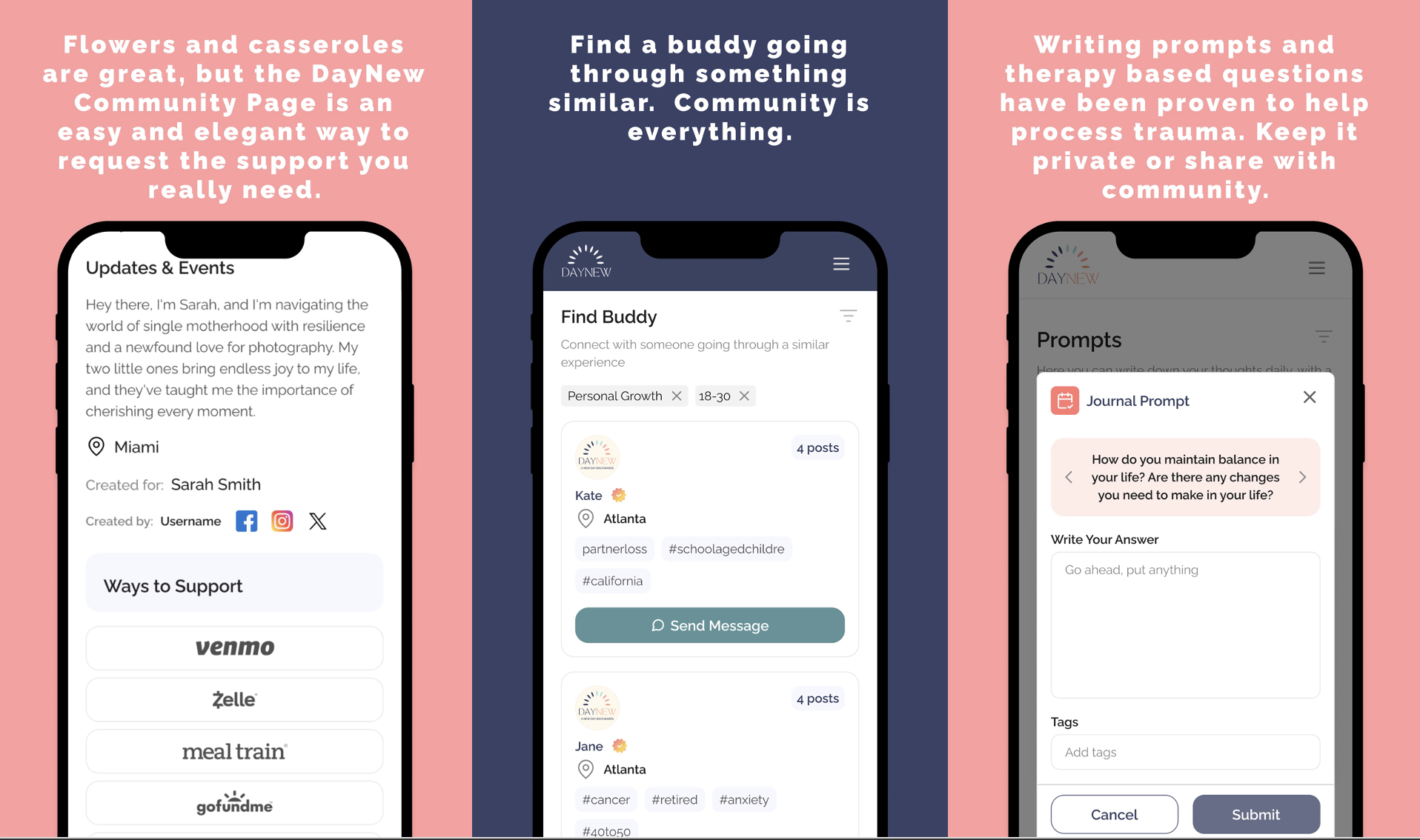
Some people find it hard to ask for help because they don’t want to feel like a burden to their family and friends. DayNew’s Community feed acts as a dedicated space for users to be direct about what they want from supporters, whether it be money to buy groceries, a place to sell and donate belongings, or a job listing for a babysitter.
“[Eloise and I] got lots of flowers and casseroles. While that’s beautiful, generous and thoughtful, we also got a lot of comments like ‘Whatever you need,’ and we were always ill-equipped on how to answer that or didn’t feel comfortable… The community page takes the ickiness of the ask out. It also takes the ickiness out of the supporters’ side because now they actually know what you need, and they don’t feel like they’re bothering you.” Nissim said.
There’s also a “Find a Buddy” feature for users to get one-on-one support from people who are going through similar tragedies. Users can search for others with the same hashtags in their profiles, including #partnerloss, #parentloss, #cancerloss, #covidloss, and so on.
Similar to other grief support platforms (Grief Refuge, Untangle, and Grief Works), DayNew has a Journal feature where users can vocalize how they feel by either answering prompts or freehanding an entry that speaks from the heart. The company compares the prompts to homework from a therapist, asking tough and thought-provoking questions such as “What’s something about grief you never knew before?” and “What’s something you wish you could tell your younger self?” Depending on comfort level, the journal entry can be kept private or shared publicly on the Community feed.
Additionally, there’s a daily mood tracker component for users to check in with themselves and log their moods on a scale of 1 to 10.
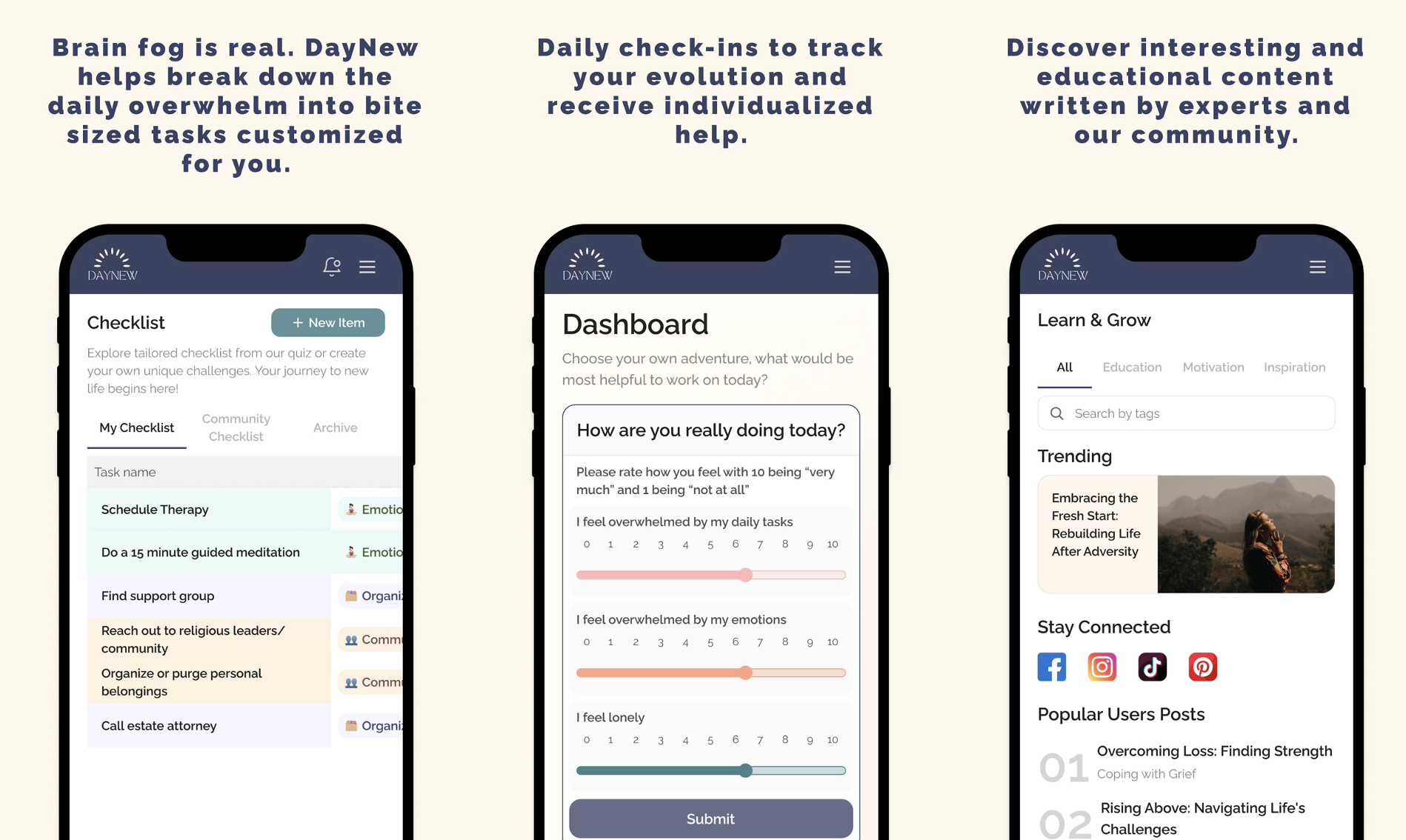
Image Credits: DayNew
DayNew offers various other features to assist users throughout their journey, including personalized lists for users to check off overwhelming tasks (sell assets, get life insurance, apply for widow social security benefits, and so on) at their own pace, a ChatGPT-powered AI tool that provides emotional advice, and a “Learn & Grow” page with educational and motivational content.
Nissim explained that the platform is also launching virtual workshops and in-person events to bring people together and teach them the benefits of “grounding and meditation” in order to promote healing. The online classes cost around $36 and feature special guests like experts, scientists, and psychologists. The first session is on May 21 and will be hosted by the founders themselves. In mid-July, there will be an in-person retreat in Mexico for about $1,800.
In the next iteration of the platform, DayNew plans to introduce a gifting feature where friends and family members can purchase classes to give to a loved one.
DayNew is free to join but it also offers a $5 per month subscription for users who want to access premium features, including the “Find a Buddy” service, direct messages, and being able to comment on public community posts.
In the digital age, users are embracing grief-related products and services to cope with death. What once was considered a taboo topic, grievers can now openly discuss loss and be reassured that they’re not alone. However, it’s important to realize that these services shouldn’t replace proper therapy and counseling but should act as an additional outlet to express their feelings.

Home From College, a career platform for young professionals and college students looking for their first job or internship, announced Wednesday that it raised $5.4 million in a seed round led by GV (formerly Google Ventures).
The new capital will go toward building out the platform’s main offering, “Gig,” a marketplace for companies to list jobs, ranging from part-time and internship opportunities to one-time projects and more long-term roles. Home From College features job listings from hundreds of top brands such as Poppi, Aquaphor, Burt’s Bees, Nivea, Urban Decay, Thrive Market, Peacock, and Steve Madden, among others.
The Los Angeles-based startup was founded in 2021 by Julia Haber, who founded WAYV, a marketing company that created “branded experiences” like pop-up shops on college campuses; and Kaj Zandvliet, a former financial analyst at Sony Music Entertainment.
Home From College had its genesis during WAYV-hosted events, where students would express their “fear of being unemployed when they graduated,” and “not having their [college] major aligning with what they actually wanted to do in life,” Haber told TechCrunch. Other pain points include students being unable to find an enjoyable way to earn extra income during their time at college, or not qualifying for jobs due to an empty resume.
Home From College aims to disrupt the traditional job search for Gen Z, who are gravitating toward more flexible opportunities outside of the 9-5. Some call Gen Z the “freelance generation,” with 67% of Gen Zers embracing freelance work and 71% prioritizing jobs with flexible working hours, per Fiverr. Gen Z is also exploring more creative roles, with many looking to build their careers in social media, entertainment, marketing, beauty, and fashion.
Haber wants Home From College to be a place for students to find gigs that fit within their busy lifestyles and provide valuable experience related to their career path and goals. So rather than applying for unpaid internships, they can take on side hustles like a social media ambassador or logo designer.
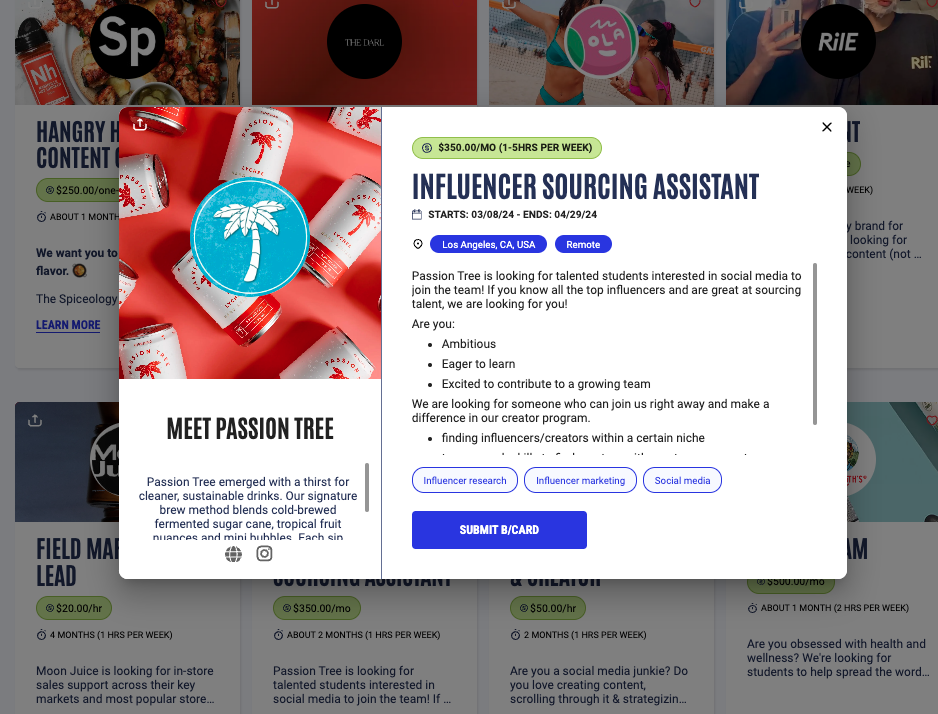
Image Credits: Home From College
“I work full time, so I’ve been using [Home From College] as a way to get side gigs,” Sierra Estevez, a recent graduate from SUNY Oneonta, told us. “I’m able to filter through the different gigs that are available to find opportunities that suit my timeframe or my schedule.”
When reviewing the marketplace, the majority of the listings are one-time gigs mainly focused on content creation or product testing, which many brands offer to get feedback from a younger demographic. The compensation varies widely. For instance, Nivea is currently offering $500 to create two TikTok videos. Smaller businesses offer much lower compensation, with one company offering just $15 to try a product and leave a review.
“All gigs on Home From College are paid… [it] helps weed out the [jobs] that feel maybe disingenuous to students or feel manipulative of their time because we know Gen Z cares a lot about that too… We always want to make sure that the opportunities for someone who is a career starter are always compensated realistic in terms of what the value exchange is,” Haber said. She added that the team reviews all the listings before they go live.
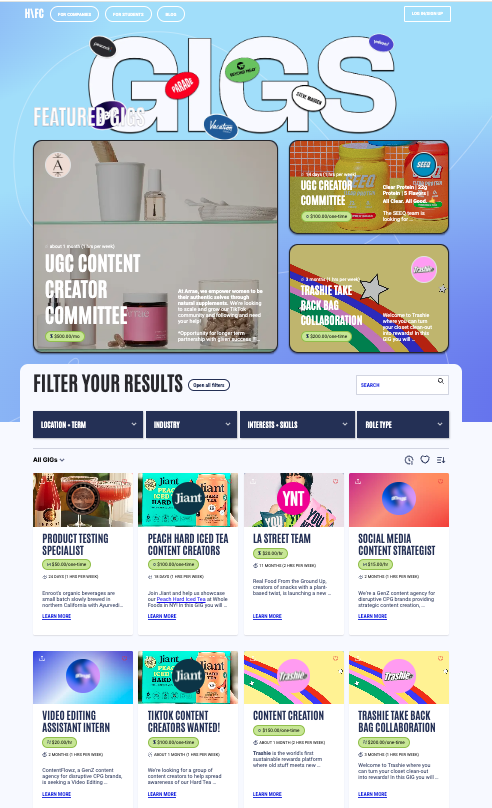
Image Credits: Home From College
Another way that Home From College caters to Gen Z and stands apart from other career sites is its interview feature where students answer questions from real companies, which they can post to their profiles. For instance, “If you had to describe your personal brand in one sentence, what would it be?” or “What role do you play in a group setting?”
In addition, the platform lets students show off their personality with fun cover designs for their profiles and colorful about pages that explain they’re background, experience, and what they’re looking for.
Students can also see the number of times companies have viewed their resumes and the total profile views they get on a weekly and monthly basis. Companies see a similar dashboard that tracks how many applicants are being reviewed and the number of contracts that have been signed.
Students can also receive messages from companies, giving them an opportunity to form connections with future employers.
“I actually get to talk to different people from these brands, whereas, with other platforms that I have tried, it’s a message that I put out or an application I’ve sent into an abyss that I never really hear back from,” Estevez added.
Home From College is also competing with design tools like Canva with its newest feature, “Resume Studio.” Although the templates offered on Home From College are arguably less advanced than Canva templates, they serve as a starting point for students who may have never made a professional resume before. The resume builder is still in beta, so the selection will likely improve over time.

Image Credits: Home From College
Home From College is free for students and has three subscription tiers for companies: Starter ($99 per month), Growth Mode ($199 per month) and Enterprise (price varies). Students are paid directly through Home From College’s platform and companies are charged a 20% service fee on top of each invoice price.
The platform has over 100,000 users. Home From College has helped facilitate “thousands and thousands” of hires, said Haber.
Home From College mainly caters to people just starting out in their careers, however, the company wants to expand its product offerings to people who have been in the workforce for ten years or less.
The company previously raised $1.5 million from PEAK6 and angel investors.

ChowNow, the online ordering platform and marketing service for local restaurants, acquired Cuboh, a Y Combinator-backed point-of-sale (POS) platform that consolidates all orders from delivery apps into one place.
This marks ChowNow’s first acquisition, which will help strengthen its POS integration solution and help restaurants tackle orders across multiple services.
However, as part of the acquisition, ChowNow laid off around 30 employees, bringing its total workforce to 300. Meanwhile, Cuboh’s entire 30-person team — including marketing, sales, product and engineering — is transitioning to ChowNow.
“We unfortunately did do a little bit of a layoff as part of the restructuring to best position us,” ChowNow co-founder and CEO Chris Webb told TechCrunch. This comes after the company laid off 100 people in 2022.
The financial terms of the deal weren’t disclosed.
Launched in 2012, ChowNow connects customers with local restaurants and helps businesses establish an online presence by providing custom online ordering systems and marketing support. It also offers a dispatch system that pairs restaurants with delivery drivers.
It doesn’t charge any commission fees like its competitors, and it allows restaurants to keep 100% of their profits. ChowNow considers over 20,000 small restaurants as customers and has helped process more than 250 million online orders. The company says it’s saved restaurants $700 million in commission fees.
ChowNow is a profitable company and has raised around $80 million to date, Webb said.
Cuboh is a notable addition to the company. Previously, ChowNow’s dashboard could only manage a restaurant’s in-house menu. Now restaurants no longer have to manually manage all their menus, mitigating the potential for errors and overall mayhem in the kitchen. Menus can be updated across all delivery apps to reflect out-of-stock items and price increases, among other changes.
Starting next week, restaurant owners can access a newly launched bundle, “ChowNow + Cuboh,” for $275 per month. The bundle combines ChowNow Pro ($199), the company’s flagship product that handles all ordering, marketing and operations, and Cuboh’s POS solution, which ranges from $100 to $200 a month.
And while ChowNow’s platform already integrates into over 30 POS systems — including Toast, Otter, MobileBytes, Positouch and more — Cuboh is delivering 14 additional integrations to the table, such as Clover, Lightspeed, Brink, Micros, Revel, Positouch, Square, Par, Dinerware, Aloha, and more.
In the future, ChowNow wants to build more integrations, such as one for catering services.
“It’s getting back to the longer-term product vision of what we’re building, of being the only platform restaurants need for their entire takeout business,” Webb said.