This story has been updated throughout with more details as the story has developed. We will continue to do so as the case and dispute are ongoing.



This story has been updated throughout with more details as the story has developed. We will continue to do so as the case and dispute are ongoing.
This story has been updated throughout with more details as the story has developed. We will continue to do so as the case and dispute are ongoing.
This story has been updated throughout with more details as the story has developed. We will continue to do so as the case and dispute are ongoing.

Dropbox has acquired AI-powered scheduling tool Reclaim.ai, which counts Calendly and Index Ventures among its backers. The development was revealed in a blog post on Reclaim.ai’s website Tuesday. Dropbox hasn’t disclosed the terms of the deal.

For retailers, e-commerce is a bit of a puzzle at the moment. Online shopping trends are expected to stay strong this year, so companies can’t afford to curtail their e-commerce budgets, but at the same time, e-commerce is more fragmented than ever before. There is a seemingly endless number of avenues to exploit — from social media companies like TikTok launching shopping, to established marketplaces, live shopping, and owned channels — and search as a channel is fading as SEO algorithms and the massive influx of content makes it hard to find what you’re looking for.

Shopify has acquired Threads.com, the Seqiuoa-backed Slack alternative, Threads said on its website. The companies didn’t disclose the terms of the deal but said that the Threads.com team will join Shopify.

Last November, Adam D’Angelo found himself at the epicenter of one of the biggest controversies in the tech industry. The board of OpenAI — the $80 billion startup leading the AI bandwagon — had abruptly booted its CEO, Sam Altman, only to reinstate him just days later. D’Angelo was on the board that dismissed Altman… and he was (and remains) on the board that brought him back in. In fact, he was the only person who kept his seat amidst the ensuing restructuring that saw a lot of the original board leave.
It was certainly a rocky time for OpenAI, but it was perhaps doubly so for D’Angelo, since the drama was playing out while his own company, Quora, was taking big steps towards AI.
Quora, the crowdsourced Q&A site D’Angelo co-founded and leads as CEO, had been building an AI platform of its own while also fundraising (a $75 million round that valued it at $425 million, per PitchBook). The company in February 2023 had launched Poe (short for Platform for Open Exploration), which lets users ask questions of and talk to a variety of chatbots, lets developers build their own bots, and offers a bot monetization program and marketplace similar to OpenAI’s GPT Store.
Quora’s core Q&A service was facing some big questions, too. Incumbent search engines like Google and Bing were beginning to use AI to produce more fluid results and answer questions, and with tools like ChatGPT and Perplexity being widely available, what could Quora do to secure a position as one of the top websites where people could get their questions answered? More crucially, does anyone actually want or need crowdsourced Q&A anymore?
For D’Angelo, those questions are intrinsic to his pursuit of AI, which he sees as an important tool that people can use to tap the Internet’s collective knowledge. An important, if understated, figure in tech for years, he’s been involved in efforts to tap the Internet’s store of knowledge for a long time — he was friends with Mark Zuckerberg in high school, where in 2002 the pair built a digital music suggestion service called Synapse that, according to this vintage piece from the Harvard Crimson, beat off acquisition offers from Microsoft and more. Later, he became CTO at Facebook when it was just starting out, and then eventually co-founded Quora.
All of that was seemingly a long road toward building AI tools for him, it appears. I recently caught up with D’Angelo about the challenges and opportunities in AI today, how to build and support a developer community, and what role humans can play when it comes to sharing and accessing knowledge. Here are a few highlights from our conversation:
The hype around AI seems to be having less of an impact on the search for information than you might think. D’Angelo said that Quora is seeing record numbers of users despite the proliferation of AI tools — although he declined to update the 400 million monthly active users figure it disclosed last July.
Still, there is a bridge between what Quora set out to do and D’Angelo’s interest in AI. Recently, in a conversation with David George, a general partner at a16z, D’Angelo said he was drawn to social networking because he was actually interested in AI. The latter was hard to develop at that time, but he saw social networks as an alternative architecture for achieving the same idea: People, assembled in a social network, in his view, almost played the role of living, large information models, as they could provide news, entertainment and more to each other.
He worked on that concept when he was with Facebook, and later, founded Quora to distill the role social networks could play in answering questions. Now, AI is taking over that role.
“In the past, humans were substituted for AI to provide answers. You could ask a question like, ‘What is the capital of California?’ and humans would answer that on Quora. Now, you can use AI tools to get that answer,” he said.
But AI, at least in its current shape today, cannot provide answers to all the questions people can have. That, D’Angelo believes, helps people retain a lot of value.
“Quora has always been founded on the idea that humans have a lot of knowledge they have access to in their heads that’s not on the internet anywhere. And AI will not have access to any of that knowledge,” D’Angelo said.
He acknowledged that AI still has a hallucination problem, which makes it hard to rely on such answers, even if newer, more advanced models are slowly making progress in tackling that issue.
Quora opened up Poe to all users last year after a few months of closed beta testing. Since then, the company has introduced tools to create and browse the bots on its marketplace.
The company’s pitch is that consumers get to use all the different kinds of models or bots on the platform. For developers, the allure lies in the possibility of reaching millions of users without having to worry about distribution across platforms. And developers can earn money on Poe in two ways: The first is through a referral when a user becomes a Poe premium subscriber via their bot; the second is by setting a per-message rate, so they get paid based on how often people use their bot.
In essence, Poe offers developers and users access to different large language models, but its functionality is similar to OpenAI’s ChatGPT and GPT Store.
But that means both platforms face some of the same challenges. They make it easy for anyone to create bots with prompts, which makes it hard for developers to stand out. D’Angelo told me that there are already a million bots on the platform, compared to 3 million custom GPTs on ChatGPT. For reference, it took Apple’s App Store more than five years to cross the million-app mark.
Both Poe and GPT Store also suffer from a ton of spam, similarly named bots, bots claiming to escape plagiarism, and even ones that flirt with copyright law. Poe has also released a feature that lets users chat with multiple bots in one conversation. All that noise makes it hard to choose a bot that will do the job well.
Despite these challenges, D’Angelo says that Quora wants to help developers earn sustainable money by improving bot discovery.
“One of our goals with developers is to be able to make a living [out of making AI bots] and cover their operational costs,” he said. “We have taken a big step forward with the pay-per-message feature, but we also want to help developers get distribution inside the platform as much as possible. So, we are working on improving our recommendation system so more people can find out about the bots.”
Poe is growing steadily, but it is still a lot smaller than ChatGPT. Market intelligence firm SimilarWeb suggests Poe has 4 million monthly active users in the U.S. (iOS and Android) and 3.1 million monthly active users worldwide (Android only). Compare this to ChatGPT users, which now averages 100 million users a week.
D’Angelo said that the company will stay away from ads, instead relying on Poe’s $19.99 per month subscription product to generate revenue. That is in contrast to some of the other AI-powered tools on the market: Perplexity, Bing Search, and Search Generative Experience (SGE) by Google all feature ads.
Quora and D’Angelo declined to disclose revenue figures, but data from analytics firm Sensor Tower indicates that Poe users have spent $7.3 million on subscriptions since its launch, amounting to close to 40,000 paid users. In comparison, ChatGPT has more than 1 million paid subscribers, according to Sensor Tower.
Despite stating the importance of human answers, Quora is already experimenting with answers written by Poe. The site surfaces the AI-written answer to some questions with a link that lets you chat with Poe if you have further questions.

Quora has started experimenting with AI-powered answers for some questions Image Credits: Screenshot by TechCrunch
D’Angelo said that Quora had already deployed systems to rate different human answers. Now, it is applying techniques like asking users through a survey if an AI-generated answer is useful.
“My goal is for the AI-written answers to be fairly ranked and only to be above a human answer if they are more useful than the human answer,” he said.
D’Angelo also wants to avoid having Quora tagged as an “answer engine.”
“I think we never really saw Quora as an answer engine. That term kind of implies that there are AI-only answers. Quora is really about human knowledge, and we’ll have AI enhance it,” he said
Quora is also working on AI tools that users can use to write answers and hopes to release them soon. D’Angelo noted that one of the tools it is testing allows users to generate an image based on their answers.
The company is using AI in a few other ways, too. One involves trying to catch bots or users using automation to answer questions on Quora. D’Angelo didn’t share details about the project, saying that the company would give a heads-up to perpetrators who are trying to game the system.
A few outlets and users have recently pointed out that the answer quality on Quora has plummeted. To that, D’Angelo said people feel that the overall standard of answers has decreased because low-quality answers have more visibility. He said AI is helping the company determine the difference between different quality of answers, and the early results look promising.
D’Angelo declined to discuss any of the OpenAI drama — “I just can’t talk about any of this stuff,” he said. “I’m not here to represent OpenAI. I can just represent Quora.” But he did say that he doesn’t see OpenAI as a competitor, because the bigger startup has, well, bigger ambitions.
“There is some sense of overlap in terms of what users can do on the GPT Store and what they can do on Poe. But that’s minor in the grand scheme of things. OpenAI is working towards this big mission to build AGI [Artificial General Intelligence]. And at Quora, we are looking to make AI products available to the world — including OpenAI’s products.”
Quora also continues to be a “big customer” of OpenAI and D’Angelo expects more collaboration with the company than competition.
“We spend a lot of money as a customer with OpenAI, because OpenAI is the biggest source of models for Poe,” he added.
While D’Angelo did mention that Quora pays “tens of millions” to developers on Poe and companies whose models the platform uses, he didn’t explicitly detail how these payments compared to the payout to OpenAI.
Quora currently doesn’t have any data licensing deals with any of the major companies, and it is not thinking about building its own model either, D’Angelo told TechCrunch.
“We are not in a rush to license our data. We want to make sure our rights and users’ rights are respected. Right now, there is not a lot of clarity around how all of this (AI landscape) will play out. So right now, we are just waiting before taking any steps in this direction,” D’Angelo said.
The company’s also relatively fresh out of its last fundraise, so it is focused on building AI across the business and improving revenue growth on its existing products. He said that Quora will go public “at some point,” but that is not the focus right now.

Google continues rolling out Gemini to different products as today the company announced that Android Studio’s bot is getting upgraded with Gemini Pro.
In May 2023, during the Google IO developer event, the company first introduced Studio Bot powered by the PaLM-2 foundation model. The company is rolling out Gemini in Android Studio in over 180 countries for the Android Studio Jellyfish version.
In February, Google also updated the base model for the Bard chatbot from PaLM-2 to Gemini Pro.
Just like the Studio Bot, the new Gemini bot lives in the IDE (Integrated Development Environment) and developers can ask coding-related questions.
The company said developers should notice improved answer quality in code completions, debugging, finding relevant resources, and writing documentation.
Google said that for privacy reasons, users will have to log in and enable Gemini explicitly to use it. Plus, the chatbot’s responses are dependent mostly on the conversation history and context provided by the developer.
The company said users can easily access the Gemini API starter template through Android Studio to add generative AI-powered features to their apps.
Google is determined to compete with tools like GitHub Copilot in its different developer-facing products. Last year, it introduced the PaLM-2-based Codey assistant to answer queries about programming and Google Cloud Services.

Web browsers have realized they are one of the best ways for users to access the present set of AI tools, so they are working on being the first-choice containers for that. SigmaOS, a Y Combinator-backed company, is now banking on users’ desire to utilize AI tools and pay for them as the company is releasing new features like link preview summaries, pinch-to-summarize, and “look it up” browsing features.
Some of these features sound and work like rival browser Arc’s recent releases. But SigmaOS claims that its feature returns better quality results, which is a hard metric to quantify.
The company is releasing pinch-to-summarize on desktop, which works a bit like Arc’s new mobile feature. While the feature summarizer captures sections like information, ratings, reviews, prices, and photos from an Airbnb listing, it just gives a small paragraph of info for an article, which is not sufficient. Arc browser’s summarize function also had its own hiccups in terms of missing out on key information, but it worked consistently across formats.
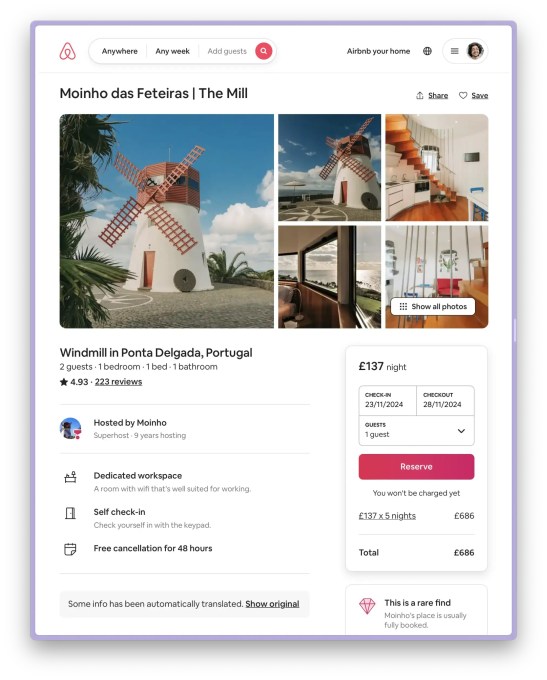
Image Credits: SigmaOS
One of the company’s co-founders Mahyad Ghassemibouyaghchi said that SigmaOS will adapt to different page types in the coming months and will present summaries in various formats based on the web page.
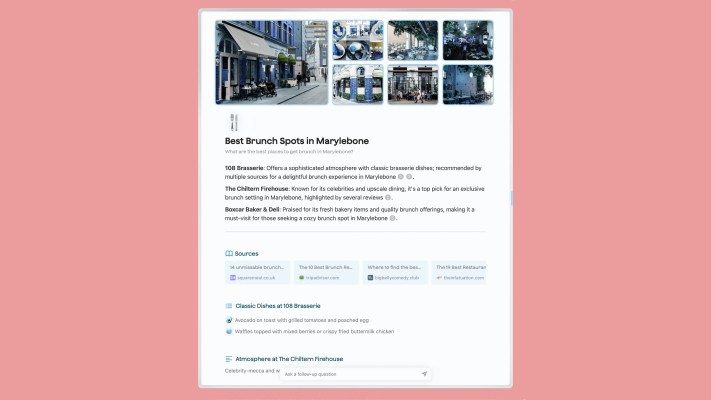
SigmaOS’s marquee feature from this release is called “Look it up.” It browses the web for a given query and makes a summary page out of the information that it finds. This is similar to Arc’s “Browse for me” function, but on desktop. One key differentiator is that users can ask follow-up questions to explore more about the topic.

Image Credits: SigmaOS
Besides that, the startup is also releasing link previews on hover and automatic renaming for locked (pinned) pages.
Last year, SigmaOS released some AI-powered features such as a contextual assistant called Airis, which can answer your questions about a webpage or the broader web.
At one point, the startup tried to monetize through team-based features. Now, the company is looking to monetize its AI features. It said that all users would get access to AI-powered features but for $20 per month users would get better rate limits for AI features. For $30 per month, they would get unlimited usage and the ability to choose between different models such as GPT-4, Perplexity and Claude 3 Haiku.
Separately, the company is now thinking big by aiming to release an AI-agent-like feature, which will let you use the browser in a hands-free mode. In a demo video, Ghassemibouyaghchi shows how users could clear emails or book an Airbnb by interacting with the browser with voice. This is a similar idea to the Rabbit r1 device, which aims to traverse an interface for you to complete a task.
The company is also aiming to build something called “repeatable flows,” which are automatic actions based on triggers like time. You can think of them as the If This Then That (IFTTT) of browsers, but that’s still in the concept stage.
Separately, SigmaOS’s competitor Arc, which recently raised $50 million in funding at a $550 million valuation, announced in January that it plans to build an AI agent that browses the web for you.
Ghassemibouyaghchi said that more than 100,000 users have been using their product. Until now, SigmaOS has raised $4 million from investors like LocalGlobe and Y Combinator. With this launch, the company aims to gain some traction and wants to prepare for its next raise.

India-based audio platform Pocket FM has secured $103 million in Series D funding led by Lightspeed Ventures with participation from Stepstone Group. The company, which counts Tencent and Times Internet as backers, aims to expand into Europe and Latin America after looking at positive results in the U.S. market.
The company has now raised $196 million across multiple rounds and is valued at $750 million, TechCrunch has exclusively learned.
TechCrunch reported last year that the company was in talks with Lightspeed to lead the funding round that it announced today.
Pocket FM offers audio series with several short episodes and aim to become the “Netflix for audio” globally. Users can listen to some series or episodes for free and unlock others by purchasing coins. Instead of adopting a subscription-based approach to let users access all content, Pocket FM has found that the pay-as-you-go model is more suitable for the company.
This doesn’t lock in users in a payment cycle. But if a user wants to listen to more content they have to buy coins — like buying level-up items in a game.
Last month, the company said that it plans to invest $40 million into its Wattpad-like writing platform Pocket Novel. Last week, the company’s co-founder Rohan Nayak posted on LinkedIn that more than 90,000 writers had signed up on the platform since February 20. Pocket Novel also pushes users to buy coins to unlock content.
While both apps have a coin-buying mechanism to unlock content, there is no integration between them at the moment. That means you can’t use the coins you bought on Pocket FM to unlock content Pocket Novel products and vice versa.
Pocket FM also has a limited audiobook vertical where it competes with the likes of Audible with a similar pay-to-unlock strategy. The company is running this product only in India with existing partnerships.
Pocket FM typically optimizes for users spending more time on the platform. To that end, the audio platform has more than 100,000+ hours of content and over 400,000 episodes across genres and languages.
The company’s U.S. expansion in 2021 has proved to be a major revenue driver. It said that Pocket FM has crossed $150 million ARR this year — with a $100 million ARR contribution from the U.S. The company is present in other markets, but it counts the U.S. and India as its biggest markets.
The platform has also seen a high level of engagement from its U.S. user base. While globally, users are spending 115 minutes on the audio platform, that average goes up to 135 minutes in the U.S.
The Pocket Novel writing platform, which has local competitors like Omidyar Network-backed Pratilipi, has more than 250,000 writers onboard. The company wants Pocket Novel to clock a $100 million in Annualized Revenue Run Rate (ARR) by 2025.
It is not surprising that Pocket FM is keen to try out generative AI-based features. It has already started testing a tool for writers in the U.S. to convert their writings into audiobooks. The company is working with Eleven Labs to provide writers with an array of 50 AI-powered voices.
The startup noted that it is also internally working on AI-powered tools that will help creators write their stories faster.
While Pocket Novel writers earn through a revenue share program, the startup provides incentives for hitting writing goals. But using AI tools that often generate unreliable or low-quality output means there is a lot of mediocre content on the platform.
Nayak told TechCrunch that essentially it is a platform’s job to filter out the noise.
“You need to filter out the noise and make sure you filter out the high-quality content which you then make available to listeners. The way we see AI at least in our context, it’s more about how you use AI to unlock productivity and efficiency gains for creators for writers,” he said.
Pocket FM says that some writers on the platform earn more than $3,000 per month but it didn’t give information about average overall income. The company doesn’t enforce an exclusivity clause when creators are onboarding the platform, but the startup said that it has some deals in place to own the IP.
Separately, the company is already talking to investors for its next round. Abu Dhabi’s sovereign wealth fund ADIA has held talks with Pocket FM for a potential mega funding round, TechCrunch reported last week.
The company didn’t directly respond to that development but said it has received significant investor interest.
“As you’re scaling you see a lot of investor interest generally. But whether it is the new round or not depends on sort of our scaling plan and depends on something materializing,” Nayak said.
Nayak also mentioned that the company is not profitable yet, but it has a high gross margin and is focusing on scaling. The startup has around 800 people and plans to add 500 personnel across the globe.