Interlagos, the venture capital firm started by former senior SpaceX leaders, is looking to raise $550 million for its first venture fund, according to regulatory filings and a confidential deck sent to prospective LPs and viewed by TechCrunch.



Interlagos, the venture capital firm started by former senior SpaceX leaders, is looking to raise $550 million for its first venture fund, according to regulatory filings and a confidential deck sent to prospective LPs and viewed by TechCrunch.

Few truly autonomous systems are deployed on the battlefield, but one startup is looking to change that with robotic systems that use cooperative behavior to boost troops’ intelligence and tactical advantage. Those systems are called “swarms,” and they’re basically collections of autonomous robots that can coordinate their actions.

Stoke Space is nothing if not ambitious. The five-year-old launch startup has generated a lot of hype due to its bold plans to develop the first fully reusable rocket, with both the booster and second stage vertically returning to Earth.

Defense tech startup Anduril has closed what will almost certainly end up being one of the largest funding rounds of the year: a $1.5 billion deal that values the company at $14 billion.

Sophisticated spacecraft often run on shockingly outdated computing systems: consider that the Perseverance rover runs on a PowerPC 750, the processor famous for running on iMacs in the late 1990s.

Try to imagine the number of parts that go into making a rocket engine. Now imagine requesting and comparing quotes for each of those parts, getting approvals to purchase the part you eventually do select, and tracking those parts until they arrive at your HQ. It’s exactly as complex as it sounds – but it doesn’t have to be, or so say two brothers who just scored funding to update the procurement process for hardware companies.

Hubble Network has become the first company in history to establish a Bluetooth connection directly to a satellite — a critical technology validation for the company, potentially opening the door to connecting millions more devices anywhere in the world.
The Seattle-based startup launched its first two satellites to orbit on SpaceX’s Transporter-10 ride-share mission in March; since that time, the company confirmed that it has received signals from the onboard 3.5mm Bluetooth chips from over 600 kilometers away.
The sky is truly the limit for space-enabled Bluetooth devices: the startup says its technology can be used in markets including logistics, cattle tracking, smart collars for pets, GPS watches for kids, car inventory, construction sites, and soil temperature monitoring. Haro said the low-hanging fruit is those industries that are desperate for network coverage even once per day, like remote asset monitoring for the oil and gas industry. As the constellation scales, Hubble will turn its attention to sectors that may need more frequent updates, like soil monitoring, to continuous coverage use cases like fall monitoring for the elderly.
Once its up and running, a customer would simply need to integrate their devices’ chipsets with a piece of firmware to enable connection to Hubble’s network.
Hubble was founded in 2021 by Life360 co-founder Alex Haro, Iotera founder Ben Wild (who sold his startup to Ring), and aerospace engineer John Kim. Haro said the first time Wild presented the idea of connecting a Bluetooth chip to a satellite, his initial reaction was, “No freaking way.” And it does sound crazy, especially as consumer electronics can struggle to connect to other Bluetooth-enabled devices that are just a few feet away.
But the demand is there: existing IoT device are power hungry, are costly to operate, and lack global connectivity, the company says. These are fundamental limitations related to Bluetooth-enabled devices today, and they prevent many industries from leveraging IoT for their businesses.
The company joined Y Combinator’s Winter 2022 cohort and closed a $20 million Series A last March. Hubble’s first innovation was to develop software enabling off-the-shelf Bluetooth chips to communicate over very long ranges with low power.
On the space side, the company also patented a phased array antenna that can launch on a small satellite. The antennas work almost like a magnifying glass, and it’s what enables an off-the-shelf Bluetooth chip to communicate with the Hubble satellite. The team also had to solve Doppler-related problems, frequency mismatches occur between fast-moving objects exchanging data via radio waves.
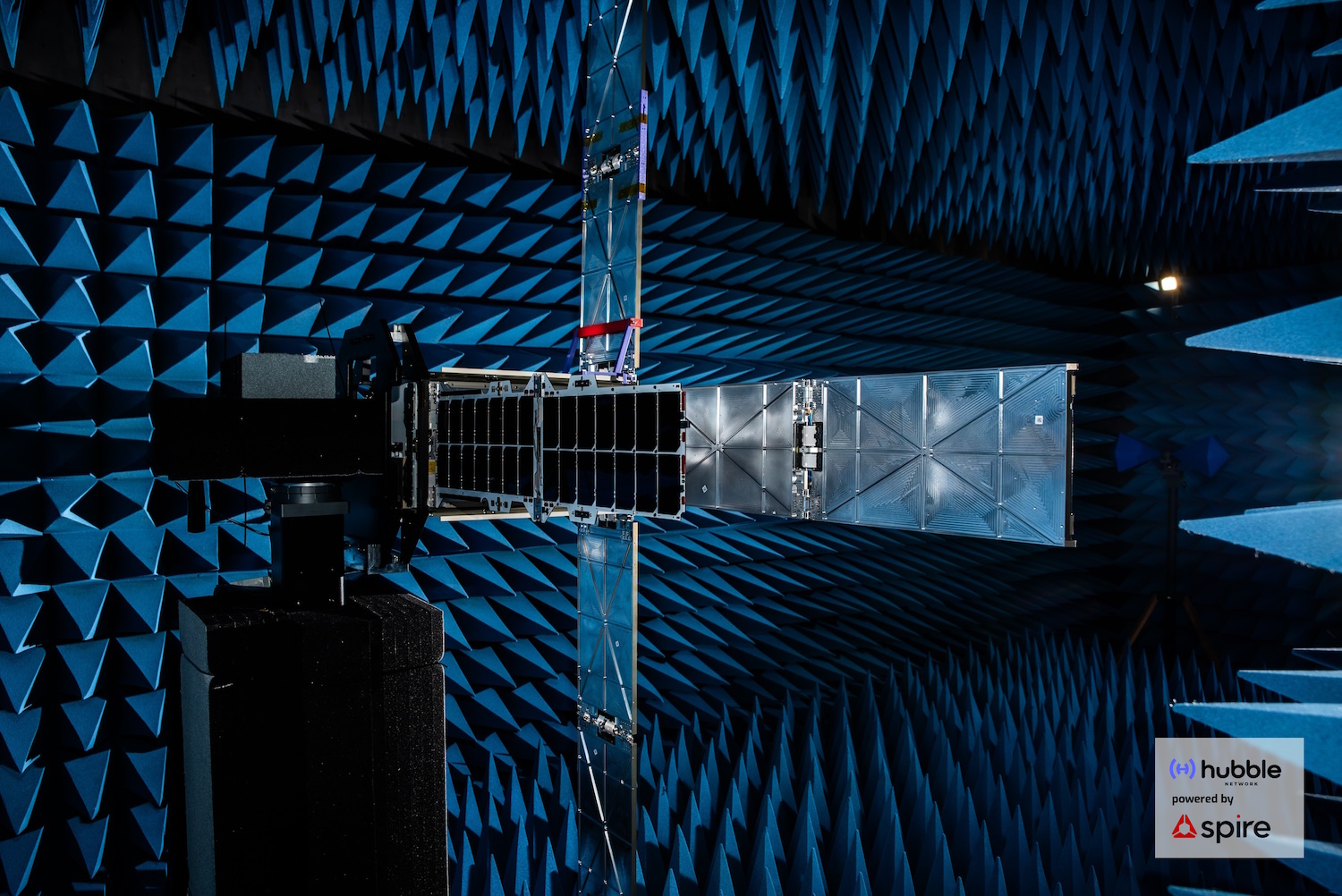
One of Hubble’s satellites in a terrestrial test chamber.
Hubble is aiming to launch a third satellite on SpaceX’s Transporter-11 mission this summer and a fourth on Transporter-13. Those four satellites will compose what Haro called the “beta constellation,” and pilot customers are starting to turn their integrations on even today, he said. The startup plans to launch the following 32 satellites all at once in the fourth quarter of 2025 or the beginning of 2026, though the launch provider has not been selected yet.
Those 36 satellites will compose Hubble’s first “production constellation,” and they’ll enable connection with a Hubble satellite roughly 2-3 hours per day from anywhere in the world.

Space and defense startup True Anomaly has laid off around 25% of its workforce and canceled its summer internship program, TechCrunch has learned.
“With our rapid growth over the past two years, we looked at every aspect of our company to make sure we are laser focused on our goals and best positioned to execute,” a company spokesperson said. “We identified the duplication of roles and functions across the company, and as such, reduced our headcount. This won’t impact our ability to execute on our contracts with customers or on our mission to bring security and sustainability to the space domain.”
While TechCrunch could not confirm the total headcount prior to these layoffs, True Anomaly had over 100 employees as of December 2023, it told the Denver Business Journal. Nearly 30 people were cut from the workforce, according to a post on LinkedIn from one of the people let go.
Employees started posting on LinkedIn about the layoffs on April 24; according to those messages, people impacted worked in sales, business development and recruiting. At least some interns were abruptly told the summer internship program was canceled last Friday, on April 19, as well. The internship was set to start on June 1.
The Centennial, Colorado-based startup closed a $100 million financing round last December; at the time, executives said staff had swelled to 107 employees. Earlier this month, True Anomaly CEO Even Rogers told TechCrunch during an interview on the company’s first mission that the company was “well-capitalized.”
True Anomaly hopes to modernize space defense with its Jackal spacecraft and Mosaic software platform for command and control operations. The startup envisions using Jackals on orbit to approach, image and gather intelligence on other objects in orbit.
True Anomaly launched that first mission, called Mission X, on March 4, though it ended early after the company failed to establish reliable communications with the two spacecraft that were deployed in orbit. The anomaly is hardly slowing them down, however. The startup is pushing to launch at least twice more in the next 12 months, aiming for another launch in October, one person told TechCrunch.
The person was offered an internship, and spoke to TechCrunch on condition of anonymity, saying that a technical recruiter suggested that the internship program had been canceled because the company didn’t have the human bandwidth to organize and supervise an intern project. The team is also starting work on the $30 million responsive space contract that the company was awarded earlier this month, the person said.

Paris-based Dark Space is taking on the dual problems of debris and conflict in orbit with their mobile platform designed to launch, attach to, and ultimately deorbit uncooperative objects in space.
Dark CEO Clyde Laheyne said the company is aiming to become the “S.W.A.T. team of space.”
The three-year-old startup is developing Interceptor, a spacecraft that is essentially a rocket-powered boxing glove that can be launched on short order to gently punch a wayward object out of its orbit.
Interceptor is itself launched from a specially outfitted aircraft. Much like a Virgin Galactic launch, the aircraft will take the rocket above the tumultuous lower atmosphere, where it can be released and ignited. Once the rocket reaches the vicinity of the target object, the spacecraft detaches and uses onboard sensors and propulsion to find and approach it. When it’s lined up correctly, Interceptor pushes against the object with its cushioned “effector,” eventually deorbiting it.
“All the space sector is organized to do planned, long missions … but orbital defense is more about unplanned, short missions,” Laheyne said. In that sense, Interceptor “is more like an air defense missile,” he explained. “It has to be ready all the time. There is no excuse that is viable to not use it.”
Unlike an actual missile or anti-satellite weapon, however, the gentle strike of the Interceptor doesn’t produce a debris field or any other dangerous, unpredictable effects.
Dark Space was founded by Laheyne and CTO Guillaume Orvain, engineers who cut their teeth at multi-national missile developer MBDA. This work experience shines through in the Interceptor concept, which is being designed to operate on-call, similar to missile systems. That’s also why Dark is developing its own launching platform: to ensure readiness for defense, civil and commercial companies at a moment’s notice, Laheyne said.
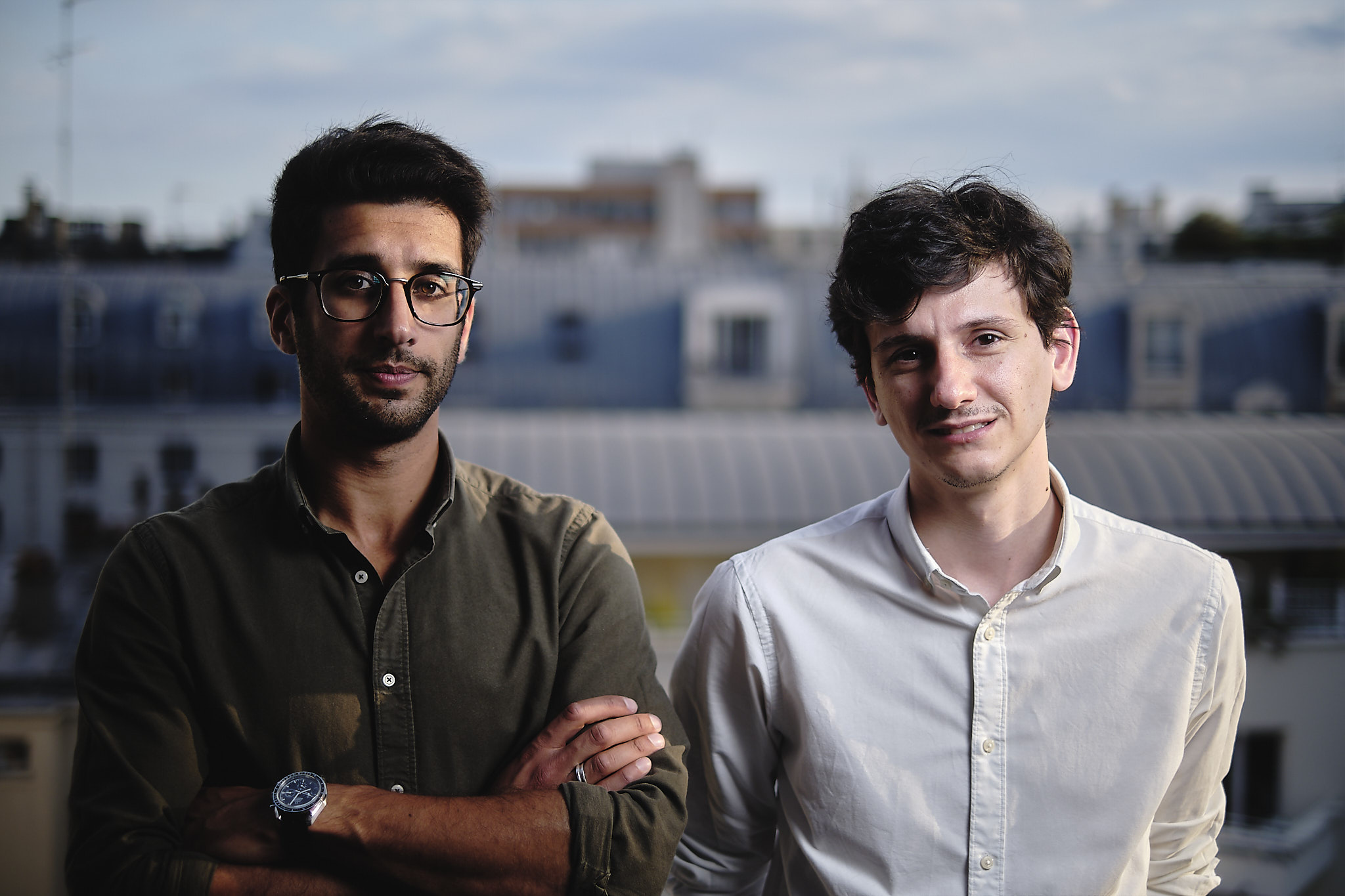
Dark Space co-founders Clyde Laheyne and Guillaume Orvain. Image credit: Dark
Dark closed a $5 million funding round in 2021, with the cap table composed of European investors including lead investor Eurazeo. The team closed a $6 million extension yesterday, including participation from its first U.S.-based investor, Long Journey Ventures. (That fund is led by Arielle Zuckerberg, the younger sister of Meta founder Mark Zuckerberg.)
The company has a lot of work ahead before it comes close to removing something like a defunct rocket second stage from orbit. Dark has been focused on developing critical systems, like the cryogenic engine and software. Now the team is shifting its focus to developing the technologies needed for the type of unplanned, quick missions Interceptor will execute, like long distance detecting and tracking, autonomous flight algorithms, and a system for reliable controlled reentry.
The team must also retrofit an aircraft — which Laheyne estimated could cost $50 million, or around the price of building a new launch pad — and have the entire platform ready for a demonstration mission in 2026.
That mission would validate many of the core technologies of the full-scale platform, though it won’t actually aim to deorbit an object, just touch one. Even this is incredibly ambitious: no company has yet cracked so-called rendezvous and proximity operations, meaning moving close to another object in space and interacting with it.
The second demonstration mission, which is currently planed for 2027, will include a deorbit attempt. If all goes to plan, the company would start deorbiting objects for allied civil agencies. As far as defense customers go, “hopefully we don’t have to use it,” Laheyne said.
“I’ve been doing missiles for years, and it’s always the same topic: if you use it first, it’s an act of war. If you’re second, it’s an act of defense. If you can do it, and people know you can do it, it’s dissuasion,” he said. “The ideal is dissuasion, the system that makes the conflict unthinkable.”

Inversion Space is aptly named. The three-year-old startup’s primary concern is not getting things to space, but bringing them back — transforming the ultimate high ground into “a transportation layer for Earth.”
The company’s plan — ultra-fast, on-demand deliveries to anywhere on Earth — sounds like pie in the sky, but it’s the sort of moonshot goal that could transform terrestrial cargo transportation. The aim is to send up fleets of earth-orbiting vehicles that will be able to shoot back to Earth at Mach speeds, slow with specially-made parachutes, and deliver cargo in minutes.
Inversion has developed a pathfinder vehicle, called Ray, that’s a technical precursor to a larger platform that will debut in 2026. Ray will head to space this October, on SpaceX’s Transporter-12 ride share mission, paving the way for Inversion’s future plans on orbit (and back).
Ray is small — about twice the diameter of a standard frisbee — and will spend anywhere from one and five weeks in space, depending on factors like weather and how the orbit aligns with the landing site, Inversion CEO Justin Fiaschetti explained in a recent interview.
This first mission will have three phases: the initial on-orbit phase, where the spacecraft will power on, charge its batteries, and hopefully send telemetry to the ground. During the second phase, Ray will use its onboard propulsion system to slow down the vehicle so it starts losing altitude and reentering the atmosphere. The reentry capsule will separate from the satellite bus (both designed in-house), with the latter structure burning up.
The third and final phase will see Ray slow down using a supersonic drogue parachute, from a reentry speed of Mach 1.8 to Mach 0.2. The main parachute will then deploy, further slowing the capsule to a soft splashdown off the coast of California.
Impressively, the company has designed and built almost all of the Ray vehicle in-house, from the propulsion system to the structure to the parachutes. This last component is key: almost no space company designs parachutes themselves, and they’re incredibly challenging to engineer from the ground up. Inversion’s engineering team completed qualification testing of the deployment and parachute systems last year.
We’ve completed a successful qualification campaign of the full recovery system for Ray, our pathfinder vehicle! Both of the parachutes and their deployment systems have been developed in-house by our recovery engineers, Connor & Daniel. pic.twitter.com/mPquy1nGbE
— Inversion (@InversionSpace) September 5, 2023
Fiaschetti said strong vertical integration has helped the company move so quickly.
“The purpose of our Ray vehicle is to develop technology for our next-gen vehicle. As such, we’ve built basically the entire vehicle in-house,” Fiaschetti said. “What we saw was that if we can build in-house now, do the hard thing first, that allows us to scale very quickly and meet our customer needs.”
The reentry vehicle is totally passive — meaning it doesn’t have active controls to navigate its reentry to Earth — but the company’s larger next-gen vehicle, called Arc, will have “football field-level” accuracy.
Inversion was founded by CEO Justin Fiaschetti and CTO Austin Briggs in 2021, but the two go back further: they met for the first time when they sat next to each other at a Boston College freshman matriculation ceremony. The pair eventually got jobs in southern California — Briggs, as a propulsion development engineer at ABL Space Systems, while Fiaschetti had brief engineering stints at Relativity and SpaceX — and they were actually roommates when they first floated the idea of developing technology to deliver cargo anywhere on Earth.
The company went through Y Combinator in the summer of 2021 (it was one of our favorites from the cohort) and closed its $10 million seed round in November that same year.
“We’ve been off to the races ever since,” Fiaschetti said. The company’s grown to 25 employees, who are based out of Torrance, California, where they have a 5,000-square-foot facility. The startup also owns five acres of land in the Mojave Desert, where it conducts engine testing. The scaling of the team and this first mission have been entirely financed by that round.
The startup sees promising markets in both government agencies and private companies; both segments could use Inversion’s reusable platform as an on-orbit testbed, or as a delivery vehicle to a private commercial space station. Inversion is aiming on pushing both reusability and duration-on-orbit “to the maximum” to bring down costs and also to support different mission profiles, Fiaschetti said.
Inversion aims to fly the next-gen vehicle, Arc, for the first time in 2026. While the two cofounders declined to provide more details on the spacecraft, the company’s website says it will be capable of carrying over 150 kilograms of cargo, to provide “proliferated” delivery in space.
“We are testing hardware consistently. We’re developing an infrastructure to be able to scale ourselves. Just as our decision to bring parachutes in house was a decision because the parachutes are so directly applicable to what we’re building, it’s making those kinds of key decisions that allows us to move move much faster than another reentry vehicle would take much longer to develop.”