Loop, the car insurance company co-founded by Harlem Capital co-founder John Henry, has laid off staff as the company struggles with fundraising.



Loop, the car insurance company co-founded by Harlem Capital co-founder John Henry, has laid off staff as the company struggles with fundraising.


The Great Rollback is here. The phrase refers to Big Tech starting to slash some of the diversity, equity and inclusion (DEI) programs that were implemented shortly after the murder of George Floyd. Most recently, Zoom announced that it laid off its DEI team. Google and Meta have started to defund their DEI programs, and funding to Black founders continues to dip. Lawsuits have been filed targeting DEI programs, forcing companies to now hide their inclusion efforts while billionaires are arguing on X about whether DEI initiatives are discriminatory or not.

AI mortgage startup LoanSnap is facing an avalanche of lawsuits from creditors and has been evicted from its headquarters in Southern California, leaving employees worried about the company’s future, TechCrunch has learned.

Sanil Chawla remembers the meetings he had with countless artists in college. Those creatives were looking for one thing: sustainable economic infrastructure that could help them scale rather than drown them in paperwork, filings and tracking down receipts.

Interest in male birth control has increased in the past few years, especially since the U.S. overturned Roe vs. Wade, which protected a woman’s right to have an abortion. Since then, states have tried to make abortion nearly impossible, prompting an increased look at contraceptives to allow both men and women to have more control over family planning. This conversation has led to the topic of male birth control — something doctors haven’t quite mastered until now, perhaps.
Kevin Eisenfrats is the founder of Contraline, a company that has developed a male contraceptive in the form of a non-hormonal, sperm-blocking gel that’s injected into the scrotum. Einsfrats discussed building this company, medical testing for it, and the medical innovation he had to create to make it all possible on TechCrunch’s Found podcast.
“Believe it or not, people have actually been working on male contraceptives since the female contraceptive pill came out in 1960,” Einsfrats told Found. “So it’s not like this is a forgotten area of research. It’s just that the science is really, really difficult.”
Einsfrats was inspired to launch his company after watching the MTV show “16 and Pregnant.” Years later, Contraline’s latest product, ADAM, is entering clinical trials in Australia, a country he says has so far been most receptive to the idea of male contraception. He plans to head to the U.S. soon and is gearing up for the long FDA approval process. So far, Einsfrats hasn’t had the hardest time fundraising — and says there has been much support even given the U.S. political climate, saying the debates have only increased interest in his work.
“We attract a certain type of investor that is really here for the long run,” he continued.
He also spoke about the importance of hiring the right team when it comes to a product like this and broke down some of the challenges that come with being the founder of a medical startup. For him especially, there have been regulatory hurdles, fundraising, and testing the medical hypothesis before landing on the right one.
All of the challenges have made him and his team stronger, he said, and he hinted about one day wanting to expand into Europe and other markets. He also spoke about possibly wanting to find ways to use his technology to develop non-hormonal female contraceptives, tackling other sorts of reproductive health issues that remain unsolved.
“We want to go after these big unsolved reproductive health problems,” he said. “We’re willing to take that risk that others are not willing to take.”

Clay Canning had an idea while in high school: smartphone screen protectors that featured logos, right on the screen.
He later connected with Rashaun Brown, who was working in sports and licensing at the time, and the idea for Screen Skinz was born.
“We both understood the opportunity and complemented each other’s weakness,” Brown, the company’s CEO, told TechCrunch. “In December 2022, I resigned from my job to pursue building Screen Skinz with Clay full time.”
Now, Screen Skinz can officially announce the closing of a $1.5 million seed round led by South Loop Ventures and Abo Ventures.
The company produces custom, patent-pending phone screen protectors that feature personalized logos or slogans that are visible when the phone screen is black and then disappear when the phone is in use. Customers can create their own designs or pick from the company’s existing catalog.
Phone accessories have always been a massive market, with the global screen protector market alone worth an estimated $51 billion as of 2023.
Screen Skinz already holds creative licenses with various big-name brands, working with organizations such as the NFL and NBA and entertainment brands like Marvel and the WWE.
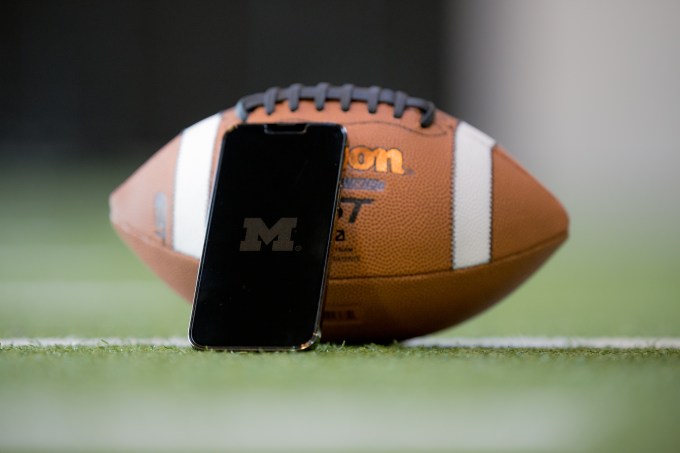
Example of Screen Skinz screen protector. Image Credits: Screen Skinz
The latest fundraise allowed Screen Skinz to move manufacturing from Asia to the U.S., allowing it to more easily control its supply chain.
The company is looking to double down on the screen protection industry, and though it currently only focuses on smartphones, there is a plan to one day expand to making screen protectors for tablets. “With our IP, we can essentially develop screen protection for any mobile device that has use for a screen protector and features a backlit display,” Brown said.
Brown described Screen Skinz’s fundraising process as “different,” stating that it took the company about a year to close its seed round. Brown and Canning intentionally took their time, as they also sought to refine their supply chain and prepare inventory for a mass go-to-market. “We wanted to do the work of selling a realistic vision to investors,” Brown said.
Screen Skinz met its co-lead investor, Abo Ventures, through Brown’s network from when he worked at Texas A&M. They then met South Loop Ventures while participating in the DivInc Sports Tech Accelerator in Houston.
Michelle Micone, the former SVP of consumer products at NFL and Hasbro, said she liked that the team had a unique concept and also figured out the manufacturing and logistics of producing it. “Customers want a high level of personalization, but it’s really, really hard to deliver on time and at a reasonable price. Screen Skinz has that formula, and I wanted to be part of it,” she told TechCrunch.
Other investors in the round include Brent Montgomery, the CEO of Wheelhouse CEO, alongside Wayne Pfeffer and Brendan O’Donnel, former directors of worldwide mobile accessory products at Apple. Pfeffer, in particular, was also sold on the idea of making screen protectors more personalizable. “For years, personalizing your device was limited to the case,” he told TechCrunch. “When I saw the evolution to the front on a screen protector, I was sold!
Brown said the company could look to raise as early as next year again. Screen Skinz next has some partnerships lined up and is focused on customer acquisition and deepening licensing relationships.


The second half of Y Combinator’s Winter 2024 cohort presented on Thursday, once again bringing dozens and dozens of new startups before a chunk of the venture investing community. As we did on Wednesday, a number of the TechCrunch crew watched the entire run of presentations, picking out a handful of favorites to highlight.
Enjoy our favorites from the second round of Y Combintor demos while we go out and buy another few pots of coffee. To work!