
10th Indian Delegation to Dubai, Gitex & Expand North Star – World’s Largest Startup Investor Connect
RetailTech

A Look At Shareholding & People At Helm


SUMMARY

Acquired by Snapdeal in 2015, Unicommerce is an ecommerce SaaS startup that enables sellers to manage their inventory across all online marketplaces

AceVector (formerly Snapdeal) is the largest shareholder in Unicommerce with a 38.18% stake, while SoftBank owns a 29.23% stake

Unicommerce’s net profit stood at INR 6.3 Cr in H1 FY24. In FY23, the startup’s net profit grew 8% to INR 6.4 Cr from INR 6 Cr in the previous fiscal year

Snapdeal-backed SaaS startup Unicommerce last week joined the rapidly growing list of startups that have filed their draft red herring prospectus (DRHP) with market regulator SEBI. The startup will sell up to 2.98 Cr shares during its initial public offering (IPO).

The SoftBank-backed startup’s IPO will only have an offer for sale, with no fresh issuance of shares. Unicommerce will also not engage in a pre-IPO placement.

Acquired by Snapdeal in 2015, Unicommerce is an ecommerce SaaS startup that enables sellers to manage their inventory across all online marketplaces. It offers integrations with all major ecommerce platforms active in India.

Unicommerce became the fifth startup to file DRHP within two weeks. Now, let’s take a look at the startup’s shareholding pattern.

Who Sits On Unicommerce’s Cap Table?

AceVector Ltd (formerly Snapdeal) is the largest shareholder in Unicommerce with a 38.18% stake. Snapdeal founders, Kunal Bahl and Rohit Kumar Bansal own a 9.95% stake in Unicommerce via their VC firm, B2 Capital Partners.

SoftBank is next on the list, with a 29.23% stake in the ecommerce SaaS player. The Japanese investing giant holds the equity stake via its UK-based entity, SB Investments Holdings (UK) Limited. Anchorage Capital is the fourth largest stakeholder in Unicommerce, as the US-based investor sits with a 7.77% stake.
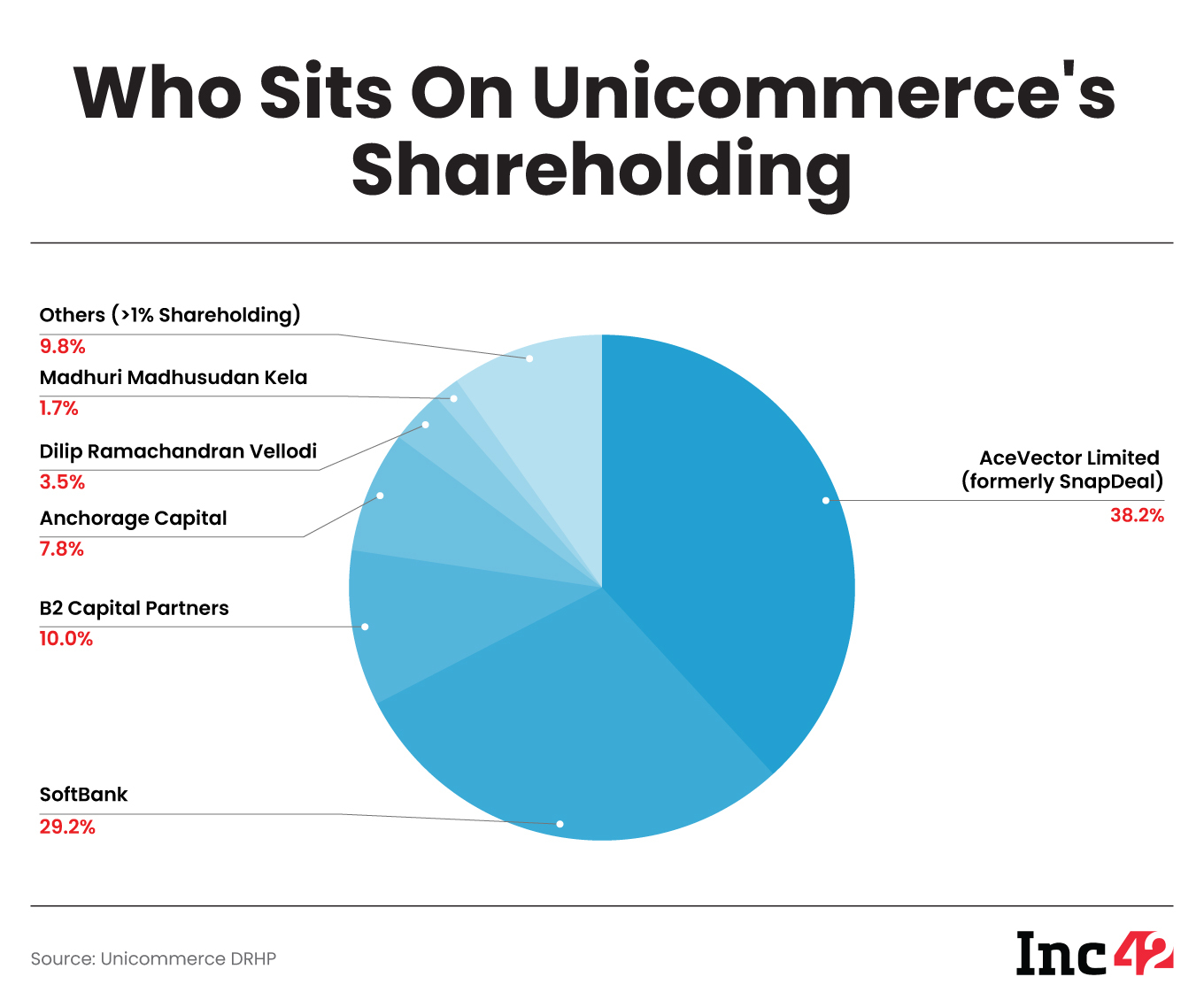
Sutherland Global Services’ founder Dilip Vellodi is the largest individual stakeholder in the ecommerce SaaS platform, with a 3.45% stake. Vellodi invested in Unicommerce less than ten days before the startup filed the draft papers. Ace investor Madhuri Kela, the wife of veteran investor Madhusudan Kela, is another significant individual shareholder in Unicommerce with a 1.66% stake.

The DRHP showed that Kela, Vellodi, Anchorage Capital, and CitiusTech cofounders Rizwan Koita and Jagdish Moorjani invested in the company on December 22, 2023.

People In Charge At Unicommerce

The board of directors at Unicommerce consists of Snapdeal cofounders Bahl and Bansal, along with several industry veterans. The board is chaired by Manoj Kumar Kohli, who also sits on the board of companies like Ola Electric, WeWork India, and Bira91, among others.
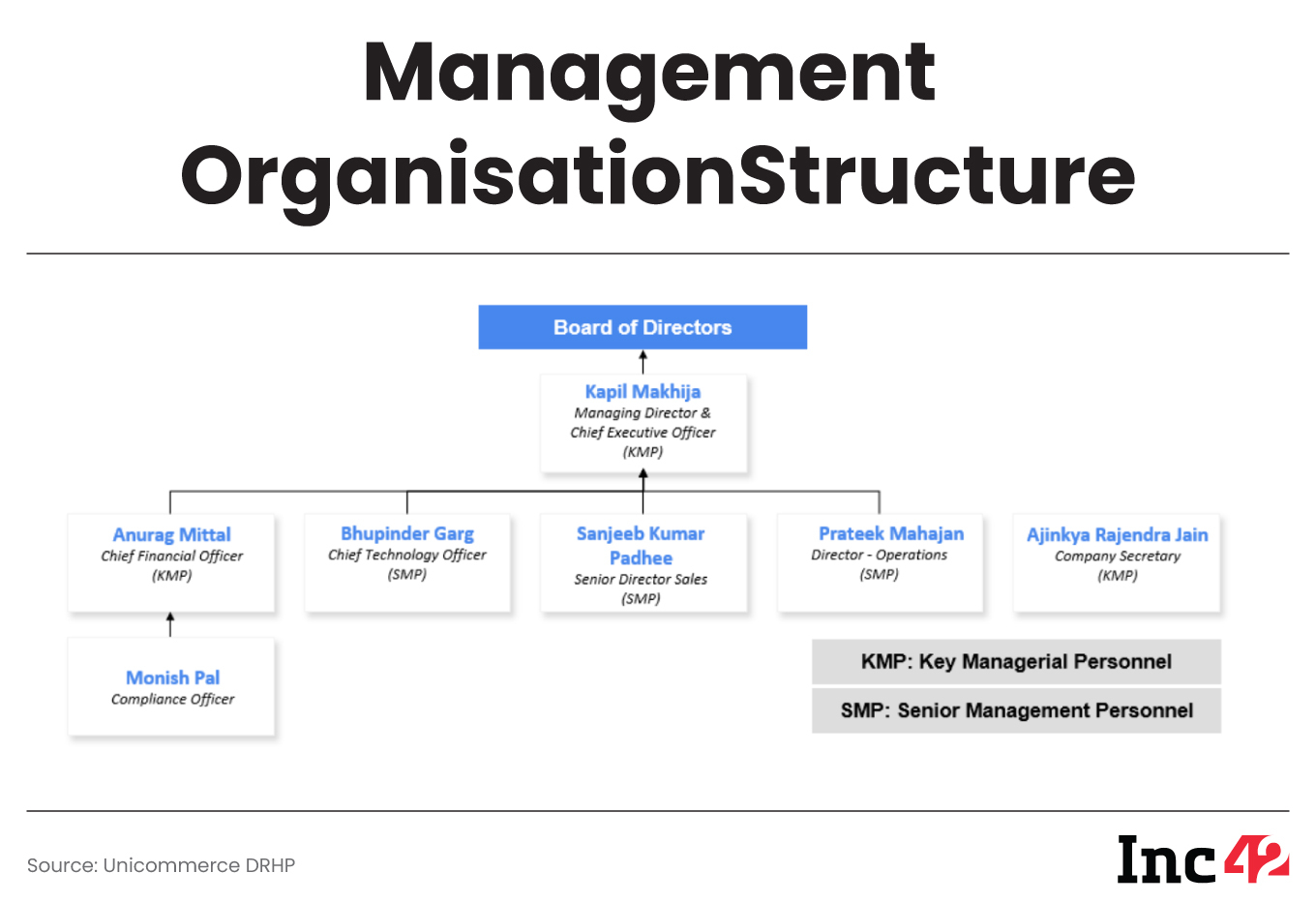
Kapil Makhija is the MD and CEO at Unicommerce, having been appointed to his position in 2017. Makhija, an IIT Delhi and IIM Bangalore alumnus, previously worked with Oracle India, A.T. Kearney, and Qwest Software Services.

Anurag Mittal is the CFO at the ecommerce SaaS startup. He joined the organisation in 2022 before being elevated to his current position in December 2022. An IIM Jammu alumnus and a trained chartered accountant (CA), Mittal previously worked with companies like Paytm, Nokia Siemens, Body Cupid, and Snapdeal.

Bhupinder Garg is Unicommerce’s CTO, appointed in October 2017. An IIT Roorkee alumnus, Garg previously worked with Snapdeal, Amazon Development Centre (India), and D. E. Shaw India Software.

The ecommerce SaaS startup is the third SoftBank-funded company that has filed DRHP in the past two weeks, following Ola Electric and FirstCry. In all, five startups, including MobiKwik and Awfis, have filed draft IPO papers with SEBI in the recent past.

Unicommerce’s net profit stood at INR 6.3 Cr in H1 FY24. In FY23, the startup’s net profit grew 8% to INR 6.4 Cr from INR 6 Cr in the previous fiscal year. The ecommerce SaaS startup’s operating revenue stood at INR 51 Cr in H1 FY24. In FY23, the startup’s operating revenue rose 52% to INR 90 Cr from INR 59 Cr in FY22.






Source link

by Vivek Kumar

A renewed sense of pride in homegrown brands is shaping the way consumers in cities and towns make purchasing decisions. Over half of respondents say they prefer shopping from homegrown and small business brands, citing accessibility, relatable stories, and authentic value as key reasons for their loyalty. Rukam Capital, a venture capital firm backing early-stage consumer brands, unveils this in a comprehensive study mapping the evolving behavior, preferences, and purchase drivers of Indian shoppers. India’s consumer economy is poised to become the second largest by 2030. Rukam Capital’s report- “Aspirations of New India- How Consumers Select, Shop, and Shape Brand Connections’”  aims to showcase the evolving trends in the market that in turn helps brands, startups, and investors to adapt to the evolving mindset of Indian consumers. The research captures the spirit of an India that is young, aspirational, and global in outlook yet deeply conscious of sustainability, authenticity, and community.  It further highlights that consumers have begun expressing clear willingness to pay a premium for local brands that excel in quality and champion social causes, further underscoring the appeal of startups driving community  upliftment. Commenting on the insights, Archana Jahagirdar, Founder and Managing Partner, Rukam Capital, said, “The Indian consumers are no longer passive participants in shaping trends, the market is evolving and is being pillared through affordability, aspirations and a digital sophistication. India is telling us that it is not just about what a brand sells, but how it makes them feel connected, understood, and valued. This shift is forcing even the most traditional categories to reinvent themselves beyond just seasonal triggers, whether that’s through healthier alternatives, transparent communication, or community-driven engagement. For founders, it’s a reminder that building loyalty in India now goes far beyond discounts; it’s about creating meaning in everyday consumption.” Key takeaways from the report-‘Aspirations of New India: How Consumers Select, Shop, and Shape Brand Connections’: From local to loved – homegrown brands are winning hearts of Indian consumers  Digital, dynamic and dialect are driving media habits of Indian consumers  Celebrity or influencers – who is catalyzing brand discovery and purchase decisions  Purchase drivers and deterrents for the value conscious Indian consumers  Indian consumers embrace heritage and health during festivities  Category & Channel Differentiation Discovery, Engagement & Gaming Social media responsiveness wins loyalty – 67% prefer brands that actively engage online. A new influence is also taking center stage – in-game advertisement. That was once pure entertainment has now become a powerful driver of shopping behavior The report also highlights the categories driving growth today.  Health and wellness, kitchen appliances, food and beverages, fashion accessories, and pet care are emerging as strong segments. Across categories, ease of availability, word of mouth, and strong customer service continue to be the top purchase drivers. The survey was conducted in collaboration with YouGov, with over 5000 respondents residing in 18 states to map the evolving consumer landscape of the country, representing both urban and semi-urban population.

by INC42

In today’s hyperconnected consumer landscape, FMCG brands are no longer just competing for shelf space; they are competing for attention, trust, and relevance in a vibrant digital ecosystem. The exciting shift we are witnessing is that consumers, especially digital-first millennials and Gen Z, are becoming more discerning. This marks a powerful opportunity for brands as authenticity emerged as the most valuable currency in FMCG marketing. One thing I’ve found as a cofounder is that the small moments often become the biggest touchpoints of… Source link

by Vivek Kumar

Honeywell (Nasdaq: HON) today released its Global Retailer Technology Survey, which found that India’s major retailers are fully invested in artificial intelligence (AI) and its potential to make operations more efficient. Almost all (96%) in-country retailers said they are using AI, with plans to either expand in the near future or maintain current usage of the technology, as compared to 85% globally.  The survey also highlights how Indian retailers are using AI, from smarter inventory and demand forecasting to enhanced customer service and optimized last-mile delivery. “Retailers are looking to AI to better understand what their customers want and how to best meet their needs in a constantly changing market,” said Ritwij Kulkarni, General Manager, Industrial Automation, Honeywell India. “In a country as large and diverse as India, AI has tremendous potential to create hyper-personalized customer experiences and optimize the flow of retail goods throughout the supply chain so they reach shoppers in the most efficient way.”  Other advanced technologies are making a significant impact on the retail landscape in India, with a majority of retailers already invested in machine and camera vision (CV) technologies (68%) and optical character recognition (OCR) (64%). While less common overall, augmented reality (AR) is also gaining traction, in use by 39% of surveyed Indian retailers.  OCR can significantly speed up retail workflows when replenishing the shelf inventory or identifying mislabeled prices by quickly reading labels and other product information. CV can help mitigate the growing challenge with retail shrinkage, while AR can help shoppers or employees visualize a product in a space.  While the results showed overall continued momentum for AI, Indian retailers expressed some concerns about its adoption.  Honeywell’s Global Retailer Technology Survey focused on large retailers throughout the U.S., Europe, Latin America, India and the Middle East and how they are using advanced technologies throughout their operations, including AI, automation, augmented reality, machine vision and sensors. Indian retailers participating in the survey had a minimum annual revenue of $10 million USD. Methodology Honeywell commissioned Wakefield Research to conduct the Global Honeywell Retailer Technology Survey in May 2025. This Omnibus survey polled 450 executives at large retailers about their use of AI and other technologies via an email invitation and online survey. The following markets are represented in survey data: the United States, United Kingdom, Germany, Brazil, India, United Arab Emirates and the Kingdom of Saudi Arabia. The threshold of “large” retailer varied by country, ranging from a minimum annual revenue of $100 million in the U.S. to minimum annual revenue of $5 million in the UAE and KSA.

