

GenAI has its issues. But if there’s one thing it excels at, it’s surfacing answers from vast pools of data.
Enter Glean, whose software connects to enterprise first- and third-party databases to field plain-English requests (e.g. “How do I invest in our company’s 401k?”) from employees, sort of like a custom ChatGPT. Launched by Arvind Jain, the co-founder of cloud data management company Rubrik, Glean was inspired by Jain’s observations that Rubrik employees often struggled to find the information they needed to do their jobs — and that staffers at other companies were struggling with the same.
“I saw that engineers were spending too much time outside code, account managers couldn’t find the latest research or presentation needed to close deals, new employees took too long to onboard, and so on” Jain told TechCrunch in an interview. “This growing problem destroyed productivity, sapped energy and detracted from the employee experience.”
It seems Jain was onto something.
A recent Gartner survey found that 47% of desk workers have trouble finding the data they need to perform their jobs. In the same survey, workers reported that the growing number of apps they have to manage at work — 11 on average now versus six five years ago — is exacerbating the challenge.
In 2019, Jain — along with a small founding team — built Glean as an AI-powered search app geared toward enterprise customers.
The first few iterations were along the lines of Microsoft’s SharePoint Syntex and Amazon Kendra, occupying a product category known as “cognitive search.” Using natural language processing, the early Glean could understand document minutia in addition to searches employees across an organization might perform.

Image Credits: Glean
Over the years, Glean evolved into a platform that connects with and analyzes a company’s databases and data stores to answer employee inquiries — following after the explosive GenAI trend. Glean today ingests info from sources including support tickets, chat messages and customer relationship management platform entries and applies GenAI to attempt to turn that all that into insights and relevant answers.
One imagines companies would be wary of connecting their proprietary data — especially their internal chat data — to a GenAI platform that performs this deep a level of scraping and analysis. And that wouldn’t be an incorrect assumption.
A recent Cisco poll found that more than one in four organizations have banned the use of GenAI over privacy and data security risks. In the poll, companies said they feared GenAI tools would compromise their IP or potentially disclose other sensitive information to the public — or their rivals.
But Jain asserts that Glean is “secure” and “private” — at least to the extent a cloud-based GenAI platform can be.
“Glean respects the same permissions set in a company’s data sources (Slack, Teams, Jira, ServiceNow, etc.), so employees only receive answers based on the data they’re allowed to access,” Jain said. “When a user deletes a document in the underlying application, the document gets deleted from the Glean system.”
What about the curse from which most GenAI suffers, though — hallucinations? Is Glean immune from making up facts and citations, getting summaries wrong and missing the point of basic requests?
It’s possible; this writer wasn’t able to test Glean himself. But Jain, while neither confirming nor denying Glean hallucinates, highlighted the mitigations in place to make the platform’s GenAI more reliable. including a model trained on customer data to learn industry and firm-specific jargon and letting customers switch among several open source GenAI models to drive Glean’s core experience.
“AI work assistants need to deliver personalized results based on who’s searching,” Jain said. “Various aspects of the searcher — their role, job function, management hierarchy, specific projects and responsibilities and even who they work with — end up being important in defining the content that’s relevant to them. Glean learns a custom model for every customer to deliver highly personalized results to every employee based on these attributes.”
Glean also employs RAG (short for Retrieval-Augmented Generation), an increasingly common technique used to “ground” GenAI by retrieving data from outside sources of knowledge, to boost performance. Jain says that every answer Glean gives is “fully referenceable” back to the original source.
“Glean [can recommend the] documents users might need for their day-to-day work by learning from past work patterns,” Jain said. “[It] delivers turnkey implementation of a complex AI ‘ecosystem,’ with over 100 connectors.”
Glean makes money by charging a monthly per-seat subscription, based on annual contracts.
Despite competition from vendors like Microsoft (specifically Copilot) and OpenAI (ChatGPT) as well as enterprise search providers such as Coveo, Sinequa and Lucidworks, Jain says that business has been quite strong as of late, with annual recurring revenue close to quadrupling in the last year.
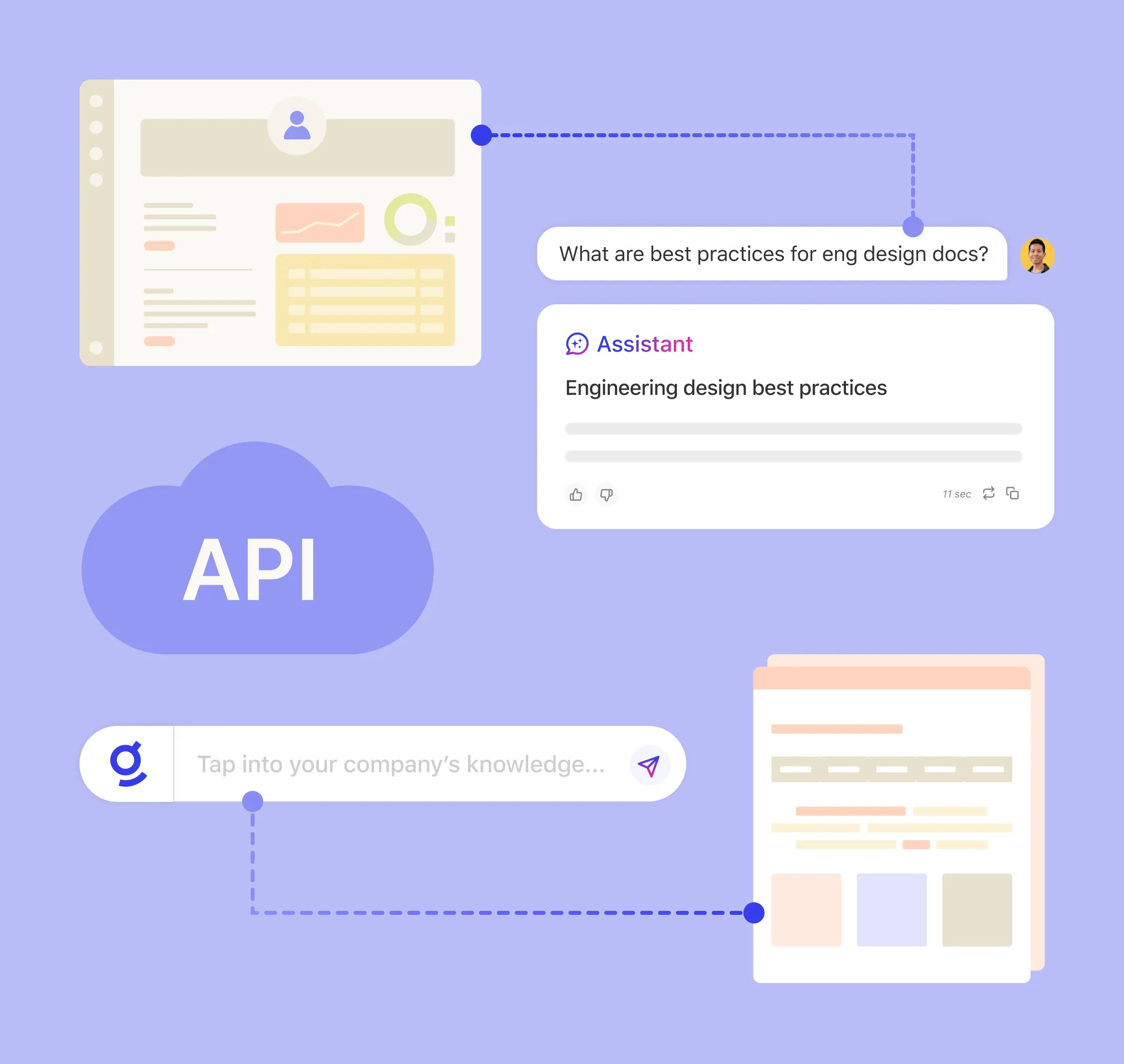
Image Credits: Glean
That runs counter to the narrative that corporations — far from embracing GenAI wholeheartedly — have been slow and wary to deploy it across their business functions.
Responding to a December 2023 survey by Convrg.io, the Intel subsidiary, only 10% of organizations said that they’d launched GenAI solutions all the way to production in 2023. The vast majority of solutions remained in the research and testing phases, the organizations said — implying companies haven’t been successful in finding money-making GenAI use cases.
Glean’s financials — and a 200-strong customer base that includes Duolingo, Grammarly and Sony — appear to have won over investors, however.
Glean today announced that it raised $200 in a Series D funding round co-led by Kleiner Perkins and Lightspeed Venture Partners with participation from General Catalyst, Sequoia Capital, Adams Street, Coatue, ICONIQ, IVP, Latitude Capital and additional strategic backers Capital One Ventures, Citi Ventures, Databricks Ventures and Workday Ventures.
Kleiner Perkins’ Mamoon Hamid had this to say in a statement: “The opportunity for Glean is enormous, and we have so much conviction in the team’s ability to provide the GenAI solution for the enterprise that we co-led this round after investing in every round prior to this, after leading their Series A in 2019. I’ve spent my venture career investing in applications that enable knowledge workers to be more productive, whether it’s Slack, Box or Figma, and see huge potential in Glean to change the way that people work.”
Jain says that the new capital, which brings Glean’s total raised to $358 million and values the startup at $2.2 billion, will be put toward expanding “all of” Glean’s teams (the San Francisco-based company has ~300 employees at present), enhancing its product and “building out a robust go-to-market motion.”
“Glean has continued to see strong and growing customer demand, especially from enterprises who’ve spent the past year evaluating the necessary requirements to bring GenAI into their organizations,” Jain said. “We’ve always been prudent in hiring and spending, and the recent increase in hiring is to meet strong customer demand.”







