
10th Indian Delegation to Dubai, Gitex & Expand North Star – World’s Largest Startup Investor Connect
Artificial Intelligence

Humane pushes Ai Pin ship date to mid-April


Hardware is difficult, to paraphrase a famous adage. First-generation products from new startups are notoriously so, regardless of how much money and excitement you’ve managed to drum up. Given all that, it’s likely few are too surprised that Humane’s upcoming Ai Pin has been pushed back a bit, from March to “mid-April,” per a new video from the Bay Area startup’s Head of Media, Sam Sheffer.

In the Sorkin-style walk and talk, he explains that the first units are set to, “start leaving the factory at the end of March.” If Humane keeps to that time frame, “priority access” customers will begin to receive the unit at some point in mid-April. The remaining preorders, meanwhile, should arrive “shortly after.”

Humane captured a good deal of tech buzz well before its first product was announced, courtesy of its founders’ time at Apple and some appropriately enigmatic prelaunch videos. The Ai Pin was finally unveiled at an event in San Francisco back in early November, where we were able to spend a little controlled hands-on time with the wearable.

The device is the first prominent example of what’s likely to be a growing trend in the consumer hardware world, as more startups look to harness the white-hot world of generative AI for new form factors. Humane is positioning its product as the next step for a space that’s been stuck on the smartphone form factor for more than a decade.
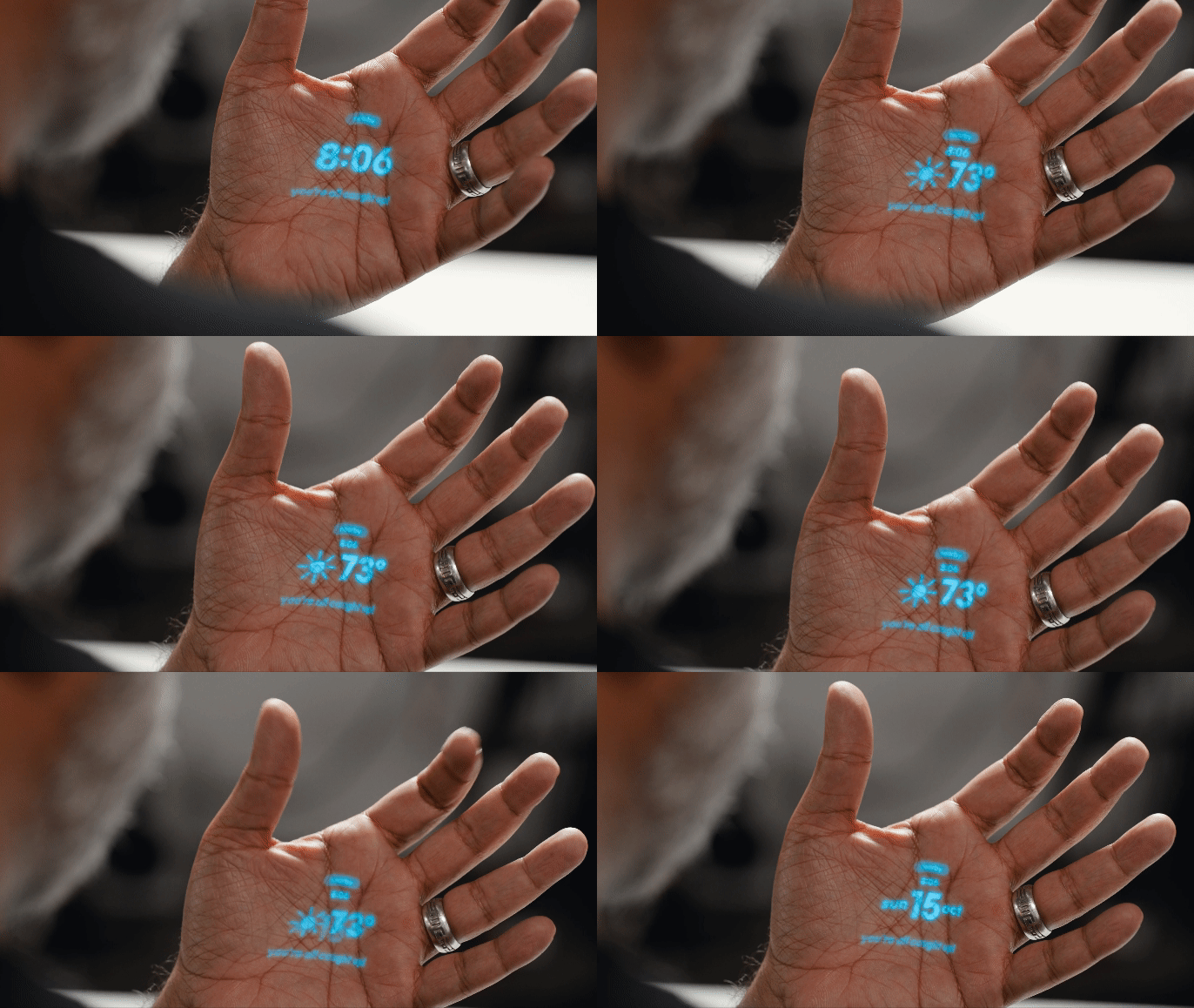
Image Credits: Humane

Of course, this will almost certainly also be the year of the “AI smartphone” — that is to say handsets leveraging platforms’ GPT models from companies like OpenAI, Google and Microsoft to bring new methods for interacting with consumer devices. Meanwhile, upstart rabbit generated buzz last month at CES for its own unique take on the generative AI-first consumer device.

For its part, Humane has a lot riding on this launch. The company has thus far raised around $230 million, including last year’s $100 million Series C. There’s a lot to be said for delaying a product until it’s consumer ready. While early adopters are — to an extent — familiar with first-gen bugs, there’s always a limit to such patience. At the very least, a product like this will need to do most of what it’s supposed to do most of the time.

During CES, the company announced that it had laid off 10 employees, amounting to 10% of its total workforce. That’s not a huge number for a startup of that size, but it’s absolutely notable when it occurs at a well-funded company at a time when it needs to project confidence to consumers and investors, alike.

The Ai Pin is currently available for preorder at $699. Those who do so prior to March 31 will get three months of the device’s $24/month subscription service for free.






Source link

by Team SNFYI

Facebook is testing a new feature that invites some users—mainly in the US and Canada—to let Meta AI access parts of their phone’s camera roll. This opt-in “cloud processing” option uploads recent photos and videos to Meta’s servers so the AI can offer personalized suggestions, such as creating collages, highlight reels, or themed memories like birthdays and graduations. It can also generate AI-based edits or restyles of those images. Meta says this is optional and assures users that the uploaded media won’t be used for advertising. However, to enable this, people must agree to let Meta analyze faces, objects, and metadata like time and location. Currently, the company claims these photos won’t be used to train its AI models—but they haven’t completely ruled that out for the future. Typically, only the last 30 days of photos get uploaded, though special or older images might stay on Meta’s servers longer for specific features. Users have the option to disable the feature anytime, which prompts Meta to delete the stored media after 30 days. Privacy experts are concerned that this expands Meta’s reach into private, unpublished images and could eventually feed future AI training. Unlike Google Photos, which explicitly states that user photos won’t train its AI, Meta hasn’t made that commitment yet. For now, this is still a test run for a limited group of people, but it highlights the tension between AI-powered personalization and the need to protect personal data.

by Team SNFYI

News Update Bymridul     |    March 14, 2024 Meesho, an online shopping platform based in Bengaluru, has announced its largest Employee Stock Ownership Plan (ESOP) buyback pool to date, totaling Rs 200 crore. This buyback initiative extends to both current and former employees, providing wealth creation opportunities for approximately 1,700 individuals. Ashish Kumar Singh, Meesho’s Chief Human Resources Officer, emphasized the company’s commitment to rewarding its teams, stating, “At Meesho, our employees are the driving force behind our success.” Singh further highlighted the company’s dedication to providing opportunities for wealth creation despite prevailing macroeconomic conditions. This marks the fourth wealth generation opportunity at Meesho, with the size of the buyback program increasing each year. In previous years, Meesho conducted buybacks worth over Rs 8.2 crore in February 2020, Rs 41.4 crore in November 2020, and Rs 45.5 crore in October 2021. Meesho’s profitability journey began in July 2023, making it the first horizontal Indian e-commerce company to achieve profitability. Despite turning profitable, Meesho continues to maintain positive cash flow and focuses on enhancing efficiencies across various cost items. The company’s revenue from operations for FY 2022-23 witnessed a remarkable growth of 77% over the previous year, amounting to Rs 5,735 crore. This growth can be attributed to Meesho’s leadership position as the most downloaded shopping app in India in both 2022 and 2023, increased transaction frequency among existing customers, and a diversified category mix. Additionally, Meesho’s focus on improving monetization through value-added seller services contributed to its revenue growth. Meesho also disclosed its audited performance for the first half of FY 2023-24, reporting consolidated revenues from operations of Rs 3,521 crore, marking a 37% year-over-year increase. The company achieved profitability in Q2 FY24, with a significant reduction in losses compared to the previous year. Furthermore, Meesho recorded impressive app download numbers, reaching 145 million downloads in India in 2023 and surpassing 500 million downloads in H1 FY 2023-24. Follow Startup Story Source link

by Team SNFYI

You might’ve heard of Grok, X’s answer to OpenAI’s ChatGPT. It’s a chatbot, and, in that sense, behaves as as you’d expect — answering questions about current events, pop culture and so on. But unlike other chatbots, Grok has “a bit of wit,” as X owner Elon Musk puts it, and “a rebellious streak.” Long story short, Grok is willing to speak to topics that are usually off limits to other chatbots, like polarizing political theories and conspiracies. And it’ll use less-than-polite language while doing so — for example, responding to the question “When is it appropriate to listen to Christmas music?” with “Whenever the hell you want.” But Grok’s ostensible biggest selling point is its ability to access real-time X data — an ability no other chatbots have, thanks to X’s decision to gatekeep that data. Ask it “What’s happening in AI today?” and Grok will piece together a response from very recent headlines, while ChatGPT, by contrast, will provide only vague answers that reflect the limits of its training data (and filters on its web access). Earlier this week, Musk pledged that he would open source Grok, without revealing precisely what that meant. So, you’re probably wondering: How does Grok work? What can it do? And how can I access it? You’ve come to the right place. We’ve put together this handy guide to help explain all things Grok. We’ll keep it up to date as Grok changes and evolves. How does Grok work? Grok is the invention of xAI, Elon Musk’s AI startup — a startup reportedly in the process of raising billions in venture capital. (Developing AI’s expensive.) Underpinning Grok is a generative AI model called Grok-1, developed over the course of months on a cluster of “tens of thousands” of GPUs (according to an xAI blog post). To train it, xAI sourced data both from the web (dated up to Q3 2023) and feedback from human assistants that xAI refers to as “AI tutors.” On popular benchmarks, Grok-1 is about as capable as Meta’s open source Llama 2 chatbot model and surpasses OpenAI’s GPT-3.5, xAI claims. Image Credits: xAI Human-guided feedback, or reinforcement learning from human feedback (RLHF), is the way most AI-powered chatbots are fine-tuned these days. RLHF involves training a generative model, then gathering additional information to train a “reward” model and fine-tuning the generative model with the reward model via reinforcement learning. RLHF is quite good at “teaching” models to follow instructions — but not perfect. Like other models, Grok is prone to hallucinating, sometimes offering misinformation and false timelines when asked about news. And these can be severe — like wrongly claiming that the Israel–Palestine conflict reached a ceasefire when it hadn’t. For questions that stretch beyond its knowledge base, Grok leverages “real-time access” to info on X (and from Tesla, according to Bloomberg). And, similar to ChatGPT, the model has internet browsing capabilities, enabling it to search the web for up-to-date information about topics. Musk has promised improvements with the …

