
10th Indian Delegation to Dubai, Gitex & Expand North Star – World’s Largest Startup Investor Connect
Artificial Intelligence

Attentive.ai snags $7M to boost automation in landscaping, construction services


Attentive.ai, a startup building vertical software for landscaping and construction services in the U.S., has raised $7 million in a new funding round as it looks to enhance its AI-led offerings and expand them to more businesses.

Led by Vertex Ventures Southeast Asia and India, the all-equity Series A round, which follows the earlier $5 million seed investment, also received participation from Attentive.ai’s existing investors: Peak XV’s Surge and InfoEdge Ventures. Additionally, Mumbai-based investment firm Tenacity Ventures has come on board this time through a secondary investment.

Landscaping and outdoor services primarily rely on manual measurements that involve labor and operational costs. Whether site measurement or paving maintenance, businesses spend hundreds of dollars and tens of hours before kicking off their projects to estimate the cost, appropriate material and time required. Inaccurate estimates also sometimes lead to overbidding and underbidding and impact revenue goals. As the real estate industry grows, landscaping and outdoor services companies look for tech-driven solutions to bring efficiencies and cut operational expenses. Enter Attentive.ai to address these needs using AI and computer vision.

Founded in April 2021 with a focus specifically on North America, the Delaware-based startup, which has an office in India’s Noida, offers an end-to-end business management platform with AI-based workflows to bring automation to landscaping and construction companies. The platform — already used by some major industry players, including Juniper, U.S. Lawns, Beary Landscaping, Greenscape, Nanak and East Coast Facilities, among others — helps companies save time and effectively bid for outdoor contracts using automated site measurements through Automeasure. The automation tool targets services such as landscape, paving and facilities maintenance and snow management.

Companies using Attentive.ai’s Automeasure can get measurements of properties — be they commercial, retail chains or housing societies — using a Google Maps-like interface from where they receive the estimates by searching for a particular property address and defining the lot boundary based on their requirements. Additionally, the tool allows users to manually upload blueprints in PDF so that the software can trace and determine the quantity of material required based on the site size and other parameters. The tool also lets companies transfer all their existing construction takeoffs. Furthermore, the startup provides a dedicated on-site assistance app, which can be installed on a mobile or tablet device, to help the operations team add notes to the sitemaps by geotagging site data, and lets the ground staff access real-time data while on the go.
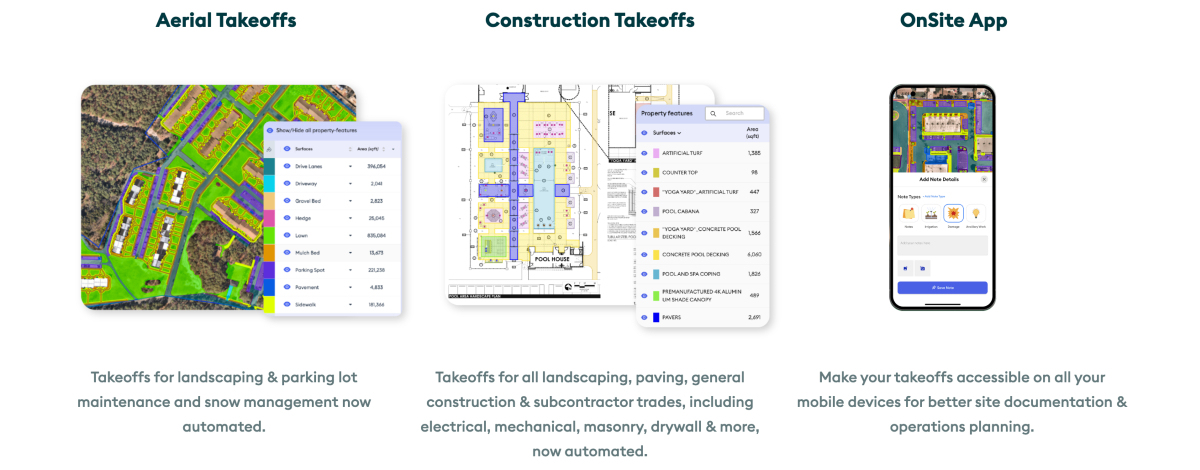
Attentive.ai's Automeasure tool

Image Credits: Attentive.ai

In addition to Automeasure, Attentive.ai has a flagship, cloud-based business management software for landscaping and construction companies. Called Accelerate, it automates sales processes and operational workflows, gives access to production planning with overtime alerts and live sales pipeline tracking, and prevents ghost clock-ins. The software is also integrated with aerial and blueprint takeoffs.

“Earlier, businesses used to go on to the site, measure the site — go in with a measuring wheel and measure the entire site. It used to take hours and days. Now, they can just enter the address of that site. Computer vision will process all the available aerial imagery of that site and give you the data… we are also doing generative AI-based automatic scheduling of different properties and jobs that companies need to do,” said Shiva Dhawan, co-founder and CEO of Attentive.ai, in an interview.

Dhawan co-founded the startup along with Rishabjit Singh (CTO) and Aishwarya Maurya (VP Product Strategy) to solve some of the most pressing concerns of construction and outdoor service businesses through its software that helps enhance their sales and operations.

Up until now, Attentive.ai focused on the landscaping industry. However, with the new funding coming in, the startup has expanded its focus to construction operations and started targeting general and sub-contractors and suppliers in an industry which it considers to be valued at more than $3 trillion, through a tool called Beam AI. It can deliver multiple construction estimates simultaneously after receiving blueprint plans from users by automating their tracing. At the back end, the startup has a quality assurance team that reviews the auto-generated estimates.

Even though Attentive.ai is one of the few startups bringing automation to landscaping and construction operations, the industry has had some competitive solutions for some time. These include Aspire and LMN in landscaping, Bluebeam and StackCT in construction and Go iLawn and PropertyIntel in property measurement. Nonetheless, Dhawan told TechCrunch the startup has an AI-based DNA and is a deep tech AI services company, and its team includes a background in fintech mapping and insurance.

“We come from an AI-based background where our strength is in the computer vision space, whereas these companies don’t have that tech DNA,” he said.

The startup, the co-founder believes, also has the advantage of offering round-the-clock customer support from India, which is “highly cost-effective and reliable.”

Attentive.ai looks to utilize the fundraising to expand its go-to-market team in the U.S. and widen its headcount of 160, of which five are based in the U.S. and the rest are in India, by hiring more people. Additionally, the startup plans to use some of its fresh capital on product development.

“Attentive’s innovative technology leverages Vision AI to drive disruptions in old-economy industries such as Outdoor Field Services and Construction. Organisations in these sectors are hungry for technology solutions that can drive efficiencies in their businesses. Shiva and his team have demonstrated tremendous commitment to addressing their customers’ needs and the delight was evident when we spoke to their customers,” said Nikhil Marwaha, senior executive director, at Vertex, in a prepared statement.

The startup, with a $4 million annual recurring revenue rate, has over 500 companies as its customers across the U.S. and Canada, of which about 300 are landscaping, 100 are paving maintenance and 100 are construction companies. It seeks to add more customers by bolstering its product and marketing.




Source link

by Team SNFYI

Facebook is testing a new feature that invites some users—mainly in the US and Canada—to let Meta AI access parts of their phone’s camera roll. This opt-in “cloud processing” option uploads recent photos and videos to Meta’s servers so the AI can offer personalized suggestions, such as creating collages, highlight reels, or themed memories like birthdays and graduations. It can also generate AI-based edits or restyles of those images. Meta says this is optional and assures users that the uploaded media won’t be used for advertising. However, to enable this, people must agree to let Meta analyze faces, objects, and metadata like time and location. Currently, the company claims these photos won’t be used to train its AI models—but they haven’t completely ruled that out for the future. Typically, only the last 30 days of photos get uploaded, though special or older images might stay on Meta’s servers longer for specific features. Users have the option to disable the feature anytime, which prompts Meta to delete the stored media after 30 days. Privacy experts are concerned that this expands Meta’s reach into private, unpublished images and could eventually feed future AI training. Unlike Google Photos, which explicitly states that user photos won’t train its AI, Meta hasn’t made that commitment yet. For now, this is still a test run for a limited group of people, but it highlights the tension between AI-powered personalization and the need to protect personal data.

by Team SNFYI

News Update Bymridul     |    March 14, 2024 Meesho, an online shopping platform based in Bengaluru, has announced its largest Employee Stock Ownership Plan (ESOP) buyback pool to date, totaling Rs 200 crore. This buyback initiative extends to both current and former employees, providing wealth creation opportunities for approximately 1,700 individuals. Ashish Kumar Singh, Meesho’s Chief Human Resources Officer, emphasized the company’s commitment to rewarding its teams, stating, “At Meesho, our employees are the driving force behind our success.” Singh further highlighted the company’s dedication to providing opportunities for wealth creation despite prevailing macroeconomic conditions. This marks the fourth wealth generation opportunity at Meesho, with the size of the buyback program increasing each year. In previous years, Meesho conducted buybacks worth over Rs 8.2 crore in February 2020, Rs 41.4 crore in November 2020, and Rs 45.5 crore in October 2021. Meesho’s profitability journey began in July 2023, making it the first horizontal Indian e-commerce company to achieve profitability. Despite turning profitable, Meesho continues to maintain positive cash flow and focuses on enhancing efficiencies across various cost items. The company’s revenue from operations for FY 2022-23 witnessed a remarkable growth of 77% over the previous year, amounting to Rs 5,735 crore. This growth can be attributed to Meesho’s leadership position as the most downloaded shopping app in India in both 2022 and 2023, increased transaction frequency among existing customers, and a diversified category mix. Additionally, Meesho’s focus on improving monetization through value-added seller services contributed to its revenue growth. Meesho also disclosed its audited performance for the first half of FY 2023-24, reporting consolidated revenues from operations of Rs 3,521 crore, marking a 37% year-over-year increase. The company achieved profitability in Q2 FY24, with a significant reduction in losses compared to the previous year. Furthermore, Meesho recorded impressive app download numbers, reaching 145 million downloads in India in 2023 and surpassing 500 million downloads in H1 FY 2023-24. Follow Startup Story Source link

by Team SNFYI

You might’ve heard of Grok, X’s answer to OpenAI’s ChatGPT. It’s a chatbot, and, in that sense, behaves as as you’d expect — answering questions about current events, pop culture and so on. But unlike other chatbots, Grok has “a bit of wit,” as X owner Elon Musk puts it, and “a rebellious streak.” Long story short, Grok is willing to speak to topics that are usually off limits to other chatbots, like polarizing political theories and conspiracies. And it’ll use less-than-polite language while doing so — for example, responding to the question “When is it appropriate to listen to Christmas music?” with “Whenever the hell you want.” But Grok’s ostensible biggest selling point is its ability to access real-time X data — an ability no other chatbots have, thanks to X’s decision to gatekeep that data. Ask it “What’s happening in AI today?” and Grok will piece together a response from very recent headlines, while ChatGPT, by contrast, will provide only vague answers that reflect the limits of its training data (and filters on its web access). Earlier this week, Musk pledged that he would open source Grok, without revealing precisely what that meant. So, you’re probably wondering: How does Grok work? What can it do? And how can I access it? You’ve come to the right place. We’ve put together this handy guide to help explain all things Grok. We’ll keep it up to date as Grok changes and evolves. How does Grok work? Grok is the invention of xAI, Elon Musk’s AI startup — a startup reportedly in the process of raising billions in venture capital. (Developing AI’s expensive.) Underpinning Grok is a generative AI model called Grok-1, developed over the course of months on a cluster of “tens of thousands” of GPUs (according to an xAI blog post). To train it, xAI sourced data both from the web (dated up to Q3 2023) and feedback from human assistants that xAI refers to as “AI tutors.” On popular benchmarks, Grok-1 is about as capable as Meta’s open source Llama 2 chatbot model and surpasses OpenAI’s GPT-3.5, xAI claims. Image Credits: xAI Human-guided feedback, or reinforcement learning from human feedback (RLHF), is the way most AI-powered chatbots are fine-tuned these days. RLHF involves training a generative model, then gathering additional information to train a “reward” model and fine-tuning the generative model with the reward model via reinforcement learning. RLHF is quite good at “teaching” models to follow instructions — but not perfect. Like other models, Grok is prone to hallucinating, sometimes offering misinformation and false timelines when asked about news. And these can be severe — like wrongly claiming that the Israel–Palestine conflict reached a ceasefire when it hadn’t. For questions that stretch beyond its knowledge base, Grok leverages “real-time access” to info on X (and from Tesla, according to Bloomberg). And, similar to ChatGPT, the model has internet browsing capabilities, enabling it to search the web for up-to-date information about topics. Musk has promised improvements with the …



