
10th Indian Delegation to Dubai, Gitex & Expand North Star – World’s Largest Startup Investor Connect
AgriTech

How Nosh’s AI-Powered Robot Chefs Are All Set To Transform Indian Kitchens


SUMMARY

Founded in March 2018 by Yatin Varachhia, Sudeep Gupta, and Amit Kumar Gupta, Nosh plans to serve the economically well-to-do migrant population of metropolitan cities to sell its cooking robots to make their life easier, bestowing them with the joy of home-cooked meals

Nosh offers an AI-enabled robot that can follow commands and prepare food automatically. The device comes with over 100 pre-loaded recipes in cuisines including Italian and Indian

Nosh could emerge as one of the pioneering players in the highly lucrative robot kitchen market, which is expected to reach $4.4 Bn in size by 2028

It may sound strange but in the ever-growing world of technology, robots have evolved to keep us well fed. With such technological advancements, it is possible to imagine being able to sit back and relax after a hectic day at work while a robot chef prepares your favourite meal as nutritious and tasty as home-cooked food.

Bengaluru-based startup Euphotic Labs, aka Nosh, is developing AI-enabled robots that can follow commands, cooking instructions, and prepare food, giving you a much-needed respite from your daily hustles. 

Founded in March 2018 by Yatin Varachhia, Sudeep Gupta, and Amit Kumar Gupta, Nosh is looking at serving the economically well-to-do migrant population of metropolitan cities to sell its cooking robots to make their life easier, bestowing them with the joy of home-cooked meals.

At a time when robots, equipped with different capabilities, are increasingly gaining popularity among restaurants, food chains, cloud kitchens, and homes, Nosh could emerge as one of the pioneering players in the highly lucrative robot kitchen market, which, as per a report, is expected to reach $4.4 Bn in size by 2028, growing at a CAGR of 12.6% between 2021 and 2028.

The Craving That Gave Birth To Nosh

The idea to build a machine that can cook food at home took shape a few years ago when both Varachhia and his wife were struggling to find time to cook at home due to their hectic work schedule and had no option but to hire help to prepare meals for them. 

The couple was surprised to find that several other families, too, were sailing on the same ship and struggling to find time to enjoy cooking and savour the true flavours of food cooked with love and care.  

Despite employing the help to cook meals for them, the only thing that was missing was the flavours to satiate their taste buds. This was another pressing issue as the Gujarati couple would often crave authentic Gujarati cuisine, but the flavours largely remained missing from their lives in Bengaluru. 

Unable to find a straight solution to satisfy their desire for authentic Gujarati cuisine, Yatin started building Nosh, a machine that can truly automate the entire cooking process, paving the way for Euphotic Labs.

Nosh allows users to load ingredients (veggies, oil, water, etc.) in the machine as per the requirement of a recipe. Once users command it to cook, the device starts cooking as per an individual’s taste and requirement.

It comes with a mobile app through which users can command Nosh’s cooking robot to customise any dish. The device comes with pre-loaded recipes and cooks over 100 of them in cuisines including Italian and Indian.

The device comes with a camera, which helps the AI-powered machine cook perfect meals and healthy treats. The Nosh machines are powered by the startup’s in-house AI and can cook anything that requires a pan or a pot.

Nosh’s Journey To Finding Product-Market Fit

In 2018, Nosh did its first proof of concept but there was a lot of scope for further improvements. Since then, the machine has undergone several tweaks and user trials — both in terms of hardware and AI. Currently, the startup is working on its seventh prototype.

Initially, Nosh built its product for the broader consumer market. However, in 2019, the startup joined hands with cloud kitchens listed on Swiggy and EatFit to automate their operations. 

Varachhia explained that with profitability becoming the major focus for these cloud kitchen startups, they adopted the cold chain method rather than cooking fresh food, which ended the use case for Nosh in the cloud kitchen space.

In mid-2020, Nosh reverted to building for the consumer market. “We have received a good response from the consumer market and have been able to pre-book 1,000 orders from across India while there are more than 4,500 people on the waiting list. We have been able to secure these orders with zilch marketing spends,” Varachhia said. 
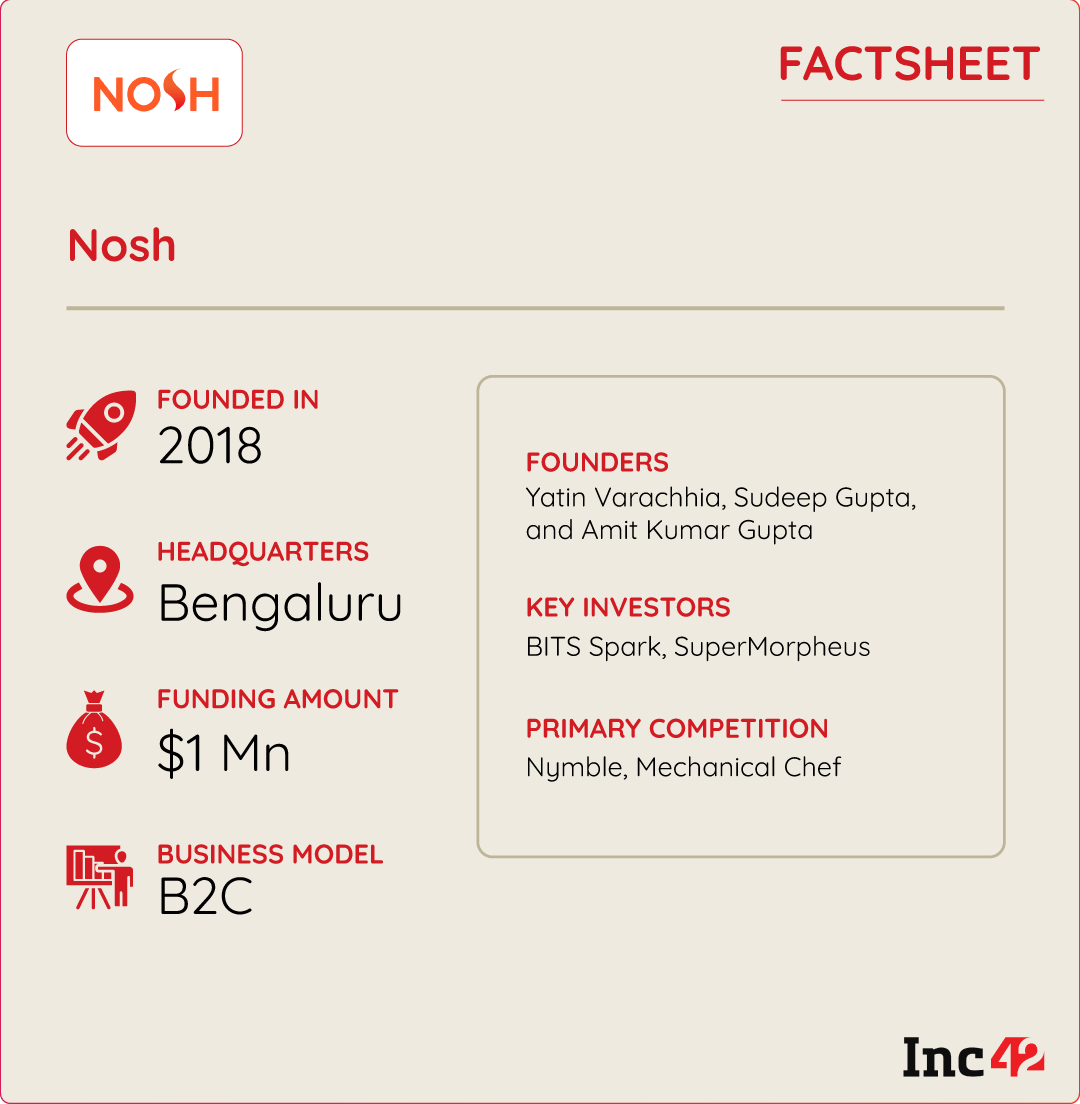
Nosh factsheetNosh factsheet

Nosh has charged INR 40,000 per customer for its pre-orders, however, the machines (the cooking robot) are expected to cost INR 50,000 apiece once they are floated in the market. The startup is planning to first start with the delivery of its pre-orders from October this year.

While Nosh has taken the onus on itself to deliver the first lot of pre-orders to its customers, it eventually has plans to sell its cooking robots via various ecommerce platforms like Flipkart and Amazon.

With just $1 Mn in seed funding raised so far, the founders claim to have kept their R&D costs low. Nosh’s cap table includes names like BITS Spark, SuperMorpheus, and a few other angel investors.

Besides, the startup’s working capital is largely driven by pre-orders. Further, the startup’s machines are made at different contract manufacturing facilities. 

What’s Next?

In 2024, Nosh aims to make and deploy 5,000 cooking robots but the projections are heavily dependent on the supply chain. The startup is not looking to raise any funding this year due to weak market sentiments. 

Meanwhile, Nosh is working on training its AI robots in more Indian recipes and adding a multi-cuisine menu to the already-impressive list of food items that it can make.

In the kitchen robotics market, Nosh competes with Bengaluru-based Nymble and its cooking robot Julia, and another startup Mechanical Chef. 

Besides, in the US and European markets, several players, including Samsung, HeroX, NVIDIA, Sony, Miso Robotics, and Moley have launched kitchen robots.

As per a report, North America and Canada are leading the markets for AI-powered kitchens and robotic chefs. Among South Asian countries, India, China, Japan, Malaysia and Singapore are leading the demand for automated chefs and cooking robots.

While there is a huge scope in the global market, it will be interesting to see if Nosh can play its cards right and capture a juicy chunk of this lucrative sector in the years to come.






Source link

by Vivek Kumar

Atlassian, a leading provider of team collaboration and productivity software, has launched its latest research report, the AI Collaboration Index 2025. The report highlights that 77% of Indian knowledge workers now use generative AI daily, a significant rise from 46% in 2024. This outpaces counterparts in regions including the US (59%), Germany (54%), France (47%), and Australia (45%). The report, commissioned by Atlassian’s Teamwork Lab, surveyed more than 12,000 knowledge workers worldwide, including over 2,000 respondents in India. It explores how individuals and teams are adapting to the surge in AI adoption, highlighting both major productivity gains and persistent challenges in collaboration. Even during the early stages of AI adoption, India’s workforce is seeing significant individual productivity benefits. The report found Indian professionals are saving an average of 1.3 hours a day using AI – compared to a global average of just under one hour. How Indian business leaders model AI use has also had an immense impact on their teams. The Index found workers whose managers model AI use are four times more likely to integrate it throughout their daily workflows and three times more likely to become ‘strategic AI collaborators’, meaning they use AI as a team of expert advisors who can enhance decision making. Molly Sands, Head of the Teamwork Lab at Atlassian, said, “India has become one of the fastest-growing regions for everyday AI use in the workplace. But our research shows that ramping up individual productivity with AI isn’t necessarily translating into real business impact. The next wave of value comes from using AI to connect knowledge, coordinate work, and align teams – bridging silos and driving action on shared goals – we must see knowledge workers shift to become strategic AI collaborators. Organisations that move beyond isolated efficiency gains, of simple AI users, and focus on AI-powered collaboration will unlock the full potential of their people and resources.” Additional Key Findings from India: While much research focuses on AI adoption, the Atlassian AI Collaboration Index 2025 goes further, exploring how people perceive AI’s role in the workplace and its broader impact on how we work. The report emphasizes the need for a mindset shift to unlock AI’s full potential, moving from AI as a tool for individual efficiency to AI as a collaborative teammate capable of transforming teamwork. This shift is crucial for Indian organizations to fully capitalize on AI’s opportunities. The AI Collaboration Index 2025 also warns that overemphasis on personal productivity could cost the Fortune 500 an estimated $98 billion annually in lost returns on AI investments. Instead, Atlassian advocates for a shift towards AI-powered teamwork practices, including:

by INC42

Whatever we gather for cooking isn’t consumed entirely. In fact, a large part of the food meant for human consumption remains unused every day. That’s where food can be converted to feed. It’s green, it’s clean, and it guarantees zero landfill, claims Wastelink.  “The science behind our business lies in the food that was destined for humans but could not reach humans for supply chain issues. It can be best utilised to feed animals,” said Saket Dave, whose Wastelink is trying to address two issues with one solution.  After… Source link

by Vivek Kumar

Two Brothers Organic Farms (TBOF), the farmer-owned regenerative food company, recently launched a compelling new brand film this August in celebration of India’s Independence Day. Premiered on the company’s official YouTube channel, the film delivers a bold and timely message: true freedom lies in the power to choose food that is pure, honest, and deeply rooted in intention, food that nourishes both people and the planet. The film traces the journey of TBOF from a single farm in Maharashtra started by two brothers, to a nationwide movement empowering 20,000+ farmers and reaching 700,000+ customers in over 65 countries. “We industrialised, globalised, standardised. But we broke our food system, our soil, our health” says Ajinkya Hange, Co-founder & Farmer of Two Brothers Organic Farms. The narrative is based on the real-life journey of co-founders Mr. Satyajit and Mr. Ajinkya Hange, who left their corporate careers to return to their ancestral village in Maharashtra and rebuild a system that puts farmers and the soil first. Two Brothers Organic Farms seeks to inspire a new generation not just to eat better, but to think differently about food, sustainability, and agriculture. Launched during India’s Independence Day week, the brand film is a compelling call to action: to seek freedom from artificial ingredients, and factory-processed foods. Through this campaign, the brand aims to spark a deeper conversation around food and freedom, urging consumers to question what’s on their plate, make conscious choices, and take pride in India’s rich agricultural heritage. It’s a reminder that true independence lies in everyday decisions that shape our health, our farmers’ livelihoods, and the future of the planet. The film also captures TBOF’s scale and integrity, showing its mega kitchens in Bhodani, its real-time traceability technology, and its upcoming warehouse expansions. Every aspect of the brand’s supply chain is backed by third-party testing and global certification standards, while farmer training programs continue to expand across India. The film reinforces that TBOF’s greatest strength lies in its people -farmers, cooks, villagers, and the communities who are redefining what it means to grow and consume food. “We are not just a brand; we are a movement to Fix the broken food system” says Satyajit Hange, Co-founder & Farmer of Two Brothers Organic Farms, the brand is redefining what it means to build a brand rooted in purpose, powered by people. “Through this campaign, we want to highlight that food sovereignty is a form of freedom too, the freedom to grow, eat, and live with dignity. We are redefining what it means to build a brand rooted in purpose and powered by people” The film reflects TBOF’s mission to build a future where food is nourishing for the soil, the farmer, and the consumer and redefines progress by returning to roots.

