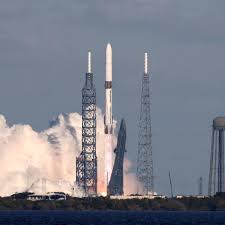
New Glenn Marks Major Milestone for Blue Origin
Blue Origin has taken a decisive leap forward in the commercial space race with the successful launch of its Blue Origin New Glenn rocket launch, a mission that signals the company’s strongest advance yet toward competing directly with SpaceX. The launch, reported yesterday in a New York Times update, marks the first fully operational flight of the highly anticipated New Glenn heavy-lift rocket.
Crowds following the rocket launch today watched as New Glenn lifted off from Cape Canaveral, showcasing the reusable first stage and advanced propulsion system that Blue Origin has spent years refining. The successful ascent and booster recovery reinforced the company’s long-term plan: building a reliable, reusable launch system capable of transporting satellites, cargo, and eventually crew missions to orbit and beyond.
Blue Origin Launch Today Strengthens Bezos’ Position in Space Race
Blue Origin, founded and owned by Jeff Bezos, continues to push deeper into the competitive landscape dominated by SpaceX. The Blue Origin launch today provided a clear demonstration of growing maturity in the company’s technology, answering critics who questioned whether New Glenn would ever clear the pad after years of delays.
Observers noted that the mission comes at a moment when NASA launch today schedules are packed, signaling an active period for US aerospace operations. With this milestone, Bezos’s company can now compete for high-value satellite deployments, government contracts, and future NASA missions.
New Glenn Launch Connects Boeing, NASA, and Commercial Clients
The New Glenn launch deployed a series of commercial satellites into orbit, representing Blue Origin’s commitment to working across public and private sectors. Analysts point out that New Glenn’s heavy-lift capabilities provide an alternative to SpaceX’s Falcon Heavy, offering more options for companies and agencies that require diverse launch schedules.
This mission also demonstrated improved coordination with NASA facilities, and future Blue Origin New Glenn launch plans include cargo missions aimed at supporting lunar operations and deep-space research. While not yet a human-rated rocket, New Glenn is designed with future crewed missions in mind, potentially including operations that align with long-term Mars exploration strategies.
New Glenn Launch 2: What Comes Next?
Blue Origin has already scheduled New Glenn launch 2, expected to take place early next year. Engineers confirm that the next mission will focus on testing advanced recovery systems and expanded payload capabilities. If successful, Blue Origin could quickly scale to multiple launches per year, joining the ranks of the world’s most active rocket providers.
The successful rocket launch puts pressure on competitors and signals a new chapter for the aerospace company. For Bezos, this marks a key moment in proving that the organization can execute at the level necessary to shape the future of commercial and government spaceflight.
Blue Origin vs SpaceX: A Renewed Rivalry
With this mission, the rivalry between SpaceX and Blue Origin has renewed vigor. SpaceX has long held dominance in the orbital launch market, but Blue Origin’s advancements could diversify launch providers and reduce market bottlenecks.
Jeff Bezos highlighted that long-term ambitions include supporting missions to the Moon and even Mars. While SpaceX continues to push forward with its Starship development, Blue Origin now has its own major hardware in operation, giving customers alternatives they’ve long awaited.
Space watchers following the Blue Origin launch live reacted positively online, noting the rocket’s stability, ascent profile, and smooth booster landing. As New Glenn evolves, it could play a major role in future infrastructure supporting Mars-bound missions and larger orbital transport systems.
Who Owns Blue Origin and Why It Matters in 2025
Readers frequently ask: Who owns Blue Origin? The answer is Jeff Bezos, who remains deeply involved in its strategic direction. His long-term vision centers not just on Earth-orbit operations but on constructing a sustainable economy in space. With this recent success, that vision appears more realistic than ever.
The latest Blue Origin launch underscores how significantly the company has progressed and how central it may become in shaping the next era of aerospace innovation.
Stay Ahead With the Latest Startup and Space Tech Updates
For more breaking stories like this, visit StartupNews.fyi: http://34.207.196.86/