
10th Indian Delegation to Dubai, Gitex & Expand North Star – World’s Largest Startup Investor Connect
Travel

Accel, Elevation To See 34X Returns; Prosus To Pocket $500 Mn


SUMMARY

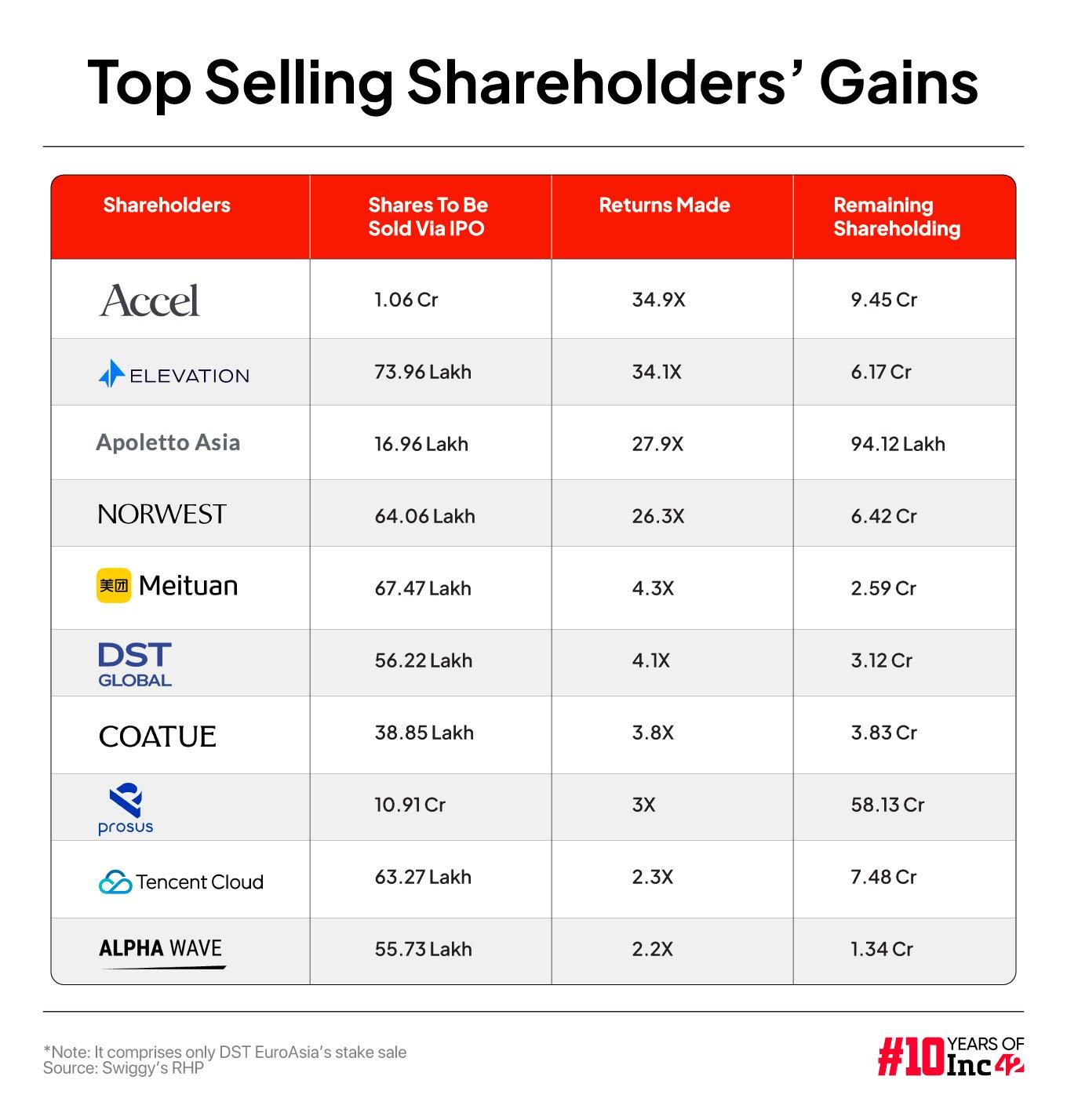
Accel is selling about 1.06 Cr shares worth more than INR 412 Cr, which would translate to a 34.9X return on its investment, while Elevation is selling 73.96 Lakh shares in the IPO

Prosus is the largest shareholder in Swiggy and will net INR 4,254.7 Cr or $500 Mn, a 3X return on its investment for selling a fifth of its stake

Brokerages have advised investors to only bid in the Swiggy IPO if they intend to hold the stock for the long term, while there have also been some ‘avoid’ recommendations

With Swiggy on the cusp of its IPO and aiming to raise more than INR 11,300 Cr, many of its early investors are set to rake in big gains 

Early investors Accel India and Elevation Capital are set to make more than 34X returns by selling a portion of the stake in the company.

Both Accel India and Elevation Capital (formerly SAIF Partners) first invested in the food delivery and quick commerce giant in 2015 during its Series A funding round. Over the years, the VC firms increased their stake in follow-up rounds.

Ahead of its IPO, Accel holds 10.51 Cr shares in Swiggy at a weighted average price of INR 11.17 per equity share. As part of the company’s offer for sale (OFS) component during its IPO, Accel is selling about 1.06 Cr shares worth more than INR 412 Cr at the higher end of the price band.

This would translate to a 34.9X return on Accel’s investment towards these shares in Swiggy.

On the other hand, Elevation Capital held 6.9 Cr shares in Swiggy at a weighted average price of INR 11.44 per equity share. As part of the OFS during the IPO, the VC firm is offloading 73.96 Lakh shares worth over INR 288 Cr, which would translate to a 34.1X return on its investment.

Among the key investors that came in later in Swiggy’s journey, Prosus is set to see the biggest outcome. The global investment giant is the largest shareholder in Swiggy and will net INR 4,254.7 Cr or $500 Mn, a 3X return on its investment for selling a small portion of its stake. 

Who Else Is Earning The Returns From Swiggy IPO

Zomato’s top rival Swiggy has set a price band of INR 371-INR 390 per equity share for its IPO, which comprises an OFS component of 17.5 Cr shares and a fresh issue of shares worth INR 4,499 Cr.  On the upper end of the price band, the company is looking to raise INR 11,327 Cr for its public offering.

Norwest Venture Partners, which also invested in Swiggy in 2015, as part of its Series B funding round, is set to rake in 26.3X return on its investment by selling 64.06 Lakh shares of 7.06 Cr shares in the company.
Swiggy shareholders' returnsSwiggy shareholders' returns

Similarly, Apoletto Asia is also expected to make 27.9X returns by selling around 17 Lakh shares as part of the OFS, worth more than INR 66 Cr.

On the other hand, the investors that joined the game comparatively later, including Tencent, DST Global, and Swiggy’s biggest stakeholder Prosus, are also expected to more than double their returns. 

Prosus first invested in Swiggy via Myriad International Holdings (MIH) India Food Holdings in 2018, leading the company’s $1 Bn funding round where Tencent and others also participated. Today, Prosus holds a 31% stake or more than 69 Cr shares in Swiggy, but it’s only selling a fifth of this stake in the IPO. 

Tencent Cloud Europe B.V. held 8.12 Cr shares in Swiggy at an weighted average price of INR 165.47 per equity share. As part of the OFS, the Chinese internet company will sell 63.27 Lakh shares worth INR 246.7 Cr, translation to a 2.3X return on its investment on these shares.

DST Global’s DST EuroAsia is making 4.1X gains by selling 56.22 Lakh shares in Swiggy as part of the OFS. Coatue PE Asia is also set to make 3.8X returns by offloading 38.85 Lakh shares.

Meanwhile, Chinese food delivery company Meituan, which held 3.26 Cr Swiggy shares via Inspired Elite Investments, is expected to see a 4.3X return on its investment towards these shares by selling 67.47 Lakh shares.

On the other hand, Alpha Wave, which entered as Swiggy’s investor in 2021, is making 2.2X return by offloading almost half its shares in the company.

Among its other selling stakeholders are cofounders Sriharsha Majety, Lakshmi Nandan Reddy, and Rahul Jamini, Goldman Sachs, Times Internet Limited, and Harmony Partners.

Swiggy IPO: A Quick Recap

In its RHP filed last month, Swiggy increased the size of the fresh issue to INR 4,499 Cr while slightly trimming the OFS size for the IPO. The company is seeking valuation of $11.3 Bn, 26% lower than the $15 Bn it was targeting in its initial filings.

Opening tomorrow (Wednesday, November 6), bidding for Swiggy’s IPO will continue till Friday, November 8. The anchor bidding will take place later today.

Speaking to Inc42, Mehta Equities’ Prashanth Tapse earlier said that only long-term investors should invest in the IPO. Recently, brokerage firms, including Bajaj Broking and SBI Securities have advised investors to subscribe to the offer only with a long term investment perspective. 

Meanwhile, Aditya Birla Money has given an ‘avoid’ recommendation. 

“While Swiggy’s decision to lower its valuation leaves some upside room for the investors, we still recommend an AVOID recommendation to this issue due to the “reported negative” cash flows and ongoing losses, alongside a slightly high valuation of 7.7X FY24 price-to-sales,” said the investment firm’s research note on Swiggy’s IPO.

It is pertinent to note that Swiggy is going public with significant losses on its books. Arch rival Zomato is already a profitable company and way ahead of Swiggy in most of the metrics across food delivery, quick commerce, and going-out verticals.

Swiggy’s consolidated net loss widened by over 8% year-on-year (YoY) to INR 611 Cr in the June quarter (Q1) of FY25 while operating revenue increased 35% YoY to INR 3,222.2 Cr. In FY24, Swiggy posted a net loss of INR 2,350 Cr on an operating revenue of INR 11,247.3 Cr.






Source link

by Honey

Jetstar’s Big Move: Avalon Takes Off Internationally In a major win for Victorian travelers, Jetstar Airways has unveiled an ambitious expansion plan at Avalon Airport, set to reshape regional aviation from 2026 onward. The low-cost carrier announced it will launch its first-ever international flights from Avalon, connecting the airport directly to Bali (Denpasar) — one of Australia’s most popular leisure destinations. Alongside this exciting addition, Jetstar will also reinstate its Avalon–Adelaide route, which was suspended during the COVID-19 pandemic, and increase the frequency of Avalon–Brisbane services to meet surging passenger demand. The announcement represents a pivotal milestone for both Jetstar and Avalon Airport, which has long sought to expand its global footprint. The introduction of international routes marks the next phase of Avalon’s growth strategy — positioning it as a strong secondary airport option to Melbourne’s Tullamarine. Avalon Airport: From Domestic Hub to International Gateway Avalon Airport’s journey toward becoming an international gateway has been a long time coming. The introduction of Jetstar’s Bali flights cements its status as a crucial player in regional connectivity and tourism development. For Geelong and western Melbourne residents, the new service provides convenient and affordable access to one of Asia’s most beloved holiday destinations. According to Avalon Airport management, the Avalon–Bali route will not only attract thousands of leisure travelers but also strengthen tourism and economic ties between Victoria and Indonesia. Local businesses, particularly in the hospitality and tourism sectors, are expected to benefit from increased visitor flow. “The demand for outbound leisure travel remains exceptionally strong, and Bali continues to be a top destination for Australians,” said a Jetstar spokesperson. “Avalon is ideally located to serve both regional Victoria and Melbourne’s west, and these new services will make international travel more accessible and affordable for everyone.” Reconnecting Australia: Adelaide and Brisbane Routes Boost Domestic Travel Beyond international expansion, Jetstar’s decision to restart the Avalon–Adelaide route has been welcomed by frequent flyers and regional businesses alike. The route, which ceased operations during the pandemic, had long been a staple connection between Victoria and South Australia. Its return highlights Jetstar’s commitment to rebuilding domestic travel networks that were disrupted by COVID-19. Additionally, the airline plans to add more Avalon–Brisbane flights, responding to a sharp rise in domestic travel demand. This move will enhance connectivity between key eastern cities, providing travelers with more flexible and cost-effective options. Analysts believe Jetstar’s growing presence at Avalon could lead to more destinations being added in the coming years, transforming the airport into a vital hub for both domestic and short-haul international routes. Infrastructure Upgrades: Avalon Gets a Public Transport Link To complement Jetstar’s expansion, Avalon Airport is also set to receive a long-awaited public transport connection, improving accessibility for passengers traveling from Geelong and Melbourne. The new bus service will make it easier for travelers to reach the airport, which has previously faced criticism for limited transport options. The introduction of this link is seen as a crucial step toward making Avalon more competitive with larger airports. “Connectivity has …

by Honey

Jetstar’s Big Move: Avalon Takes Off Internationally In a major win for Victorian travelers, Jetstar Airways has unveiled an ambitious expansion plan at Avalon Airport, set to reshape regional aviation from 2026 onward. The low-cost carrier announced it will launch its first-ever international flights from Avalon, connecting the airport directly to Bali (Denpasar) — one of Australia’s most popular leisure destinations. Alongside this exciting addition, Jetstar will also reinstate its Avalon–Adelaide route, which was suspended during the COVID-19 pandemic, and increase the frequency of Avalon–Brisbane services to meet surging passenger demand. The announcement represents a pivotal milestone for both Jetstar and Avalon Airport, which has long sought to expand its global footprint. The introduction of international routes marks the next phase of Avalon’s growth strategy — positioning it as a strong secondary airport option to Melbourne’s Tullamarine. Avalon Airport: From Domestic Hub to International Gateway Avalon Airport’s journey toward becoming an international gateway has been a long time coming. The introduction of Jetstar’s Bali flights cements its status as a crucial player in regional connectivity and tourism development. For Geelong and western Melbourne residents, the new service provides convenient and affordable access to one of Asia’s most beloved holiday destinations. According to Avalon Airport management, the Avalon–Bali route will not only attract thousands of leisure travelers but also strengthen tourism and economic ties between Victoria and Indonesia. Local businesses, particularly in the hospitality and tourism sectors, are expected to benefit from increased visitor flow. “The demand for outbound leisure travel remains exceptionally strong, and Bali continues to be a top destination for Australians,” said a Jetstar spokesperson. “Avalon is ideally located to serve both regional Victoria and Melbourne’s west, and these new services will make international travel more accessible and affordable for everyone.” Reconnecting Australia: Adelaide and Brisbane Routes Boost Domestic Travel Beyond international expansion, Jetstar’s decision to restart the Avalon–Adelaide route has been welcomed by frequent flyers and regional businesses alike. The route, which ceased operations during the pandemic, had long been a staple connection between Victoria and South Australia. Its return highlights Jetstar’s commitment to rebuilding domestic travel networks that were disrupted by COVID-19. Additionally, the airline plans to add more Avalon–Brisbane flights, responding to a sharp rise in domestic travel demand. This move will enhance connectivity between key eastern cities, providing travelers with more flexible and cost-effective options. Analysts believe Jetstar’s growing presence at Avalon could lead to more destinations being added in the coming years, transforming the airport into a vital hub for both domestic and short-haul international routes. Infrastructure Upgrades: Avalon Gets a Public Transport Link To complement Jetstar’s expansion, Avalon Airport is also set to receive a long-awaited public transport connection, improving accessibility for passengers traveling from Geelong and Melbourne. The new bus service will make it easier for travelers to reach the airport, which has previously faced criticism for limited transport options. The introduction of this link is seen as a crucial step toward making Avalon more competitive with larger airports. “Connectivity has …

by INC42

When Thirukkurungudi Vengaram Sundram Iyengar, the Indian industrialist who founded the TVS Group, introduced intercity passenger bus service in Tamil Nadu in 1912, India barely had any organised bus services. At the time, most people relied on trains for long-distance travel and bullock carts for shorter routes, while motor cars were accessible only to a wealthy few. Today, 40% of India’s road-based travel demand comprises buses. While a large part of this percentage consists of unorganised, local players, tech-driven companies are… Source link

