
10th Indian Delegation to Dubai, Gitex & Expand North Star – World’s Largest Startup Investor Connect
EV

Can Indigrid Fix The Component Puzzle For Indian EV Makers?


SUMMARY

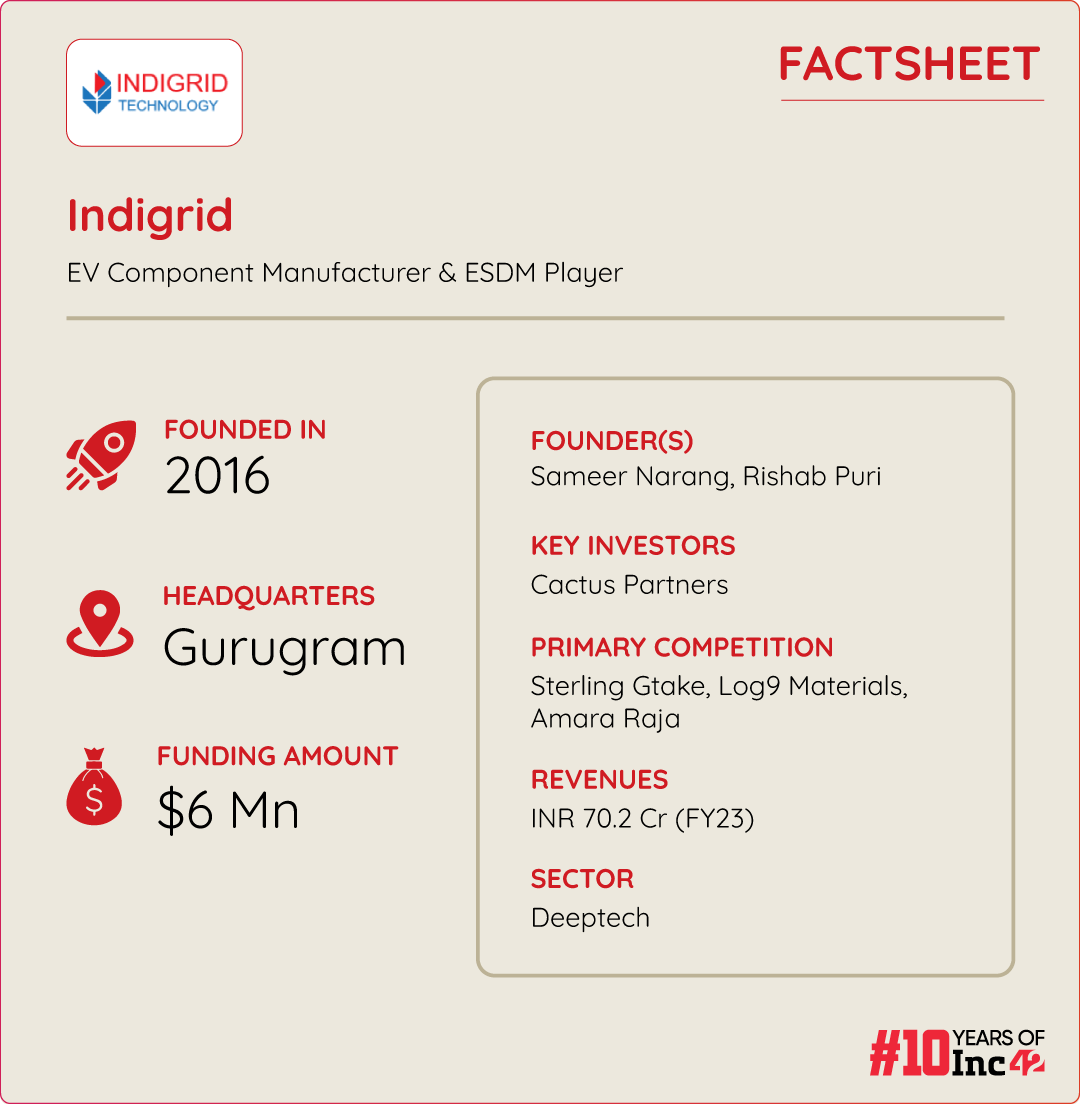
Founded in 2016 by Sameer Narang and Rishab Puri, Indigrid Technology is an ESDM startup, which entered the EV market to provide Indian OEMs with domestic power solutions to push electrification further

The startup clocked a revenue of INR 33.5 Cr in FY22, and its FY23 top line stood at INR 70.2 Cr. Its profit almost doubled to INR 80.7 Lakh in FY23 from INR 41.3 Lakh a fiscal ago

Indigrid faces significant competition from Amara Raja, Exide, and Log9 Materials in the battery space and companies like Sterling Gtake in the powertrain space

India’s electric vehicle (EV) boom has reshaped the country’s automotive industry in the last three to four years. Key stakeholders, from vehicle manufacturers to auto component makers and policymakers, have made electric mobility an integral part of their core strategies.

However, this shift was initially led by EV original equipment manufacturers (OEMs), while the focus on developing EV components domestically came later.

If we were to look back, the government’s policy incentives and subsidies have nudged both new-age tech startups and established automakers to invest heavily in EVs. 

Many new players entered the market as EV OEMs on the back of a growing market opportunity and the simplicity of manufacturing EVs, which require fewer components compared to traditional internal combustion engine (ICE) vehicles.

Amid this rapid growth, core technologies like batteries and motors were initially overlooked. This followed several mishaps, many of which were attributed to the use of low-quality components from China.

However, a series of safety incidents, including fires in 2022, brought this issue to light and shifted the government’s focus to these critical areas.

By 2023, the government tightened regulations around domestic value addition, and the industry continued to face challenges in building a fully self-reliant EV supply chain due to significant gaps in component manufacturing.

To bridge this gap, Delhi NCR-based electronics system design and manufacturing (ESDM) startup Indigrid Technology entered the EV market to provide Indian OEMs with domestic power solutions to push electrification further.

Indigrid designs and manufactures most of the power electronics for EVs in-house, including battery packs, motor controllers, and vehicle control units. It offers a full-stack solution to two-wheeler EV OEMs, helping them comply with localisation norms.

While a handful of EV OEMs, including Ola Electric, Ather Energy, Matter, River, and Ultraviolette, have vertical integration as their strategy, most are still completely dependent on third-party manufacturers for EV components – a market Indigrid has started capturing. 

The Genesis Of Indigrid 

Founded in 2016 by Sameer Narang and Rishab Puri, Indigrid began its operations in 2017, focussing solely on electronics manufacturing. Gradually, the startup expanded its capabilities to include both electronic design and manufacturing.

As an ESDM startup, Indigrid has primarily built its business in the automotive sector, boasting a strong client base that includes top-tier companies like HELLA and Motherson Sumi. The startup offers a range of products to its automotive customers, including lighting solutions, engine control systems, and emission control components.

In addition to its automotive operations, Indigrid has a non-automotive vertical, which functions as a contract manufacturer for components used in refrigeration, IoT devices, and various industrial tools.

After nearly six years of building deep expertise in the automotive industry, Indigrid entered the EV components manufacturing space in late 2022, aiming to capitalise on the growing demand for locally produced components.

Speaking with Inc42, Indigrid’s cofounder Narang, said that before venturing into the EV space, the startup had built its foundation around power electronics for ICE vehicles, which immensely helped the company to start designing and manufacturing power electronics for EVs.

Indigrid’s EV vertical kicked off by building battery packs for EV two-wheelers. Its first two products were IGT RED and IGT Blu – a 48-volt and a 60-volt battery, respectively. It tied up with a Japanese company, Murata Business Engineering, which helped Indigrid design its first battery packs.

“The first thing we wanted to understand was how batteries power EVs. We also realised that all the products that were coming in from China were inefficient. This was when we started by making two battery packs for EVs, which were initially given to the fleet operators,” said Narang.

Soon, Indigrid came up with its in-house motor controllers for EVs and built a powertrain for these vehicles.

Although Indigrid still imports motors and a few other core components, it designs and manufactures the entire powertrain, EV electronics like the VCU and 4G tracker, as well as battery packs in-house.
indigrid factsheetindigrid factsheet

The startup counts electric two-wheeler OEMs Revolt, Bounce, EV MOTO, and MECPower Mobility as its customers. Besides, Indigrid is working with a few two-wheeler players in retrofitting its EV solutions in their existing ICE vehicles to convert them into electric.

The company also provides batteries and powertrains for erickshaws and other electric three-wheelers. It also converts diesel vehicles used for airport ground support to electric.

Indigrid has raised more than $6 Mn since its inception. The startup recently raised $5 Mn led by Cactus Partners

Indigrid’s Financial Health

As a contract manufacturer in the ESDM space, Indigrid claims to have grown significantly over the last few years. Notably, the startup clocked a revenue of INR 33.5 Cr in FY22 and its FY23 top line stood at INR 70.2 Cr. Its profit almost doubled to INR 80.7 Lakh in FY23 from INR 41.3 Lakh the year before. It is yet to file its FY24 earnings report.

Narang told Inc42 the startup clocked INR 47 Cr in revenue in the first half of FY25. It aims to close the fiscal with INR 120-INR 140 Cr in the top line. The company projects to clock revenue between INR 250 and INR 300 in FY26.

According to Narang, the startup’s ESDM vertical has contributed 80% to its top line so far this year. The split is expected to be 70-30 in FY25, with 30% coming from the EV solutions vertical.

“In the EV business, we see a customer being added at least every week, there is always a new product requirement where we have to slightly customise the software solution and provide it to the customer. So, there is a lot of traction here, and if the built-up happens, it will happen quickly,” Narang said.

Indigrid’s Next Milestones 

While Indigrid is building a strong position in the EV sector, several challenges remain for EV OEMs, and, consequently, for power electronics providers like Indigrid.

According to the founder, one key hurdle is that EV OEMs need to opt for recertification of their vehicles every time they change the powertrain or the battery, which is not only cost-intensive but also a time-consuming process.

It is also pertinent to note that as a solution provider across multiple verticals, Indigrid faces significant competition from Amara Raja, Exide, and Log9 Materials in the battery space and companies like Sterling Gtake and Matter in the powertrain space.

Meanwhile, Indigrid expects to double its capacities in the EV components vertical in the next 12-18 months.

With ESDM continuing to be the largest contributor to its business, the startup aims to grow this capacity by 3X in the same timeframe.

Going forward, Indigrid has set an aggressive target of growing each of the sub-verticals of its two businesses into INR 100 Cr business within 18 months.

The founder said the company is witnessing significant traction on the ESDM front with growing demand for home appliances. Besides, Indigrid is increasingly focussing on the telecom sector. It could also raise funds after March 2025.

As of now, Indigrid Technology looks well-positioned to meet the demands of India’s booming EV sector and the traditional automotive sector. 

By focussing on in-house design and manufacturing of essential power electronics, Indigrid not only addresses the growing demand for locally sourced components but also mitigates risks of low-quality imports.

However, the company faces significant challenges on the regulatory front and cut-throat competition. Despite the hurdles, its current growth path is reflective of its potential to become a key player in India’s EV ecosystem.

[Edited By Shishir Parasher]



Source link

EV
by Team SNFYI

Are you considering investing in an electric vehicle? If so, you have made the right decision. Electric cars are gaining popularity due to their numerous benefits. However, before you buy an electric car, you must consider the factors discussed in the following sections. They will help you make an informed decision. 6 Points You Must Consider While Buying Electric Cars  Let’s take a look at the important points you must consider before buying electric cars in India:  Ideally, an electric car has a driving range of over 100 km, which is sufficient for daily driving. However, high-end electric vehicles offer a driving range of over 400 km.   Considering the maximum distance the vehicle can travel on a single charge will help you determine whether the car meets your requirements. To make your purchase stress-free, research the prices of the cars and know your budget. Consider applying for an electric vehicle loan to help you fulfil your dream of owning a car without denting your savings. Use a car loan EMI calculator to calculate your monthly instalment and formulate a financial plan, considering other liabilities.  The formula for calculating electric car loan EMI is as follows: EMI = [P x R x (1+R)^N]/[(1+R)^N-1] Here,  P = Principal sum of the car loan  R = Rate of interest charged by the lender  N = Tenure of the loan in months  As you can see, the calculation procedure is time-consuming and prone to errors. So, you can use an online car loan EMI calculator to get accurate results quickly.  The battery is the most important component of an electric car, and it’s quite expensive. Therefore, it is essential to check the battery life before purchasing an electric vehicle. Find out details about the battery range and other specifications.  Moreover, check how long the battery can last and how much it will take to replace it.  Remember that you won’t find an electric vehicle charging station as easily as you find a fuel station. This is because the electric vehicle charging infrastructure has yet to establish a strong footing in India. Fast chargers are quite expensive to install in the car, and your city might have very few charging stations for them. On the other hand, standard and slow-charging systems are more reasonably priced. So, before buying an electric car, check which charging system suits your vehicle and meets your budget. Electric vehicles are equipped with software, which must be updated regularly. While some manufacturers provide the software for free, others may charge a fee for it. Moreover, remember to ensure that your electric vehicle has the latest software upgrades/updates.  You must maintain your electric vehicle regularly, just as you would a conventional car. Otherwise, its performance will be affected. Electric cars have few moving parts, requiring less maintenance effort. Also, buying spare parts for an electric car will be more expensive than for conventional cars. So, consider the maintenance costs of an electric vehicle before investing in one.  Additional Important Things to Keep …

by Team SNFYI

Bharatsure, one of India’s leading Insurtech companies offering Infrastructure as a Service (IaaS) solutions has raised INR 6 Crores from Inflection Point Ventures (IPV) and other investors including Capital A and Atrium Angels. Bharatsure is pioneering transformation in India’s insurtech landscape, unlocking vast market potential while advancing health security and insurance penetration. As an Infra-as-a-Service (IaaS) Insurtech, Bharatsure empowers ecosystem partners with seamless group and embedded insurance distribution solutions. Bharatsure has doubled its revenues in FY25 breaking even at CM3 and is gradually progressing toward EBITDA profitability by the end of this year. With a clear growth trajectory, Bharatsure has set ambitious revenue milestones, targeting INR 100 Cr by FY28 and INR 1000 Cr by FY34, reflecting its bold vision and long-term scalability in the market. Anuj Parekh and Sanil Basutkar are the co-founders of Bharatsure. Anuj, a CA and IIM-Bangalore alumnus, brings deep expertise in finance and scaling ventures, while Sanil, a CA and an ISB alumnus, employs his fintech background to drive product innovation and distribution. Coinciding with the fundraise, Bharatsure announced a new partnership with Battery Smart, India’s largest battery-swapping network for electric two- and three-wheelers, to launch natural calamity insurance exclusively for its station partners. The initiative offers protection against events such as fires, floods, earthquakes, and storms alongside personal accident coverages to safeguard individual livelihoods.  Mitesh Shah, Co-founder, IPV says, “As India moves towards a greener and sustainable future with the widespread adoption of EVs, and the infrastructure that supports it, it is time that we adapt our insurance frameworks to suit the changing needs. Bharatsure’s futuristic mindset and farsight offers financial protection and peace of mind in the face of unexpected events. In a world that doesn’t always go according to plan, insurance doesn’t just offer protection, it also carries the burden of social responsibility.” Anuj Parekh, Co-Founder & CEO of Bharatsure, added: “These station partners play a frontline role in advancing sustainable mobility, and we’re proud to design coverage that genuinely addresses their needs. The funding allows us to further develop our infrastructure too ”  With over 1,500 stations and 70,000+ drivers across 50+ cities, Battery Smart’s station partners form the backbone of India’s growing EV infrastructure. This insurance plan ensures partners are equipped with financial protection to overcome unforeseen disruptions while continuing to power the country’s EV transition.  “Our station partners are at the heart of our operations,” said Ms. Sumi Jain, AVP – Network Strategy and Operations, Battery Smart. “This insurance partnership is not just about protecting assets, it’s about empowering the individuals who are driving India’s EV revolution. Together with Bharatsure, we are fortifying the backbone of our network.”  As EV adoption picks up pace in India particularly across two- and three-wheelers, battery swapping stations are emerging as a critical part of the ecosystem. To strengthen safety for its partners, this insurance initiative complements Battery Smart’s existing safety framework, which includes a 24×7 support helpline, in-app issue reporting, mandatory onboarding training and ongoing awareness campaigns.   About Battery Smart:  Battery Smart …

EV
by Team SNFYI

Shanghai, June 2025 – In a move set to shake up the electric vehicle (EV) landscape, Tesla has officially introduced a 6-seater version of its popular Model Y SUV for the Chinese market. This marks the first time the automaker has offered this specific seating configuration in China, indicating a strong focus on capturing the growing demand for more family-friendly electric vehicles in the world’s largest EV market. The new Tesla Model Y 6 seater is expected to launch in Q3 2025 and will be manufactured at Tesla’s Gigafactory in Shanghai, which already produces Model 3 and Model Y units for the Asia-Pacific region. Family-Focused Configuration The Tesla Model Y 6 seater introduces a more versatile interior layout, offering two captain’s chairs in the second row instead of the traditional bench seat. This setup not only enhances passenger comfort but also provides easier access to the third row, making it ideal for families with children or those who frequently transport multiple passengers. Tesla’s design update is in line with customer feedback from China, where extended family travel is common, and functionality often outweighs minimalism in vehicle interiors. According to local sources, the 6-seater Model Y will also include upgraded air filtration systems and enhanced rear climate controls, catering to the preferences of premium Chinese buyers. Market Strategy in China China represents Tesla’s second-largest market after the United States, and this launch signals the company’s strategic intent to remain competitive against domestic giants like BYD and Li Auto, both of which offer flexible seating layouts in their best-selling SUVs. The addition of the Tesla Model Y 6 seater is expected to boost the brand’s presence among middle- to upper-income families who previously might have considered more spacious alternatives. Tesla is also planning a strong marketing push around the family-first messaging, emphasizing safety, comfort, and advanced self-driving features. Competitive Pricing and Delivery Timeline While official pricing has not been confirmed, early reports suggest the 6-seater Tesla Model Y will be priced slightly above the Long Range variant but remain competitive in its segment. Industry analysts expect the starting price to be around ¥350,000 (approx. $48,000), positioning it below traditional luxury competitors like Mercedes-Benz EQB or NIO ES6. Pre-orders for the Tesla Model Y 6 seater are expected to begin by late July, with deliveries starting as early as September 2025. What’s Under the Hood? Mechanically, the 6-seater Model Y will remain consistent with current dual-motor AWD versions. It is expected to feature a similar battery configuration with a range of up to 530 km (approx. 330 miles) per charge under CLTC testing standards. Tesla’s infotainment and software upgrades will also be included, featuring the latest Full Self-Driving (FSD) beta, real-time traffic visualization, and a theater mode for rear passengers—a feature well-suited to longer family drives. Final Thoughts With this latest addition, Tesla is not just responding to consumer demand—it’s setting the tone for how EVs can adapt to regional market needs. The Tesla Model Y 6 seater represents a smart blend of …






